
What is the fundamental structural and functional difference between a Feedforward Neural Network (FNN) and a Recurrent Neural Network (RNN)?
Select an answer to reveal the explanation.
Short Explanation
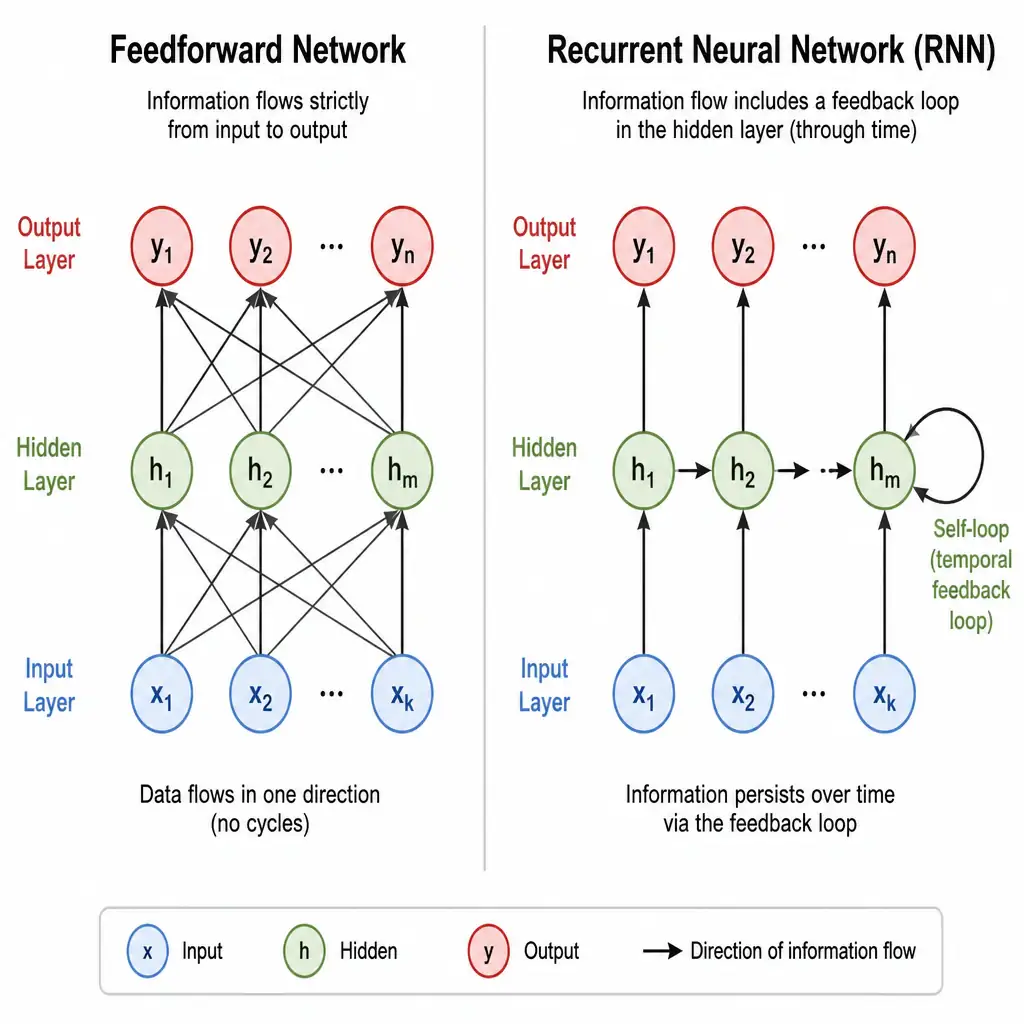
A feedforward network is a one-way street: it processes each input independently and forgets it. An RNN adds feedback loops, so information persists across steps and it can handle sequences.
Full Explanation
The fundamental difference between Feedforward Neural Networks (FNNs) and Recurrent Neural Networks (RNNs) lies in their architectural topology and how they handle data over time. In a Feedforward Neural Network, the flow of information is strictly unidirectional: from the input layer, through any hidden layers, to the output layer. There are no loops or cycles. Consequently, FNNs assume that all inputs are independent of one another. They have no temporal memory, making them suitable for static data points (like predicting a house price from features) but poorly suited for sequence modeling. In contrast, a Recurrent Neural Network introduces feedback loops (recurrent connections) within its hidden layers. At each step in a sequence, the network processes both the current input and its own hidden state (output) from the previous step. This cyclic structure allows the network to maintain an internal state, or memory, of previous inputs in the sequence. This makes RNNs highly effective for sequential and time-series data, such as natural language processing (NLP), speech recognition, and stock price forecasting. The claim that feedforward networks are limited to single-layer shallow architectures while RNNs must have deep hidden layers is incorrect because FNNs can be extremely deep, such as deep multi-layer perceptrons or ResNets. The claim that feedforward networks are designed exclusively for 2D images while RNNs are optimized for static tabular databases is incorrect because FNNs and CNNs are used for images, and RNNs are not typically used for static tabular data. The claim that feedforward networks contain cyclical connections that loop backward while RNNs flow strictly in a single forward direction is the exact opposite of reality; FNNs have no cycles, while RNNs do. For the exam, remember that FNNs are unidirectional and memoryless, while RNNs feature feedback loops for processing sequential data.