A software architect is design-reviewing several upcoming AI initiatives for an enterprise. Which of these projects would benefit most from implementing a Convolutional Neural Network (CNN)?
Select an answer to reveal the explanation.
Short Explanation and Infographic
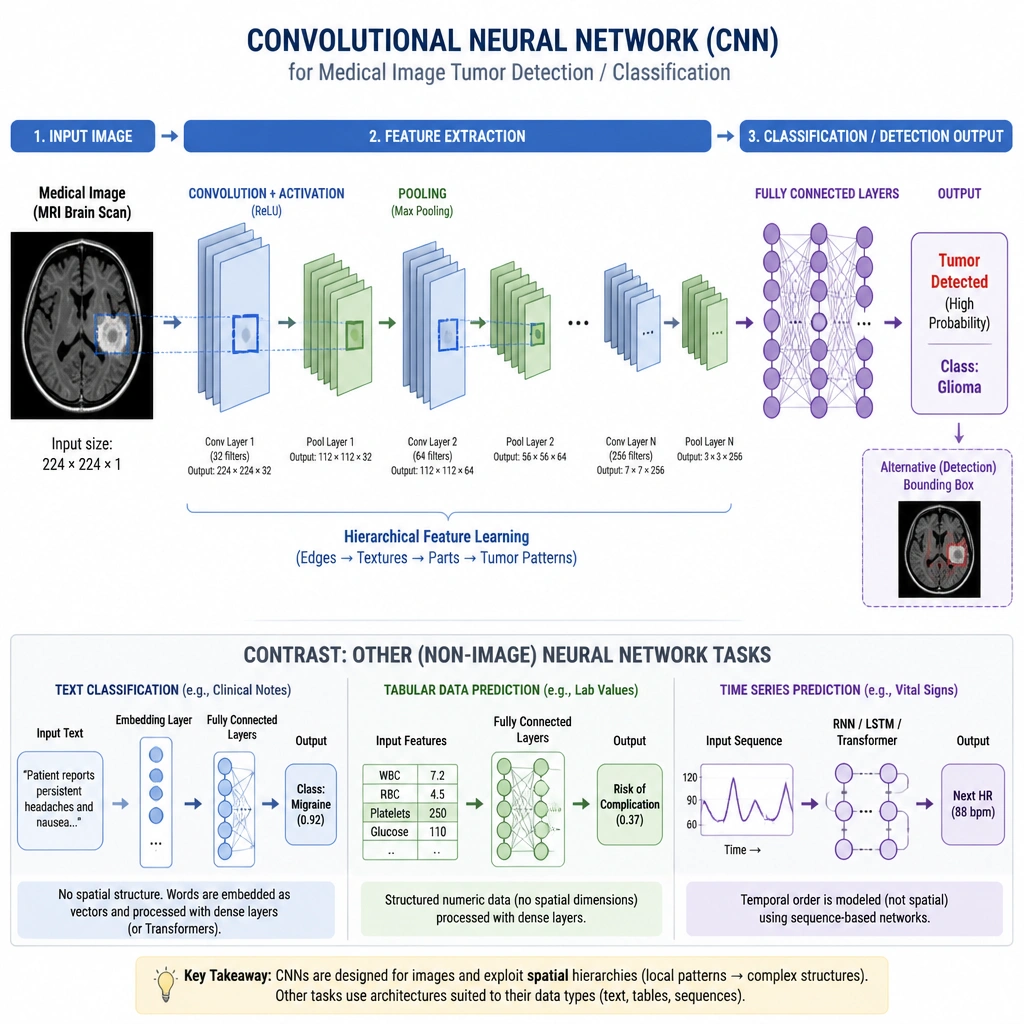
Check this out: when you're dealing with images, you've got to think about how pixels relate to each other in space. If you're analyzing a medical scan to find a tumor, you're looking for edges, shapes, and textures. A Convolutional Neural Network, or CNN, is absolutely the king of the hill for this job. Why? Because it uses filters to scan the image, block by block, picking up on those visual features. If you tried to use a regular neural network, you'd end up with a massive, unmanageable mess of connections that would fail to see the big picture. Now, things like customer segmentation? That's clustering work, usually done with unsupervised learning like K-Means. Translating languages or forecasting stocks? That's sequential data where you'd want something like an LSTM, RNN, or a modern Transformer. So, if your boss walks in and asks how to build a tumor detection system, tell them you need a CNN. Trust me on this, this will show up on your exam!
Full explanation below image
Full Explanation
Convolutional Neural Networks (CNNs) are specialized deep learning architectures designed for processing grid-structured data, most notably images. In this scenario, detecting tumors in medical imaging requires the model to identify spatial patterns, edges, textures, and complex shapes. CNNs achieve this through convolutional layers that apply localized filters (kernels) across the input space, preserving spatial hierarchy and reducing the parameter footprint compared to fully connected networks. - Distractor A is incorrect because customer segmentation typically relies on unsupervised clustering algorithms, such as K-Means or hierarchical clustering, to group tabular data based on feature similarity. - Distractor B is incorrect because stock market forecasting involves sequence-dependent time-series data, which is better suited for Recurrent Neural Networks (RNNs), Long Short-Term Memory (LSTM) networks, or transformer-based models. - Distractor C is incorrect because natural language translation operates on sequences of text. While CNNs can sometimes be applied to text, sequence-to-sequence architectures, particularly Transformers, are the standard and most effective choice for translation tasks.