An AI development team is selecting a neural network architecture for a new project. Which of the following use cases would benefit most from implementing a Long Short-Term Memory (LSTM) network?
Select an answer to reveal the explanation.
Short Explanation and Infographic
Let's look at this real-world scenario. If you're building a system to translate Spanish into English, the order of the words matters immensely. You can't just look at one word in isolation; you need the context of the whole sentence. That's where LSTMs shine! They are built for sequential data because they have internal memory to track what came before. If you're doing image classification or object detection, you'll want a Convolutional Neural Network (CNN) instead. For product recommendations, collaborative filtering or graph neural networks are the way to go. Remember: if the data is a sequence where order matters, think LSTM.
Full explanation below image
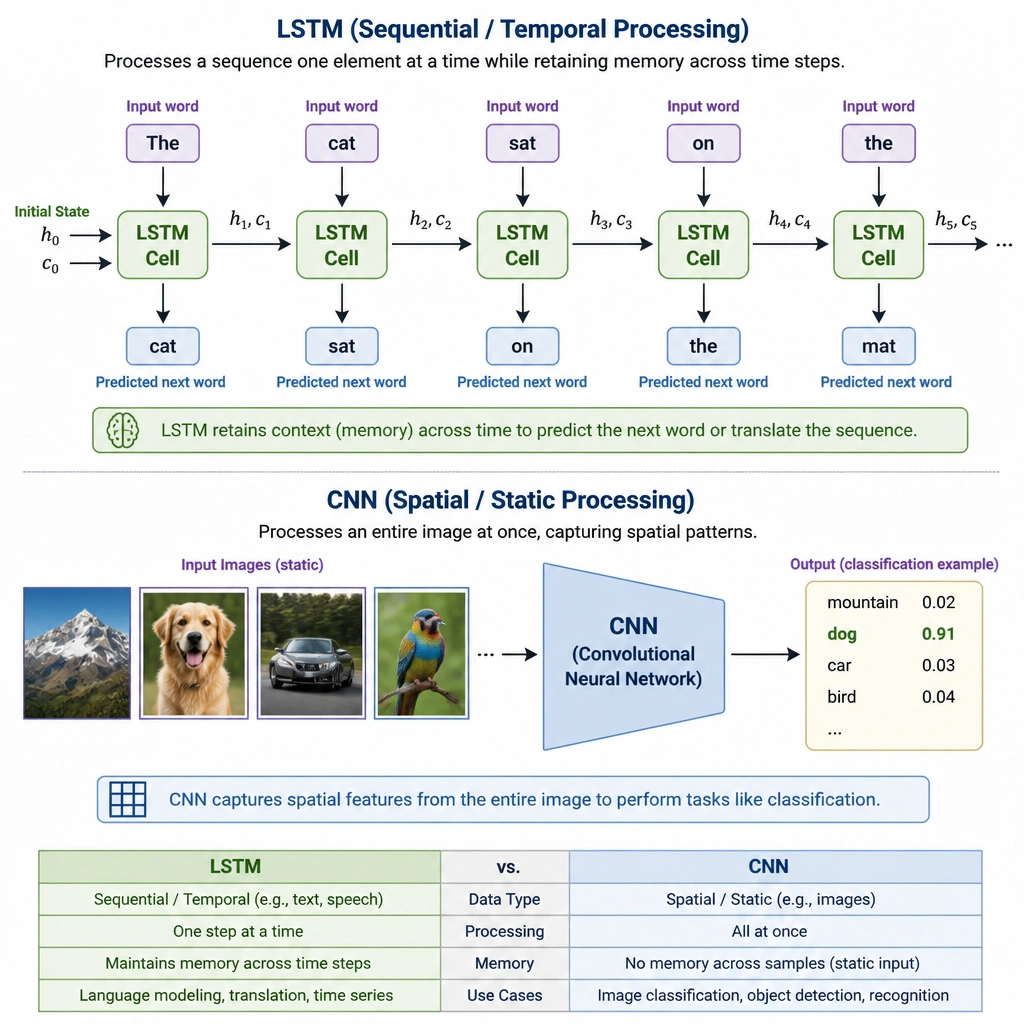
Full Explanation
Long Short-Term Memory (LSTM) networks are a specialized type of Recurrent Neural Network (RNN) designed specifically to handle sequential data where temporal order and long-term context are critical. Natural language processing (NLP) tasks, such as machine translation, text generation, sentiment analysis, and speech-to-text, are prime examples of sequential problems. In these tasks, the meaning of a word depends heavily on the words that preceded it, requiring the model to maintain a memory of past inputs over many time steps. The distractors represent applications best suited for other architectures: Image classification and object detection rely on spatial patterns in grid-like data, making Convolutional Neural Networks (CNNs) the standard choice. E-commerce recommendation systems typically use collaborative filtering, matrix factorization, or deep autoencoders rather than recurrent sequence models. Therefore, language translation and text generation, which rely on processing sequential structures, are the most appropriate use cases for an LSTM.