An e-commerce platform wants to increase user engagement and sales by showing personalized product suggestions on each user's homepage. The system analyzes the user's past purchase history, items they have viewed, and the behaviors of similar users to generate these suggestions. What type of machine learning system is being described?
Select an answer to reveal the explanation.
Short Explanation and Infographic
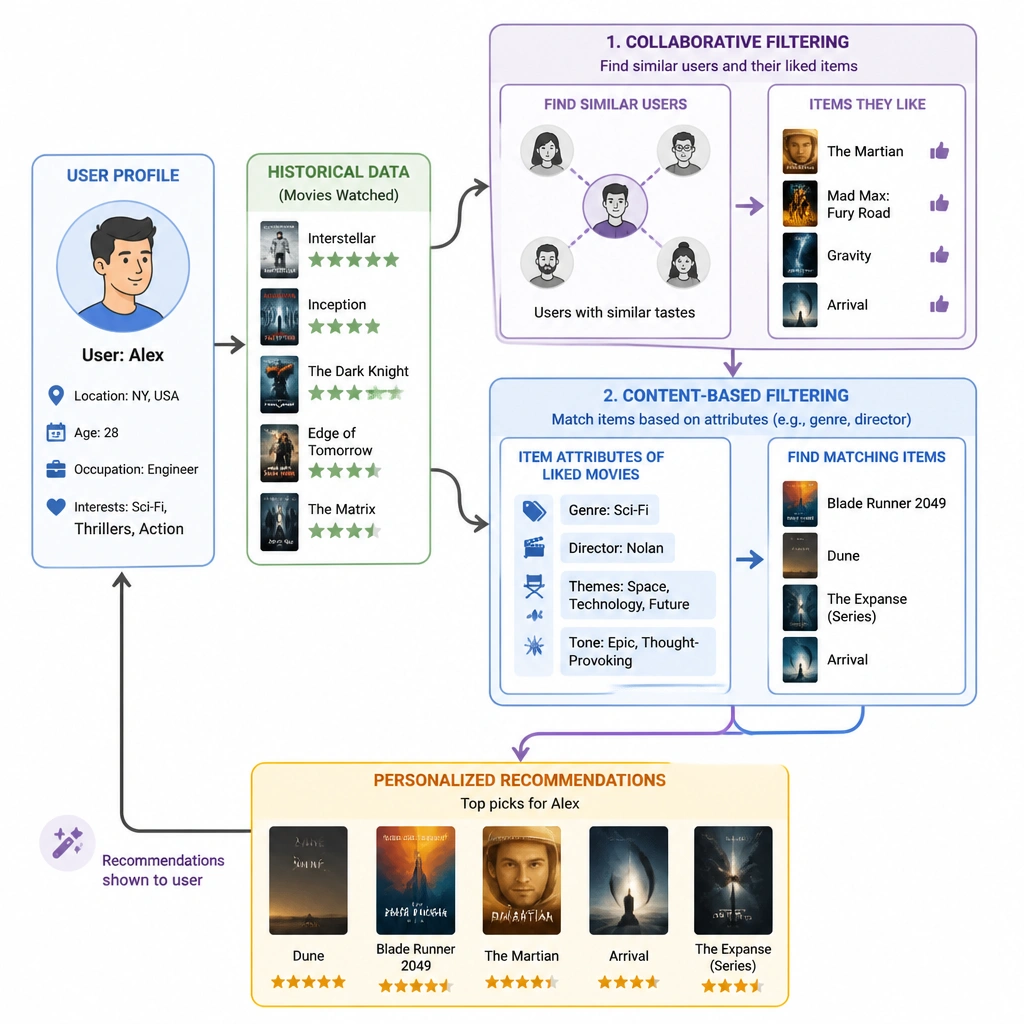
Check this out: if you've ever watched a movie on Netflix or bought something on Amazon, you've interacted with a recommender system. The whole goal here is personalization. Instead of showing the exact same storefront to every single person, the system looks at what you like, what you've bought, and what people similar to you have bought, and says, 'Hey, you might like this!' It's all about suggesting relevant items to keep users engaged. The other options do different tasks: clustering groups unlabeled data, regression predicts continuous numbers (like prices), and sentiment analysis determines if text is positive or negative. A recommender system is what drives those personalized suggestions. Let's keep rolling!
Full explanation below image
Full Explanation
The correct answer is Recommender system (Option B). A recommender system is a subclass of information filtering systems designed to predict the preference or rating a user would give to an item. The primary goal is to suggest relevant items—such as products, movies, articles, or music—to users by analyzing historical data. These systems typically use approaches like collaborative filtering (analyzing user similarities and shared behaviors), content-based filtering (matching user profiles with item characteristics), or hybrid methods to generate personalized suggestions that maximize user engagement and satisfaction. Option A (Clustering) is incorrect because clustering is an unsupervised learning task aimed at grouping unlabeled data points based on feature similarity (e.g., K-Means), rather than generating personalized item recommendations for a user. Option C (Regression) is incorrect because regression models predict continuous target variables, such as estimating a house price or stock value, not recommending discrete items from a catalog. Option D (Sentiment analysis) is incorrect because sentiment analysis is a natural language processing task used to classify the emotional tone of text (e.g., positive, negative, neutral), not to recommend items based on user preferences.