When preparing a dataset for training a machine learning model, you split the data into three separate partitions: training, validation, and test. During model development, you repeatedly train the model on the training partition and evaluate it on the validation partition to adjust hyperparameters (like learning rate and regularization strength). What is the primary purpose of the validation partition in this workflow?
Select an answer to reveal the explanation.
Short Explanation and Infographic
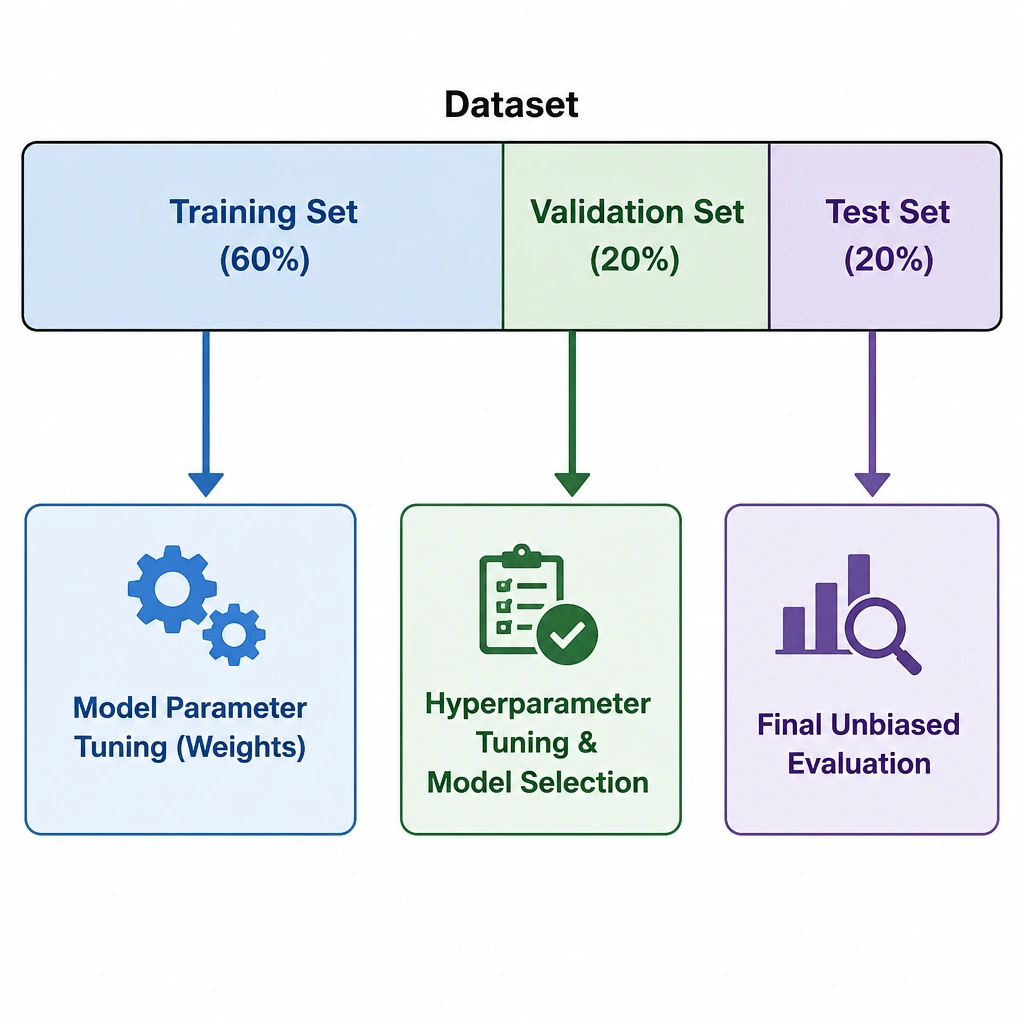
Here's the deal: if you evaluate your model on the same data you trained it on, it's going to look like a genius. But in reality, it's probably just memorizing the answers. To stop this, we split our data. The training set is where the model learns the weights. But how do we decide if our learning rate is right, or if we need more regularization? We use the validation set! It's like a practice quiz. It helps you tweak your settings—what we call hyperparameters—without letting the model look at the final exam (which is the test set!). If you use your test set to tune your model, you're cheating, and you'll get burned in production. Keep these three sets separate: train for learning, validation for tuning, and test for the final score. Got it? Sweet.
Full explanation below image
Full Explanation
The correct answer is B. In standard machine learning workflows, data is partitioned into three sets to ensure proper generalization: the training set, the validation set, and the test set. The training set is used to adjust the model's parameters (weights and biases) through optimization algorithms. The validation set is used to evaluate the model's performance during training to select the best hyperparameters (such as learning rate, batch size, or network depth) and architecture. Because the model's parameters are not directly updated using the validation set, it serves as an independent benchmark to detect overfitting to the training data. Once the final model and hyperparameters are chosen, the test set is used for a single, final evaluation of generalization performance. Option A describes the purpose of the training set, where weights and biases are updated. Option C describes the purpose of the test set, which must remain unseen until model development is complete to avoid optimistic bias. Option D describes feature scaling/normalization procedures, which are data preprocessing steps, not the purpose of the validation split.