A machine learning engineer is evaluating a new named entity recognition (NER) model designed to identify medical terms in patient records. Since the dataset is highly imbalanced—with most words not being entities—the engineer wants to use a metric that balances both precision and recall. Which evaluation metric is most appropriate for this NLP task?
Select an answer to reveal the explanation.
Short Explanation and Infographic
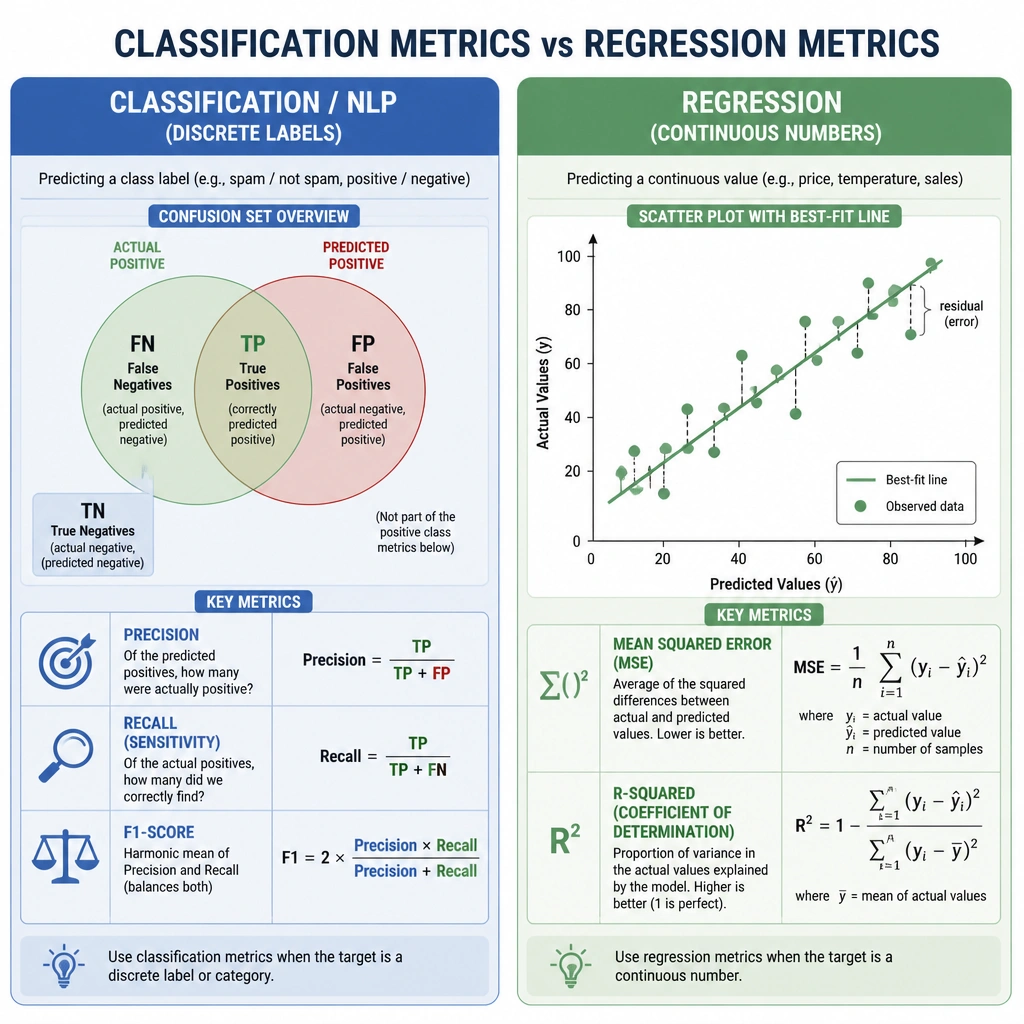
Check this out: when you're dealing with natural language processing—especially classification or finding entities in a sea of words—accuracy alone is going to lie to you. Think of it like this: if 99% of your data is just normal words and only 1% is what you're actually looking for, a model that does absolutely nothing will still be 99% accurate! Not very efficient, right? That's where the F1-Score comes in. It strikes a balance between precision (how many of our guesses were actually right) and recall (how many of the actual targets we managed to catch). Trust me on this, in the real world of NLP, F1 is your best friend when you have class imbalance. The other options here, like MSE or R-squared, are for regression problems—where you're predicting a continuous number, like home prices or temperature. Got it? Sweet. Let's keep rolling.
Full explanation below image
Full Explanation
The correct answer is F1-Score (Option C). In Natural Language Processing (NLP), tasks such as named entity recognition, spam detection, sentiment classification, and sequence labeling are structured as classification problems. These tasks frequently deal with highly imbalanced datasets where the negative class (e.g., non-entity tokens) vastly outnumbers the positive class. Standard metrics like accuracy can be highly misleading in these scenarios; a model that classifies everything as negative would achieve high accuracy but fail to identify any target entities. The F1-Score addresses this by computing the harmonic mean of precision and recall. Precision measures the ratio of true positive predictions to all positive predictions, ensuring the model does not produce excessive false alarms. Recall measures the ratio of true positives to all actual positives, ensuring the model does not miss critical targets. By balancing both metrics, F1-Score provides a robust measurement of classification quality under class imbalance. Option A, Mean Squared Error (MSE), is a regression metric that calculates the average of the squared differences between the predicted continuous outcomes and the actual target values. It is highly sensitive to outliers but is mathematically irrelevant for classification tasks. Option B, Adjusted R-squared, is also a regression metric that determines the proportion of variance in a dependent variable explained by independent variables in a regression model, adjusted for the number of predictors. It evaluates goodness-of-fit for linear models, not text classification. Option D, Mean Absolute Error (MAE), measures the average of the absolute differences between predictions and actual values in regression. None of these regression metrics are capable of evaluating discrete prediction tasks in NLP, making F1-Score the only suitable and standard metric among the choices.