As an AI systems architect deploying an automated loan-approval model, you must evaluate the project for ethical risks before pushing it to production. Which of the following represents a primary ethical concern directly related to the behavior of deployed AI systems?
Select an answer to reveal the explanation.
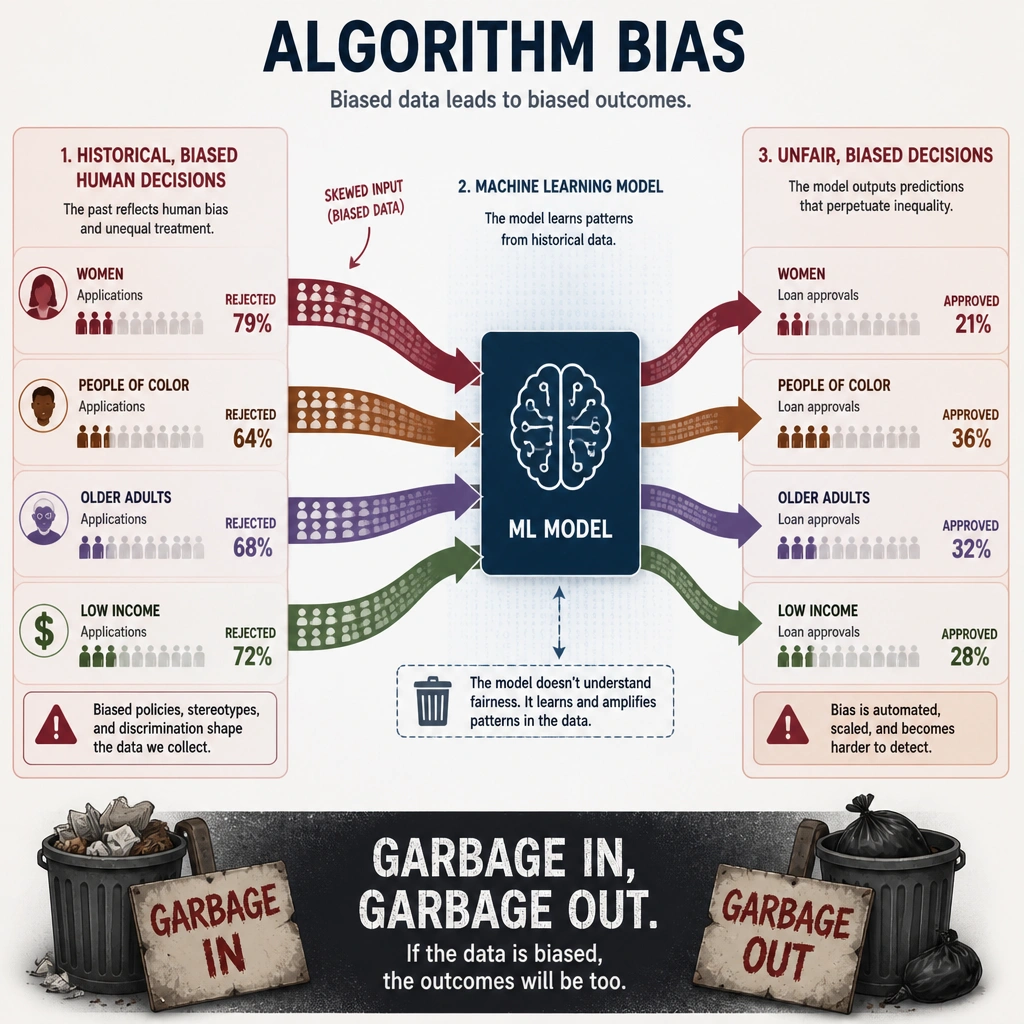
Short Explanation and Infographic
Here's the deal—when you train an AI model, it learns from historical data. And if that historical data is filled with human bias, guess what? Your model is going to learn to make biased decisions too. Imagine your company deploys an AI recruiting tool, and it starts rejecting qualified candidates because of their gender or background just because the historical hiring data had those patterns. That's a massive ethical concern, and it's a huge issue in the industry right now. Don't get confused by technical headaches like high compute costs or needing giant datasets—those are resource problems, not ethical ones.
Full explanation below image
Full Explanation
Algorithmic bias represents one of the most significant and widely recognized ethical concerns in the field of Artificial Intelligence. Because AI models learn patterns from historical training datasets, any existing societal or human biases embedded in that data will be absorbed, propagated, and potentially amplified by the system. This can lead to discriminatory decisions in critical areas such as hiring, loan approvals, criminal justice risk assessments, and facial recognition access control.
Addressing bias requires active intervention, including diverse dataset collection, fairness auditing, and bias mitigation techniques.
- Option A is incorrect because high computational cost is an infrastructure, environmental, or budgetary challenge, not a primary social/ethical concern regarding system behavior and fairness. - Option C is incorrect because while lack of interpretability (often called the 'black box' problem) is a major technical and trust challenge, the direct potential for discrimination and unfair treatment (bias) is the most prominent, direct ethical harm. - Option D is incorrect because the necessity of large datasets is a technical limitation and data collection challenge, not an inherent ethical concern in itself (though how data is sourced or consented to is ethical, the mere need for data is a technical requirement).