During the optimization process using gradient descent, what role does the hyperparameter known as the 'learning rate' play?
Select an answer to reveal the explanation.
Short Explanation and Infographic
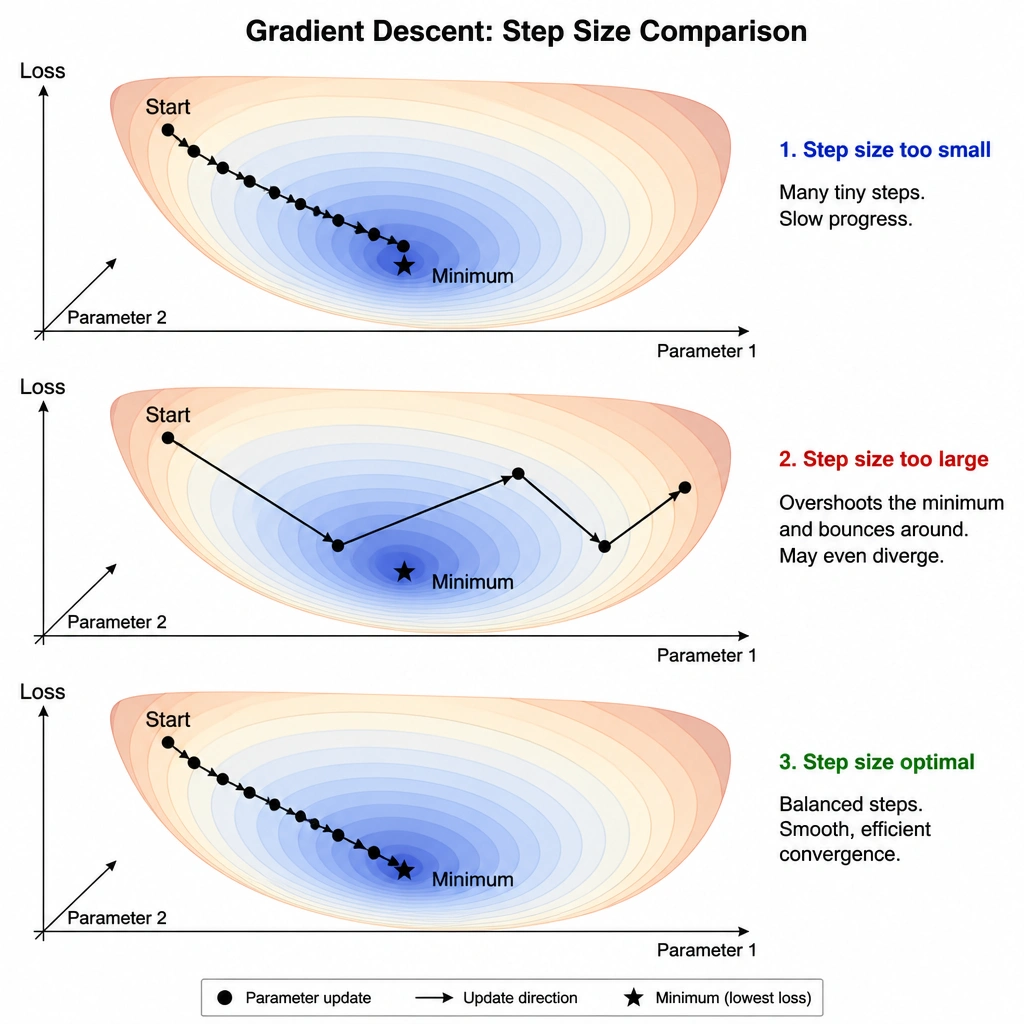
Think of the learning rate like the dial on your stove. If you turn it up too high, you'll burn your dinner—in model terms, the weights jump all over the place, overshoot the target, and never settle down. But if you turn it way too low, it'll take you three days to boil water—your training will crawl at a snail's pace. The learning rate controls the size of the step your optimizer takes down the loss mountain to find that perfect sweet spot. Pay close attention to this, because picking the wrong learning rate is one of the quickest ways to ruin a model's training.
Full explanation below image
Full Explanation
The learning rate (represented by Greek letters like \eta or \alpha) is a critical hyperparameter in training machine learning models using gradient descent or its variants (such as Adam or RMSprop). When a model processes a batch of data, it calculates the gradient of the loss function with respect to each weight. The gradient indicates the direction of steepest ascent (i.e., how to increase the error). To minimize the error, the optimizer updates the weights in the opposite direction.
The learning rate determines the scale or 'step size' of this update: weight = weight - (learning_rate * gradient).
If the learning rate is too large, the optimizer may overshoot the optimal minimum and potentially diverge, causing training loss to explode. If it is too small, the model will take excessively small steps, leading to slow training progress and risk of getting trapped in suboptimal local minima or saddle points.
To address the distractors: - Option B refers to the number of epochs, which is a separate hyperparameter specifying how many passes the model makes over the entire dataset. - Option C refers to evaluation metrics, such as accuracy or F1-score, which measure model performance rather than guiding optimization steps. - Option D refers to the model architecture (depth and width), which is configured before training and is independent of the learning rate.
Finding the optimal learning rate often involves using techniques like learning rate schedules or learning rate finders.