
You are dealing with a dataset that has hundreds of features, causing your model training to be slow and prone to overfitting. You want to simplify the dataset by transforming the original features into a smaller set of uncorrelated variables while preserving as much of the data's original variance as possible. Which technique should you use?
Select an answer to reveal the explanation.
Short Explanation
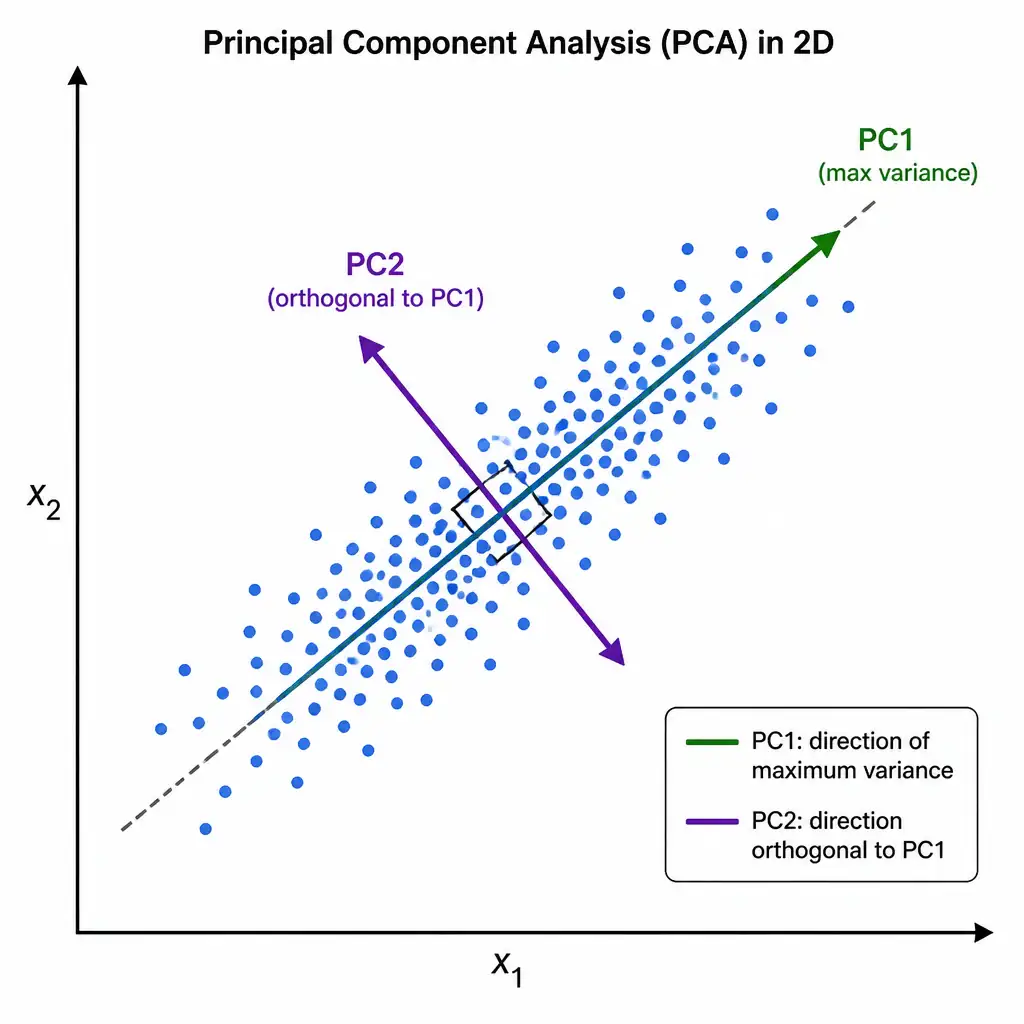
You've got a high-dimensional dataset that's slowing training and inviting overfitting. Principal Component Analysis is the right move because it transforms many correlated features into fewer uncorrelated components while preserving as much variance as possible. Clustering groups data, and regression predicts outcomes, so neither one shrinks your feature space the way PCA does.
Full Explanation
Principal Component Analysis (PCA) is a widely used unsupervised learning technique in statistics and machine learning. It aims to reduce the dimensionality of a dataset consisting of a large number of interrelated variables while retaining as much variation, or information, as possible. PCA achieves this by calculating eigenvectors and eigenvalues from the covariance matrix of the data, then projecting the data onto new orthogonal axes called principal components. The first principal component accounts for the largest possible variance, the next component accounts for the next largest variance, and so on. By selecting only the top components, practitioners can significantly simplify datasets without losing critical information, which makes PCA the correct technique for reducing dimensionality while preserving variance. Linear Regression is a supervised algorithm used to model the relationship between independent features and a continuous target variable for prediction, not for dimensionality reduction. K-Means Clustering is an unsupervised algorithm used to group similar data points into clusters based on distance metrics; while it groups data, it does not transform high-dimensional feature spaces into lower-dimensional principal components. Logistic Regression is a supervised classification algorithm used to estimate the probability of a binary outcome based on input features, so it is not used to compress correlated features into uncorrelated variables that preserve variance.