An architect is reviewing different machine learning models to determine which ones leverage layers of interconnected artificial nodes (neurons) to process data. Which of the following is NOT classified as a neural network architecture?
Select an answer to reveal the explanation.
Short Explanation and Infographic
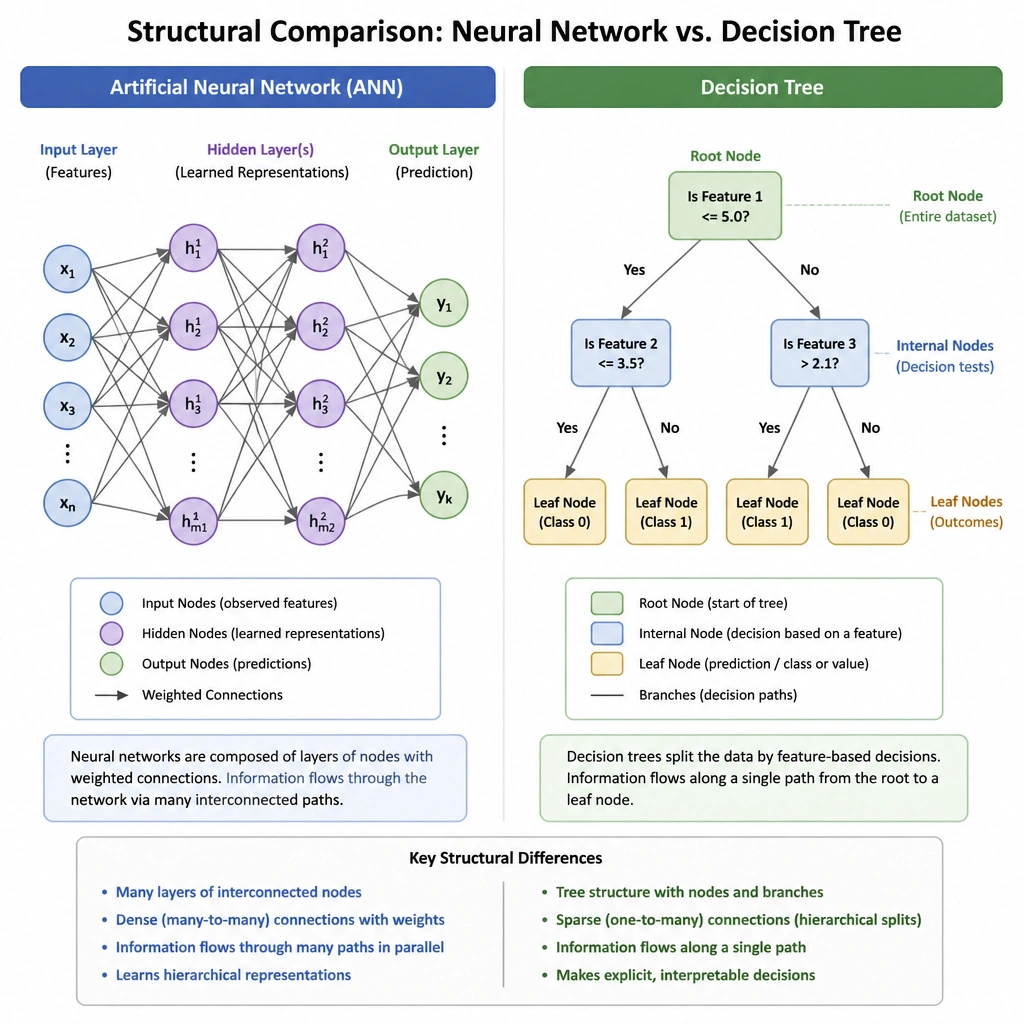
Here's the deal: neural networks are all about mimicking the brain's structure with layers, weights, and nodes. You've got CNNs for images, RNNs for sequences, and GANs for creating fake faces that look incredibly real. But a Decision Tree? Think of that like a giant flowchart of "yes/no" questions. If the temperature is over 80 degrees, do this; if not, do that. It's a classic machine learning algorithm, but it doesn't use neurons, weights, or backpropagation. So, when the exam asks which one isn't a neural network, don't get tripped up—spot the flowchart!
Full explanation below image
Full Explanation
Neural networks, or artificial neural networks (ANNs), are computational models inspired by the structure and function of biological brains. They consist of layers of interconnected processing units called artificial neurons (nodes). These networks learn representation from data through training algorithms like backpropagation, which updates connection weights to minimize errors. Decision Trees (Option A) are non-parametric supervised learning methods used for classification and regression. Instead of using interconnected layers of nodes that compute weighted sums and apply activation functions, decision trees partition the feature space recursively based on attribute values. A decision tree creates a model that predicts the value of a target variable by learning simple decision rules inferred from the data features. While they are a foundational machine learning algorithm, they are not neural networks. Recurrent Neural Networks (RNNs) (Option B) are a class of neural networks containing loops that allow information to persist. They are specifically designed for sequence data like time series and natural language processing. Generative Adversarial Networks (GANs) (Option C) consist of two neural networks—a generator and a discriminator—that compete in a zero-sum game framework to generate new, synthetic data instances that resemble the training set. Convolutional Neural Networks (CNNs) (Option D) are deep neural networks that employ convolution operations in place of general matrix multiplication in at least one of their layers. They are optimized for processing grid-structured data like images. Therefore, while all options are machine learning tools, only the Decision Tree is not structured as a neural network.