When analyzing the performance of a binary classification model at various decision thresholds, what does the acronym 'ROC curve' stand for?
Select an answer to reveal the explanation.
Short Explanation and Infographic
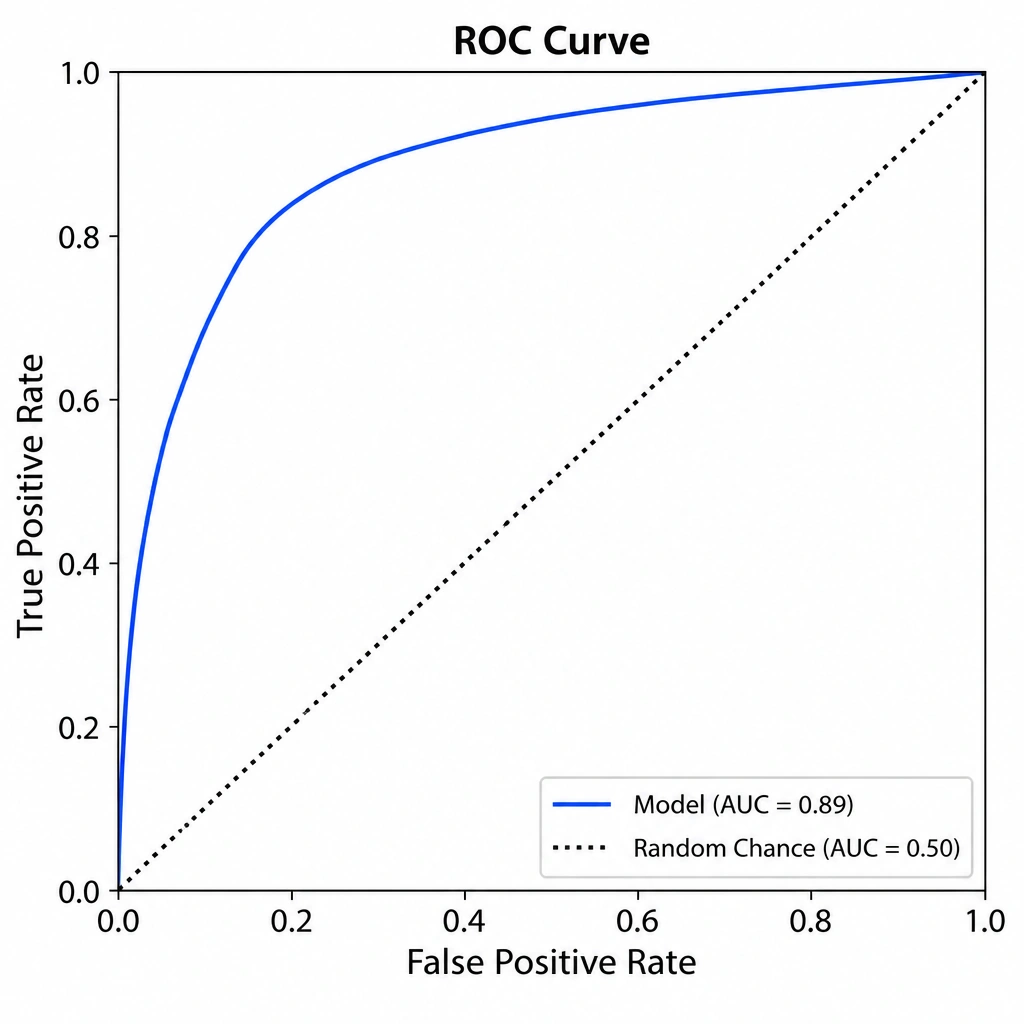
I remember when I first heard this term—it sounded like some ancient military code. And that's because it is! The term 'Receiver Operating Characteristic' was invented during World War II for radar receiver operators who were trying to figure out if a blip on their screen was an incoming enemy plane or just noise. Today, we use ROC curves to plot the True Positive Rate against the False Positive Rate as we change our model's classification threshold. It's a standard tool for measuring how well a model can separate two classes. Memorize this exact term, because exam writers love to give you fake lookalike names to trip you up. Option A is the one you need.
Full explanation below image
Full Explanation
The acronym ROC stands for Receiver Operating Characteristic. This term originated in signal detection theory during World War II, where it was developed to describe the ability of radar operators to distinguish between true signals (such as incoming aircraft) and background noise (clutter).
In modern machine learning, an ROC curve is a fundamental visualization tool used to assess the diagnostic ability of a binary classifier system as its discrimination threshold is varied. The curve is constructed by plotting two key metrics: 1. True Positive Rate (TPR), also known as Sensitivity or Recall, on the y-axis: $$TPR = \frac{TP}{TP + FN}$$ 2. False Positive Rate (FPR), also known as $1 - \text{Specificity}$, on the x-axis: $$FPR = \frac{FP}{FP + TN}$$ Each point on the ROC curve corresponds to a specific decision threshold (e.g., classifying an instance as positive if the predicted probability is greater than $0.3, 0.5, \text{or } 0.8$). By plotting these points, the curve illustrates the trade-off between sensitivity and specificity. The Area Under the ROC Curve (AUC) is a single metric that summarizes this performance. An AUC of 1.0 indicates a perfect classifier, while an AUC of 0.5 indicates a model that performs no better than random guessing.
Let's address the distractors: - Options B, C, and D are fabricated terms designed to look plausible to someone who does not know the official terminology, but they have no basis in machine learning literature.
Remember: Receiver Operating Characteristic is the formal name, and it is plotted to show the trade-off between True Positives and False Positives across different classification thresholds.