
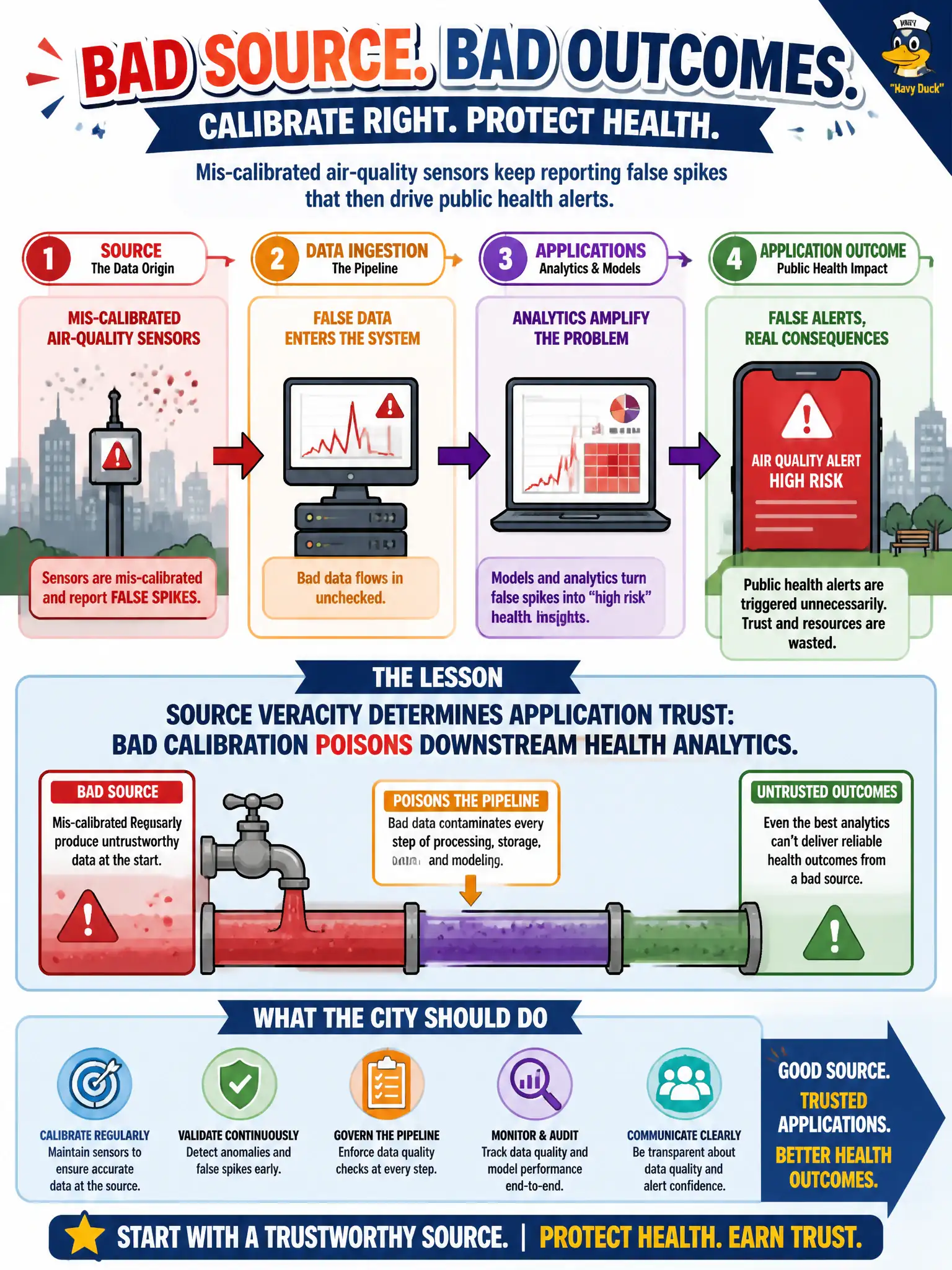
Mis-calibrated air-quality sensors keep reporting false spikes that then drive public health alerts. What lesson about sources and applications should the city apply?
Select an answer to reveal the explanation.
Short Explanation
If the sensor lies, the health app shouts for no good reason. Calibration is veracity — and veracity decides whether the application earns trust. Pretty dashboards and fast spikes do not fix a crooked meter.
Full Explanation
Downstream applications inherit the truthfulness of their sources. Mis-calibrated air-quality sensors produce false volume and alarming velocity while failing Veracity, so public health alerts become unreliable. Programs pair sensor maintenance and validation with analytics release criteria because civic trust in health guidance depends on source quality, not UI polish.
Claiming applications never depend on sensor quality if fonts look modern fails by concept: presentation cannot fix bad calibration. Claiming only storage brand names matter fails by concept: calibration is central to analytic trust. Claiming false spikes prove Velocity alone retires Veracity fails by concept: fast falsehoods still fail Veracity.
Exam caveat: Source veracity determines application trust—bad calibration poisons health analytics; UI and storage brands do not substitute for validation.
Operational check: Schedule calibration checks, gate health alerts on sensor validation status, and suppress or flag feeds that fail calibration until repaired. Document residual risk for civic operators and revisit after the next production change window. Confirm owners, SLAs, and rollback criteria in the runbook before go-live.