
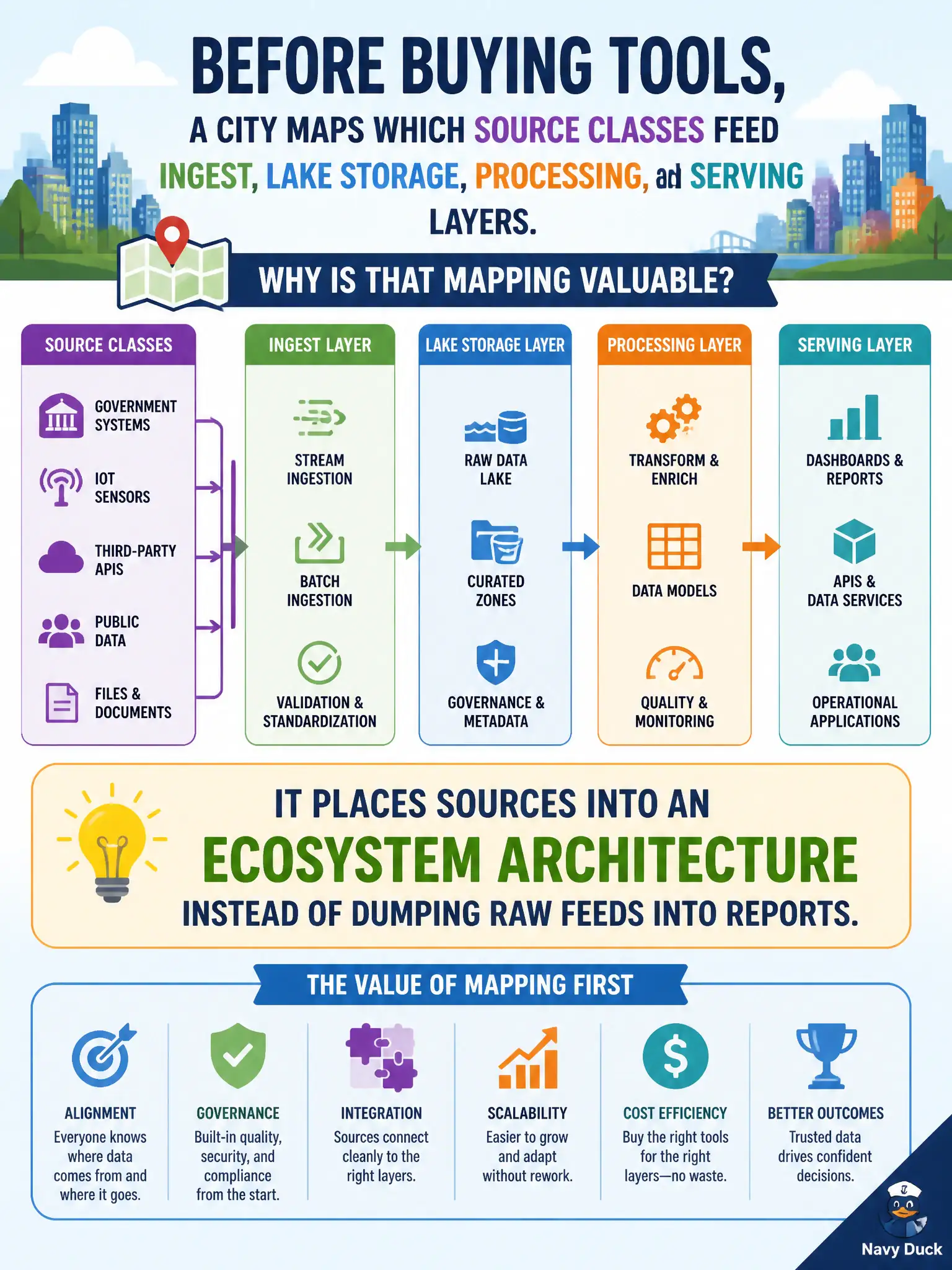
Before buying tools, a city maps which source classes feed ingest, lake storage, processing, and serving layers. Why is that mapping valuable?
Select an answer to reveal the explanation.
Short Explanation
Sources without a landing plan are like packages with no address. Mapping which feeds hit ingest, storage, processing, and serving keeps the city from pasting raw streams into slide decks. Architecture first, shopping second.
Full Explanation
Domain skills include relating sources to ecosystem architecture context. Mapping which source classes feed ingest, lake storage, processing, and serving layers places sources into an architecture instead of dumping raw feeds into reports. Cities that do this before buying tools improve fit, capacity planning, and civic accountability for each hop.
Claiming mapping proves sources can dump straight into public PDFs with no pipeline fails by concept: the point is layered architecture, not PDF dumping. Claiming mapping replaces architecture because spreadsheets become the system of record fails by concept: spreadsheets are not the architecture. Claiming it guarantees every source is low Velocity and structured fails by concept: mapping reveals—not erases—Velocity and structure diversity.
Exam caveat: Source-to-layer mapping prevents ad-hoc dumps and guides tool fit; it does not make architecture optional or declare all sources low Velocity.
Operational check: Produce a matrix of source class versus ingest/store/process/serve, mark Velocity class per feed, and use it in the procurement package before tool awards. Document residual risk for civic operators and revisit after the next production change window.