
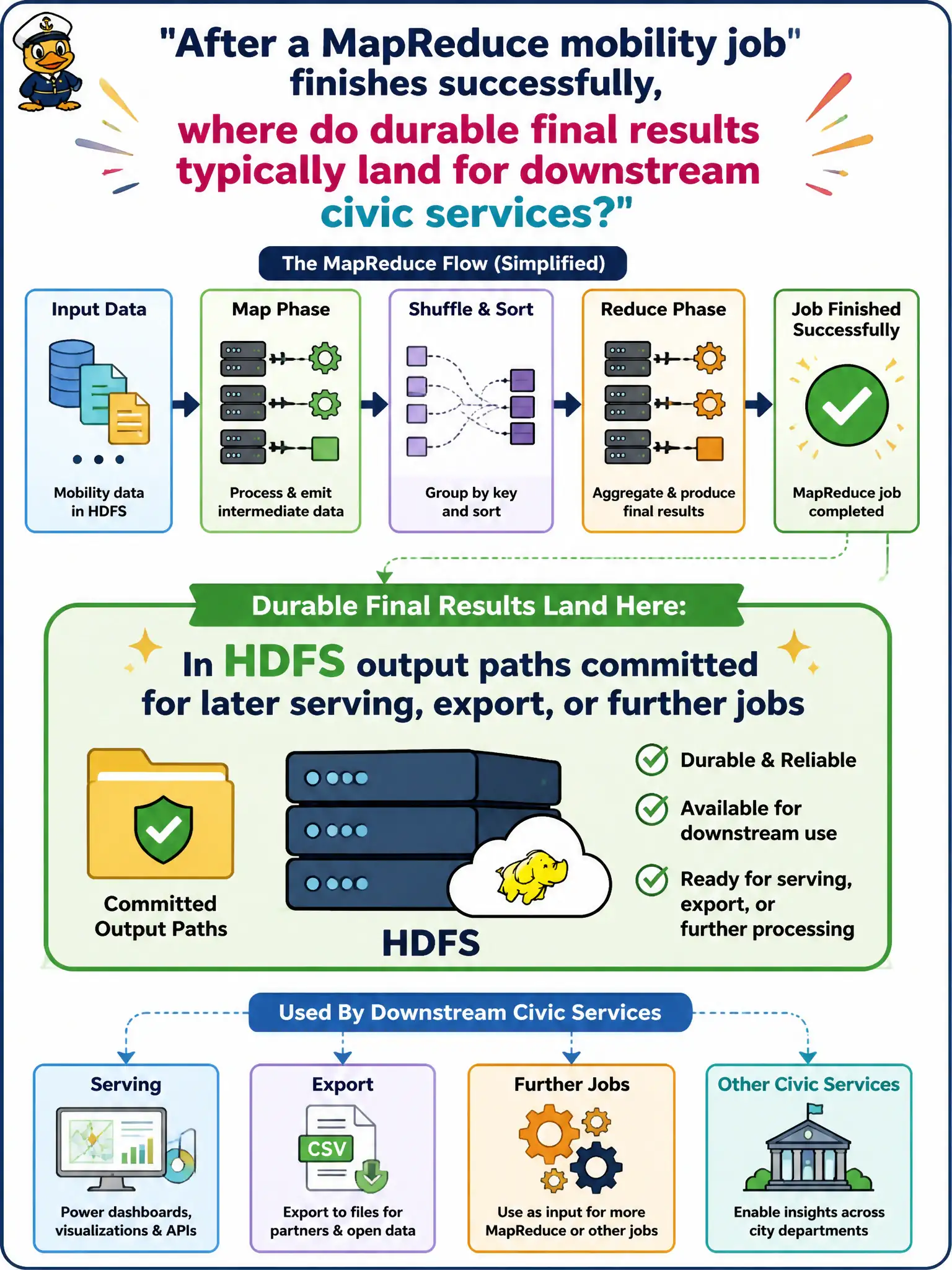
After a MapReduce mobility job finishes successfully, where do durable final results typically land for downstream civic services?
Select an answer to reveal the explanation.
Short Explanation
When the night shift ends, results need a file cabinet others can open tomorrow—HDFS output paths. Mapper heap and browser caches disappear. Sticky notes on racks are not a data platform.
Full Explanation
After a MapReduce mobility job finishes successfully, durable final results typically land in HDFS output paths committed for later serving, export, or further jobs—downstream civic services need durable, shared artifacts, not ephemeral heap. Leaving results only in ephemeral mapper heap memory that vanishes when the JVM exits provides nothing durable for the city. Storing results exclusively inside the browser cache of the analyst who submitted the job fails enterprise sharing and auditability. Unreplicated sticky notes taped to the rack doors are not a storage architecture. Exam caveat: successful MapReduce jobs commit outputs to distributed storage (commonly HDFS) for downstream use. Operational check: confirm the mobility job’s output directory, replication, and success markers; register the path in the catalog; and point serving or export jobs at that committed location. In municipal platform operations, record the rationale in the architecture decision record so future on-call staff know which pattern was chosen and which failure modes the rejected options would create for city services. Re-validate after the next maintenance window that monitoring, access paths, and recovery steps still match the documented design for agencies that depend on this platform.