
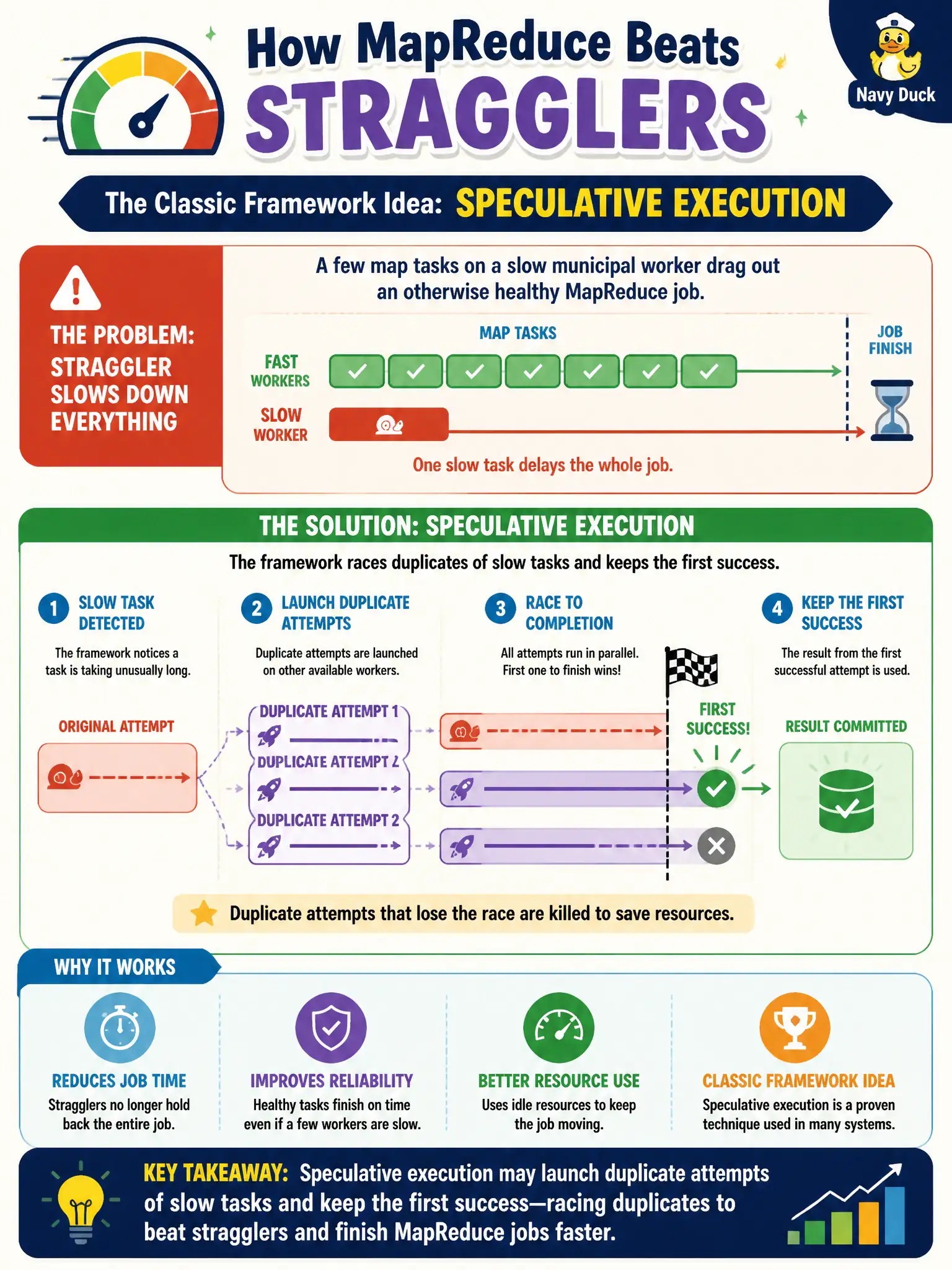
A few map tasks on a slow municipal worker drag out an otherwise healthy MapReduce job. Which classic framework idea races duplicates to mitigate stragglers?
Select an answer to reveal the explanation.
Short Explanation
When one bakery tray lags, start a twin tray elsewhere and take whichever finishes first. Speculative execution races duplicates of stragglers. Wiping splits or reformatting HDFS is not the fix.
Full Explanation
When a few map tasks on a slow municipal worker drag out an otherwise healthy MapReduce job, speculative execution may launch duplicate attempts of slow tasks and keep the first success—classic straggler mitigation in the framework. Deleting all input splits so no map work remains does not mitigate stragglers; it cancels the job’s purpose. Converting every key into a unique reducer with mandatory skew worsens reduce behavior rather than helping slow mappers. Requiring operators to reformat HDFS after each slow task is destructive and unrelated to speculative execution. Exam caveat: speculative execution races duplicates for stragglers; it is not a substitute for fixing bad nodes long-term. Operational check: enable speculative execution where appropriate, watch for duplicate attempts on slow tasks, and still repair or quarantine chronically slow workers in the municipal fleet. In municipal platform operations, record the rationale in the architecture decision record so future on-call staff know which pattern was chosen and which failure modes the rejected options would create for city services. Re-validate after the next maintenance window that monitoring, access paths, and recovery steps still match the documented design for agencies that depend on this platform.