
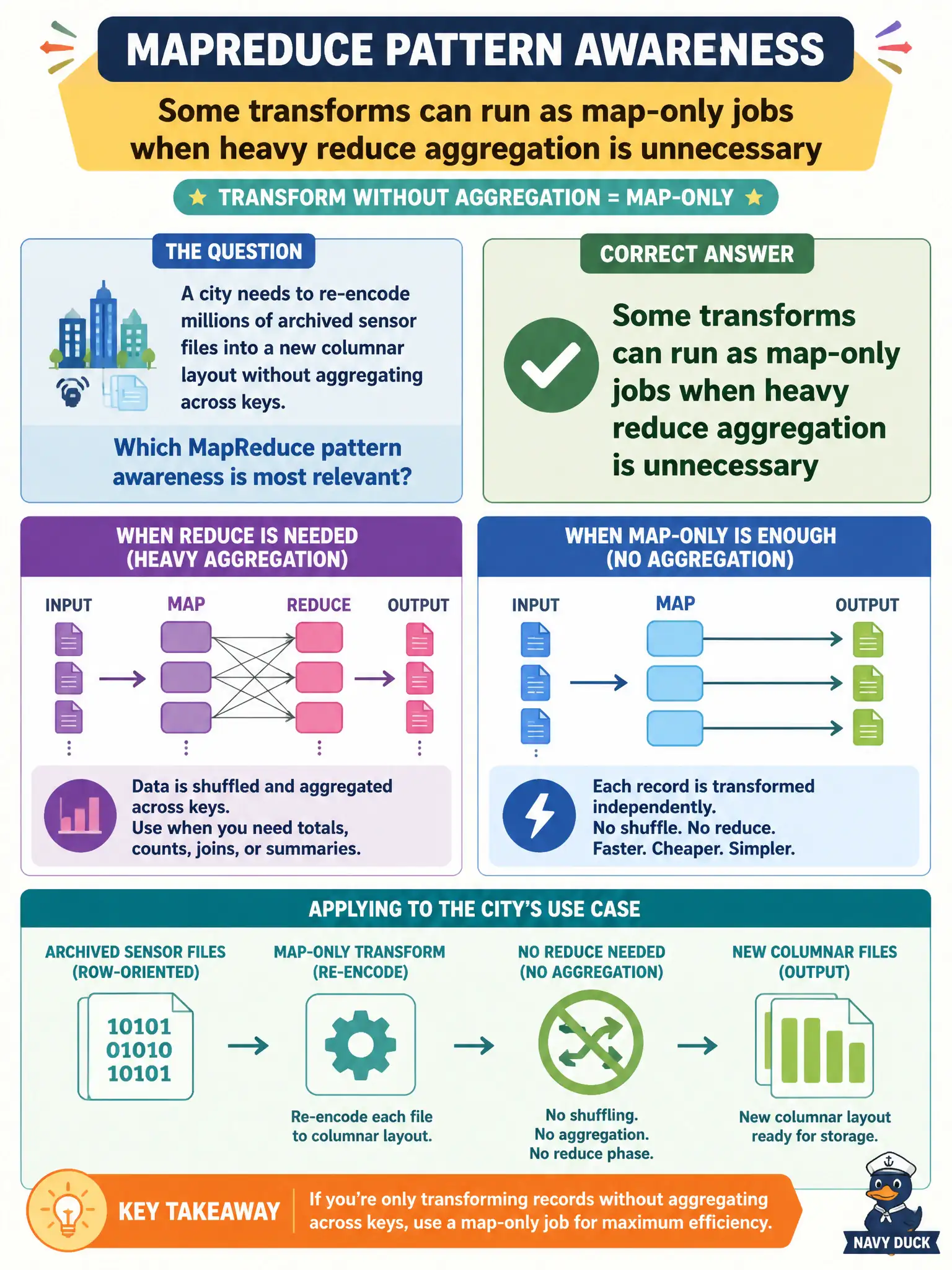
A city needs to re-encode millions of archived sensor files into a new columnar layout without aggregating across keys. Which MapReduce pattern awareness is most relevant?
Select an answer to reveal the explanation.
Short Explanation
Sometimes you just need every page photocopied into a new format—no need to total the whole binder. Map-only jobs cover those per-record transforms. Forcing a heavy reduce when nothing groups is busywork.
Full Explanation
When a city must re-encode millions of archived sensor files into a new columnar layout without aggregating across keys, map-only MapReduce jobs are relevant: some transforms run without a heavy reduce aggregation stage when grouping is unnecessary. Requiring every transform to run exactly two reducers or be invalid invents a false rule. Claiming reducers are mandatory even when no grouping or aggregation is required forces useless shuffle cost. Forbidding map tasks whenever HDFS replication is greater than one confuses storage policy with processing pattern. Exam caveat: map-only jobs are valid when the transform is embarrassingly parallel per split. Operational check: run the sensor re-encode as map-only, confirm outputs land in the new columnar layout without a reduce stage, and compare runtime to an unnecessary reduce-enabled variant. In municipal platform operations, record the rationale in the architecture decision record so future on-call staff know which pattern was chosen and which failure modes the rejected options would create for city services. Re-validate after the next maintenance window that monitoring, access paths, and recovery steps still match the documented design for agencies that depend on this platform.