
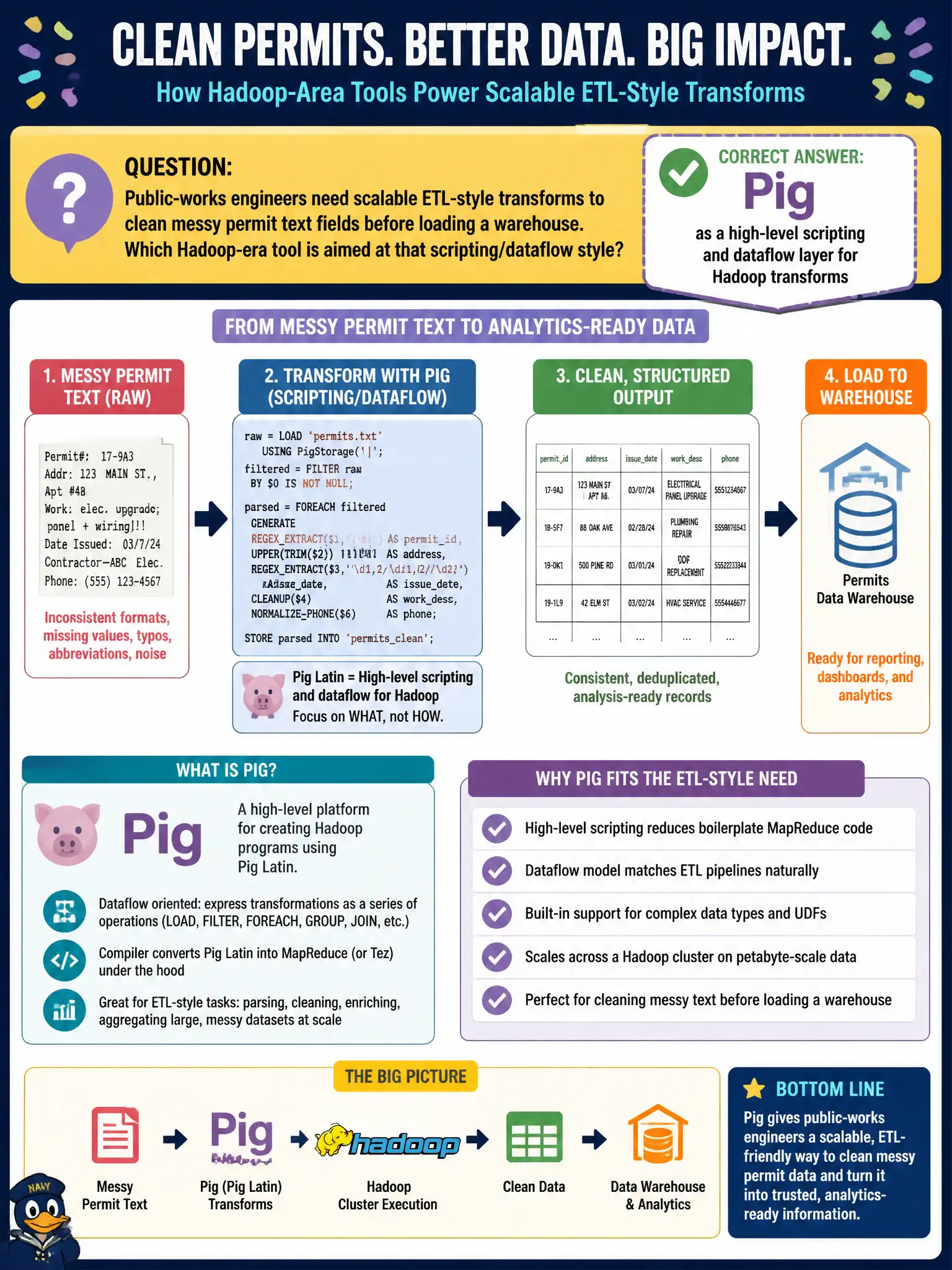
Public-works engineers need scalable ETL-style transforms to clean messy permit text fields before loading a warehouse. Which Hadoop-era tool is aimed at that scripting/dataflow style?
Select an answer to reveal the explanation.
Short Explanation
Cleaning messy permit text at scale is an assembly-line script, not a shopping-cart lock. Pig was built for that high-level dataflow style on Hadoop. OLTP procedures and cloud-fundamentals trivia miss the job.
Full Explanation
Public-works engineers who need scalable ETL-style transforms to clean messy permit text fields before warehouse load should look to Pig as a high-level scripting and dataflow layer for Hadoop transforms in the Hadoop-era toolchain. A synchronous OLTP stored procedure that locks each permit row for shoppers targets transactional apps, not scalable Hadoop ETL for analytics. Azure Fundamentals (AZ-900) virtual-machine SKU memorization does not clean permit text on HDFS. A CAP proof that forbids cleaning any free-text field is a nonsensical barrier, not a tool choice. Exam caveat: Pig is the scripting/dataflow counterpart often contrasted with Hive’s SQL style. Operational check: implement permit text cleansing as a Pig (or equivalent dataflow) script reading HDFS raw permits, write curated output, and validate field quality metrics before warehouse load. In municipal platform operations, record the rationale in the architecture decision record so future on-call staff know which pattern was chosen and which failure modes the rejected options would create for city services. Re-validate after the next maintenance window that monitoring, access paths, and recovery steps still match the documented design for agencies that depend on this platform.