
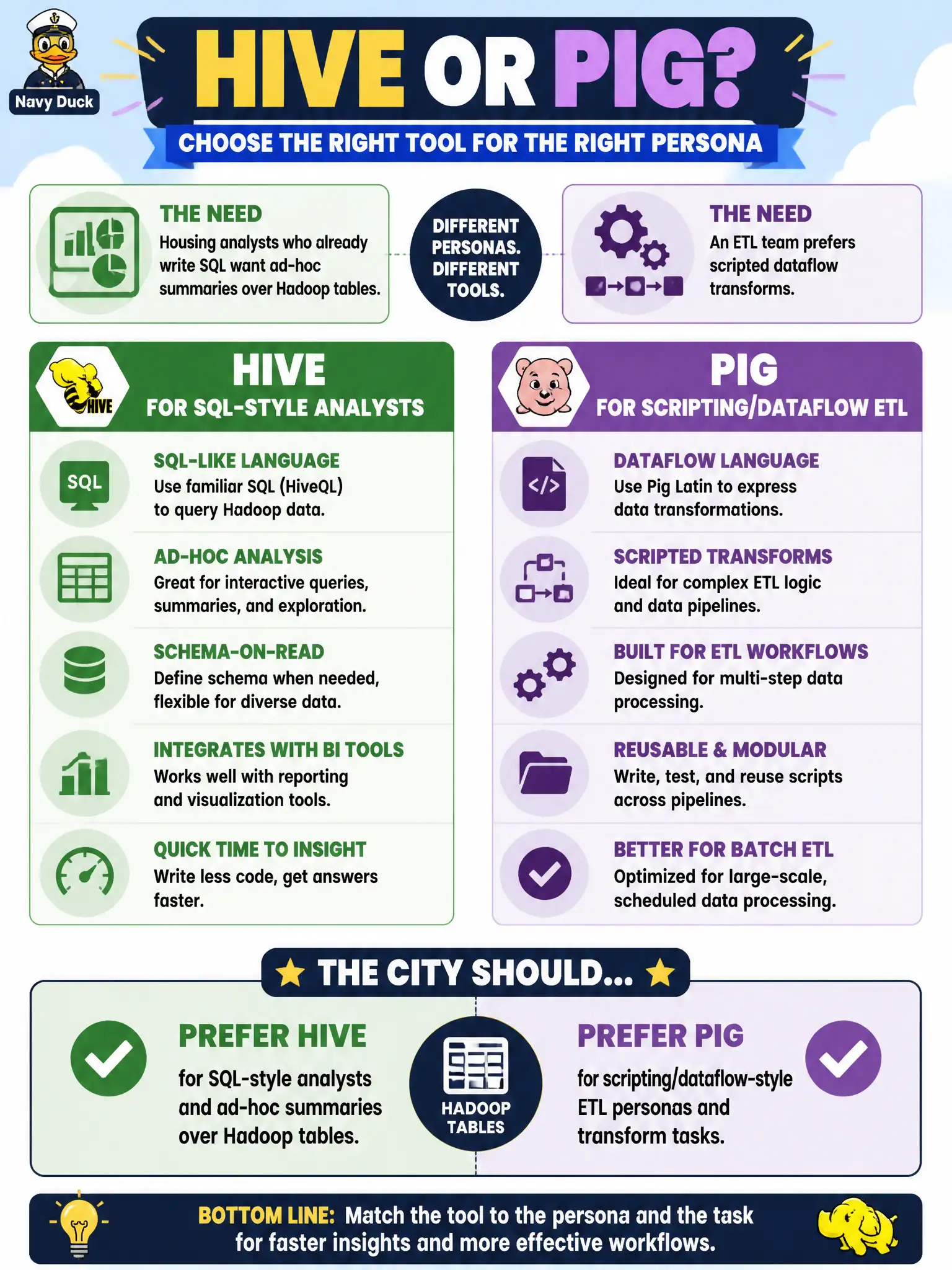
Housing analysts who already write SQL want ad-hoc summaries over Hadoop tables, while an ETL team prefers scripted dataflow transforms. How should the city choose between Hive and Pig?
Select an answer to reveal the explanation.
Short Explanation
Match the tool to the cook: SQL folks grab Hive; dataflow scripters often grab Pig. Same kitchen (Hadoop), different utensils. Neither choice is "always," and cloud-fundamentals flashcards are not a query engine.
Full Explanation
When housing analysts who write SQL want ad-hoc summaries over Hadoop tables while an ETL team prefers scripted dataflow transforms, the city should prefer Hive for SQL-style analysts and Pig for scripting/dataflow-style ETL personas and tasks—tooling follows team skills and problem shape. Always picking Pig because Hive cannot express any grouping is false; Hive expresses grouping routinely. Always picking Hive because Pig cannot run on YARN-managed clusters is false; Pig jobs run on Hadoop/YARN environments. Replacing both with AZ-900 exam flashcards before touching civic datasets confuses cloud-fundamentals study with Hadoop query tooling. Exam caveat: Hive ≈ SQL persona; Pig ≈ procedural/dataflow persona on Hadoop-era stacks. Operational check: route housing ad-hoc summaries to Hive tables and permit-cleaning ETL scripts to Pig (or successor dataflow tools), documenting the persona-based standard in the data platform guide. In municipal platform operations, record the rationale in the architecture decision record so future on-call staff know which pattern was chosen and which failure modes the rejected options would create for city services. Re-validate after the next maintenance window that monitoring, access paths, and recovery steps still match the documented design for agencies that depend on this platform.