
Developers assume they can filter a civic NoSQL store on any field as freely as a normalized SQL database. What caution should the architect emphasize?
Select an answer to reveal the explanation.
Short Explanation
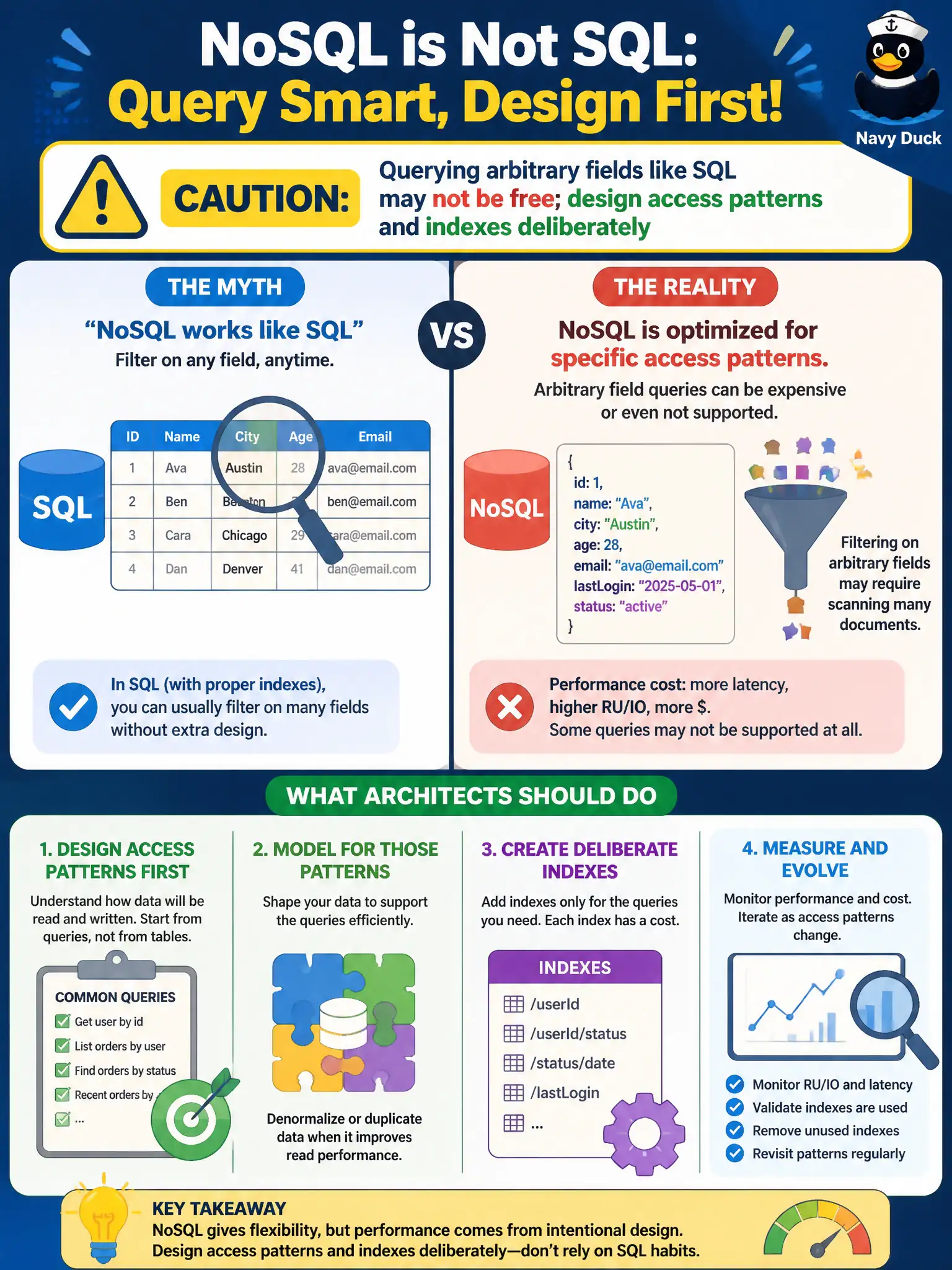
In NoSQL, "query anything anytime" is a myth that burns clusters. You design around the lookups you actually need. Think access patterns first, not SQL daydreams.
Full Explanation
Architects must caution developers that filtering a civic NoSQL store on arbitrary fields is not automatically as free as in a normalized SQL database with mature secondary indexes and optimizers. Access patterns and indexes must be designed deliberately around how the application queries. Assuming every NoSQL product indexes all nested fields at zero cost leads to surprise full scans and production timeouts. Believing secondary indexes are never needed because full scans are always faster is usually false at municipal scale. Claiming NoSQL ignores all predicates and always returns the entire cluster is a caricature—predicates work when the model and indexes support them. Exam caveat: many NoSQL exams stress “query what you modeled for,” especially partition keys and planned secondary indexes. Operational check: list the portal’s top ten query shapes, ensure each maps to a partition key or explicit index, and run explain/metrics in staging to prove none rely on accidental collection scans. In production terms for deliberate NoSQL access patterns and indexes, assign an owning team, wire a dashboard that shows the pattern is healthy under peak civic load, and require a staging drill that rehearses failure and recovery before resident impact. Revisit the choice when traffic shape, retention, or integrity needs change, and keep a named rollback owner on the change record. Re-test both the happy path and the failure path for deliberate NoSQL access patterns and indexes after material dependency upgrades so regressions are caught before the next public release.