
Which set of traits best characterizes many NoSQL systems used for municipal Big Data workloads?
Select an answer to reveal the explanation.
Short Explanation
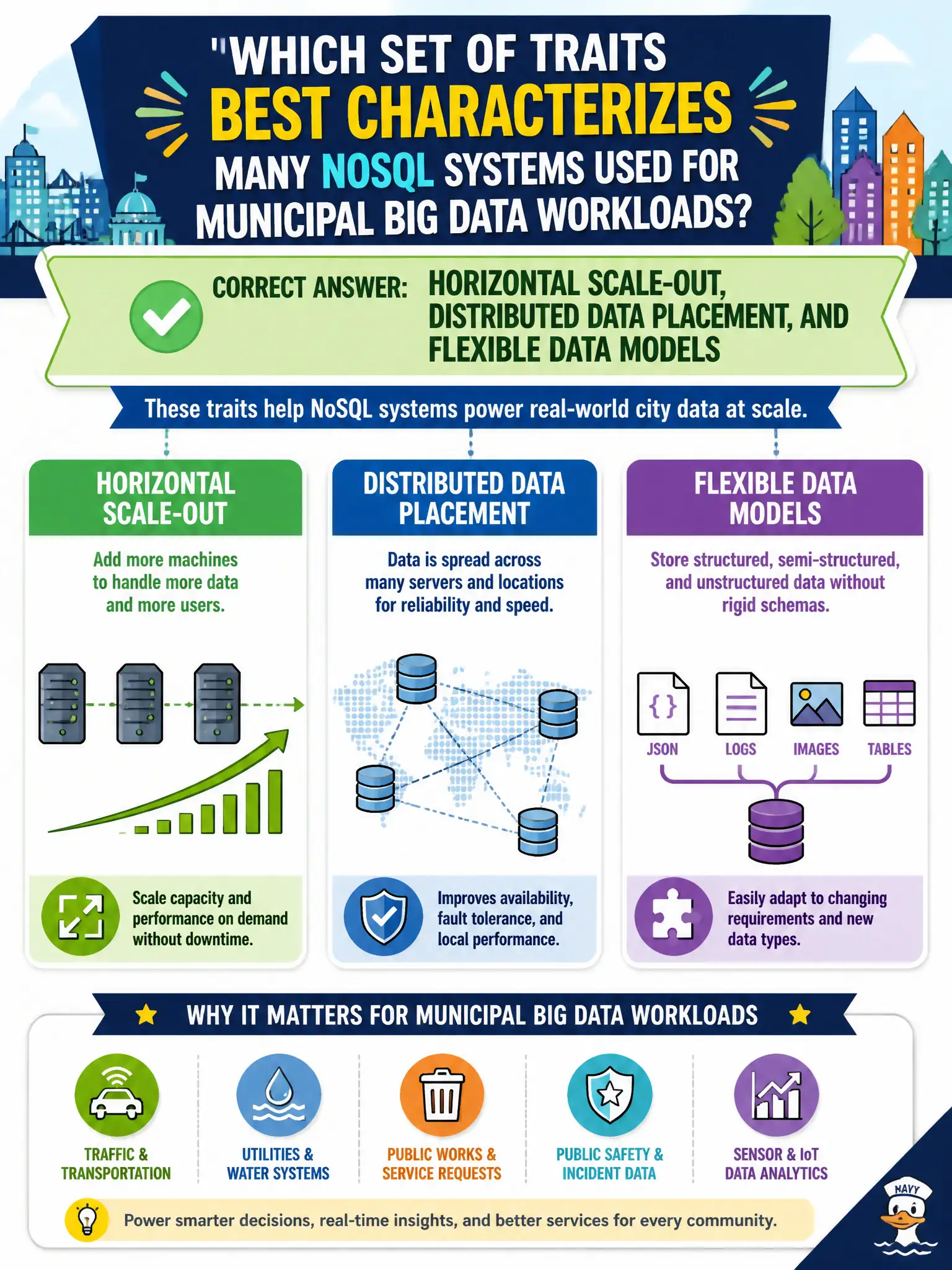
Picture adding more city trucks to the fleet instead of rebuilding one giant truck—that is horizontal scale. NoSQL usually spreads data across nodes and keeps models flexible. That combo is why cities use it for big, messy civic datasets.
Full Explanation
Many NoSQL systems used for municipal Big Data workloads are characterized by horizontal scale-out, distributed data placement across nodes, and flexible data models that tolerate varied record shapes. That combination supports high ingest and evolving civic documents better than single-box growth alone. Single-server vertical scale only with fixed schemas and mandatory multi-row joins describes classic RDBMS constraints, not the typical NoSQL value proposition in BDPC framing. Mainframe-only batch tapes with no network distribution are an archival or legacy batch pattern, not a distributed NoSQL cluster model. Spreadsheet files as the only durable cluster storage layer confuse desktop tooling with replicated, partitioned datastore architecture. Exam caveat: traits are tendencies—some NoSQL products offer stronger consistency or optional schemas—but the exam contrast is scale-out plus flexible models versus rigid single-node relational assumptions. Operational check: review a candidate NoSQL platform’s docs for sharding/partitioning, multi-node deployment, and document or column flexibility before selecting it for a city workload that expects growth and attribute churn. In production terms for NoSQL scale-out and flexible models, assign an owning team, wire a dashboard that shows the pattern is healthy under peak civic load, and require a staging drill that rehearses failure and recovery before resident impact. Revisit the choice when traffic shape, retention, or integrity needs change, and keep a named rollback owner on the change record. Re-test both the happy path and the failure path for NoSQL scale-out and flexible models after material dependency upgrades so regressions are caught before the next public release.