
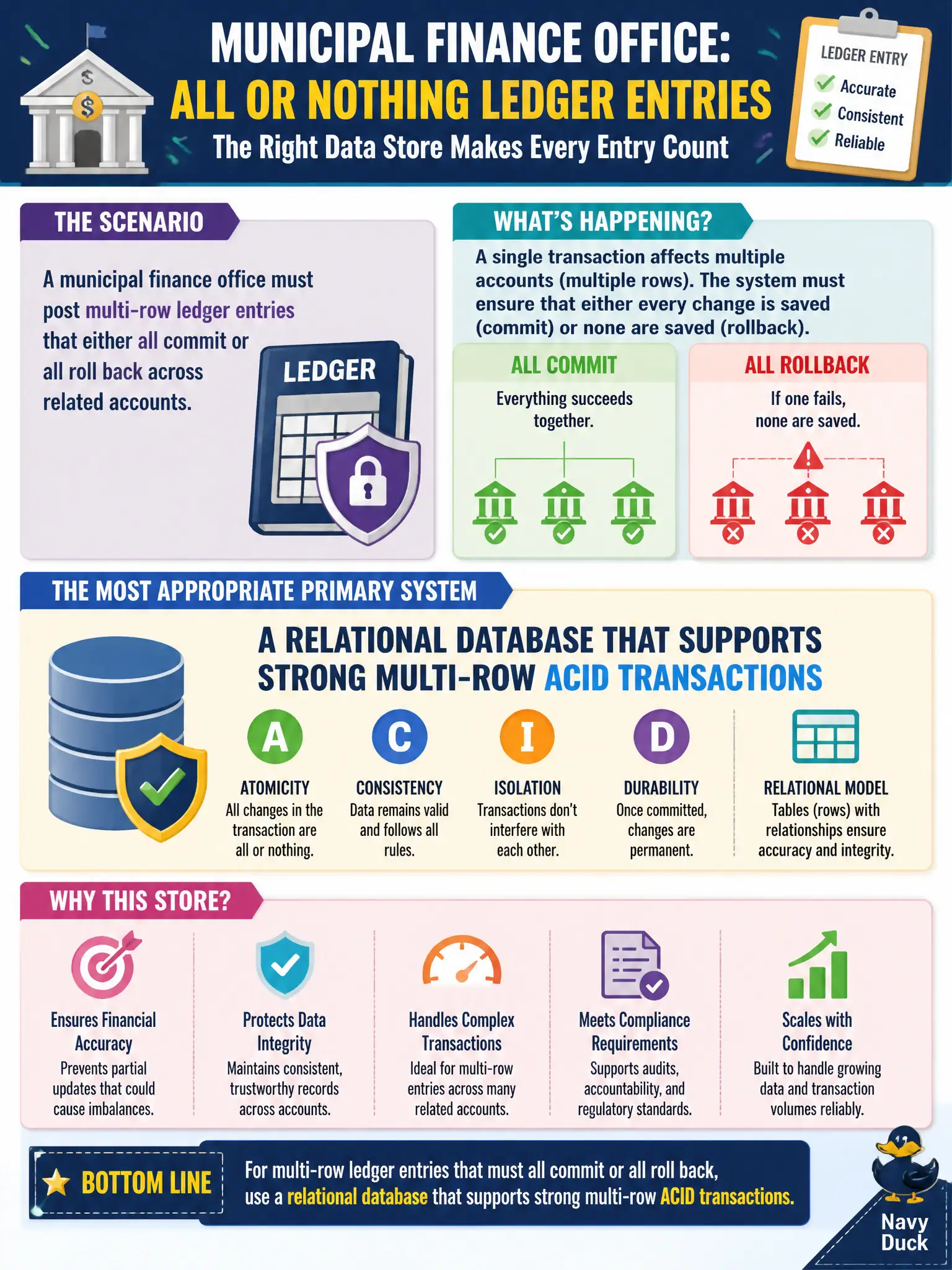
A municipal finance office must post multi-row ledger entries that either all commit or all roll back across related accounts. Which store is the most appropriate primary system?
Select an answer to reveal the explanation.
Short Explanation
City ledgers are like a balanced checkbook—every debit needs its matching credit, no half-done entries. That is classic relational ACID territory. Keep the money system on an RDBMS and save flexible NoSQL for less picky workloads.
Full Explanation
Municipal ledger posting requires multi-row atomicity: related account lines must all commit or all roll back so public financial statements stay balanced. A relational database with strong multi-row ACID transactions is the appropriate primary system for that integrity pattern. Key-value caches that expire rows after minutes optimize ephemeral lookups, not durable double-entry ledgers, and TTL would silently erase fiscal history. Graph databases excel at relationship traversal such as fraud rings, not at guaranteeing cross-account debit/credit atomicity for statutory books. A write-only append log without transactional rollback can retain events for analytics, but it does not by itself provide the all-or-nothing posting semantics finance controllers demand for day-to-day ledgers. Exam caveat: CAP and NoSQL scale arguments do not erase ACID needs; BDPC-style syllabi still place strongly transactional civic finance on relational engines even when profiles or sensors live elsewhere. Operational check: post a multi-line journal in a test ledger, force a failure mid-batch, and verify no partial balances remain visible to reports or the citizen payment portal. In production terms for multi-row civic ledger atomicity, assign an owning team, wire a dashboard that shows the pattern is healthy under peak civic load, and require a staging drill that rehearses failure and recovery before resident impact. Revisit the choice when traffic shape, retention, or integrity needs change, and keep a named rollback owner on the change record. Re-test both the happy path and the failure path for multi-row civic ledger atomicity after material dependency upgrades so regressions are caught before the next public release.