
Architects brief operations on Hadoop-style cluster roles. Which description matches the classic coordinator versus worker pattern?
Select an answer to reveal the explanation.
Short Explanation
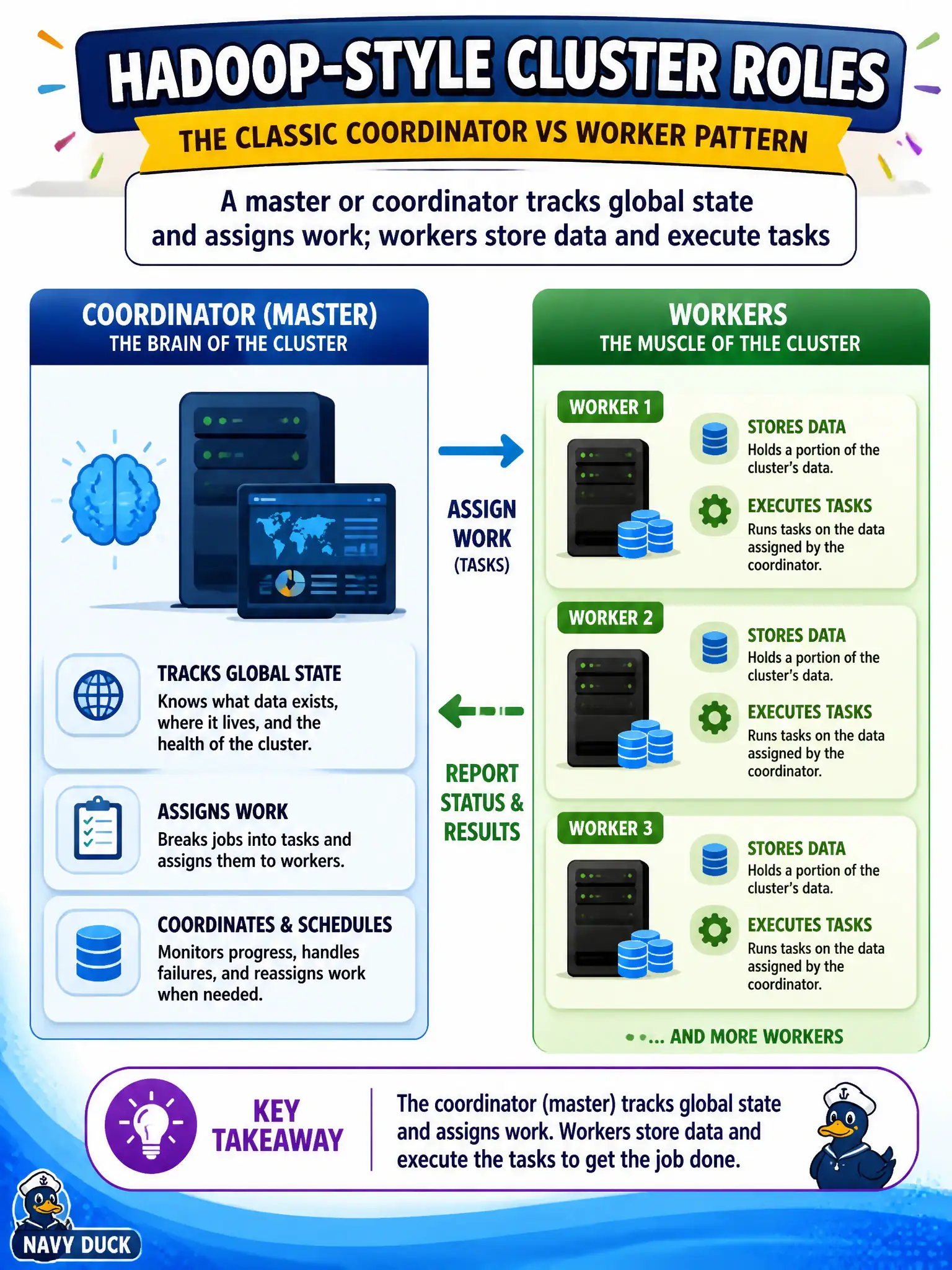
Someone keeps the map of the city; the crews do the heavy lifting on their blocks. Coordinator plans, workers store and compute.
Full Explanation
Classic Hadoop-style cluster roles follow a coordinator-versus-worker pattern: a master or coordinator tracks global state and assigns work, while workers store data and execute tasks. Municipal operations briefings should keep that mental model clear for HDFS- and YARN-style systems that utilities and cities actually operate under change control. Every node independently inventing the global file namespace with no coordinator yields inconsistency and split-brain risk across the fleet. Workers assigning work to a coordinator that only stores idle logs reverses the control flow the architecture depends on for correct scheduling. Requiring all nodes to be coordinators and none to hold data blocks removes the storage and compute workers the design needs to carry meter and sensor archives. Exam caveat: NameNode or ResourceManager-style coordination versus DataNode or NodeManager workers is the expected pattern language on BDPC. Operational check: diagram which hosts are coordinators versus workers in the city cluster, monitor coordinator high availability, ensure runbooks never instruct operators to treat any random node as namespace authority, and review that diagram after hardware refresh.