
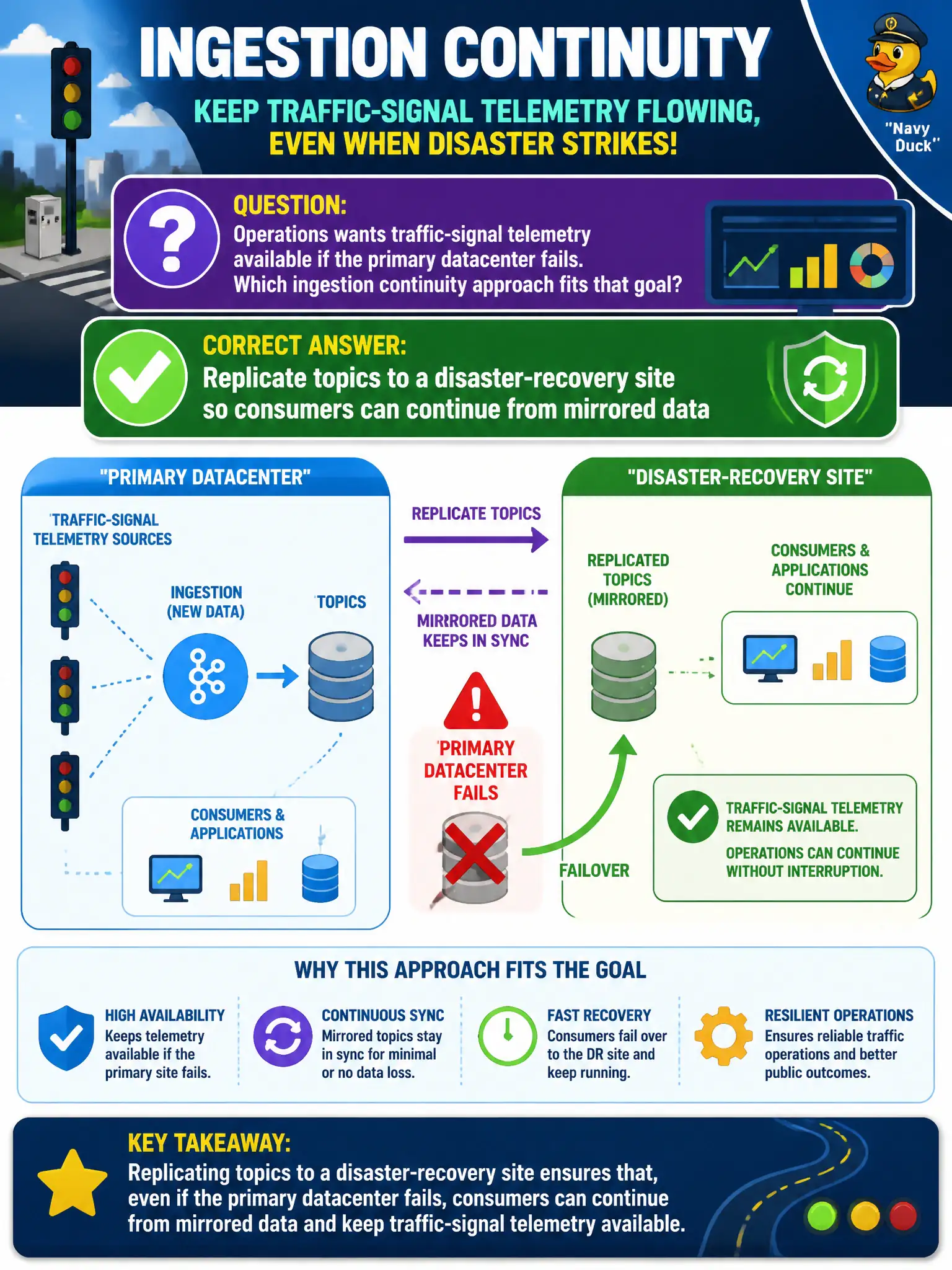
Operations wants traffic-signal telemetry available if the primary datacenter fails. Which ingestion continuity approach fits that goal?
Select an answer to reveal the explanation.
Short Explanation
If City Hall floods, you still want the signal feed alive across town. Mirroring topics to a DR site is the continuity play—not hoping spreadsheets or screenshots rebuild the bus. Same events, second home.
Full Explanation
Replicating traffic-signal topics to a disaster-recovery site mirrors the live ingestion stream so consumers can continue from secondary data after primary datacenter loss. Cross-site mirroring preserves continuity for civic telemetry far better than rebuilding history after an outage. At BDPC awareness depth, multi-datacenter replication is the continuity pattern for buses that must survive site failure.
Keeping a single datacenter topic and rebuilding from spreadsheets after an outage accepts large gaps, manual error, and slow recovery unsuitable for signal analytics that expect a continuous feed. Disabling replication so producers never wait on a second site optimizes for write latency while abandoning the stated continuity goal. Storing only dashboard screenshots offsite preserves pictures, not the event stream consumers need to resume processing.
Exam caveat: replication alone is not a complete DR plan—failover runbooks, consumer offset strategy, DNS or bootstrap endpoint changes, and RPO/RTO targets still matter. Operational check: in a controlled failover drill, point a consumer at the DR mirror, confirm it can read recent signal events without spreadsheet rebuild, and record measured lag or data-loss window against the city’s RPO.