
Flood-alert producers keep publishing while a slow emergency dashboard consumer falls behind. What ingestion design principle should the city apply?
Select an answer to reveal the explanation.
Short Explanation
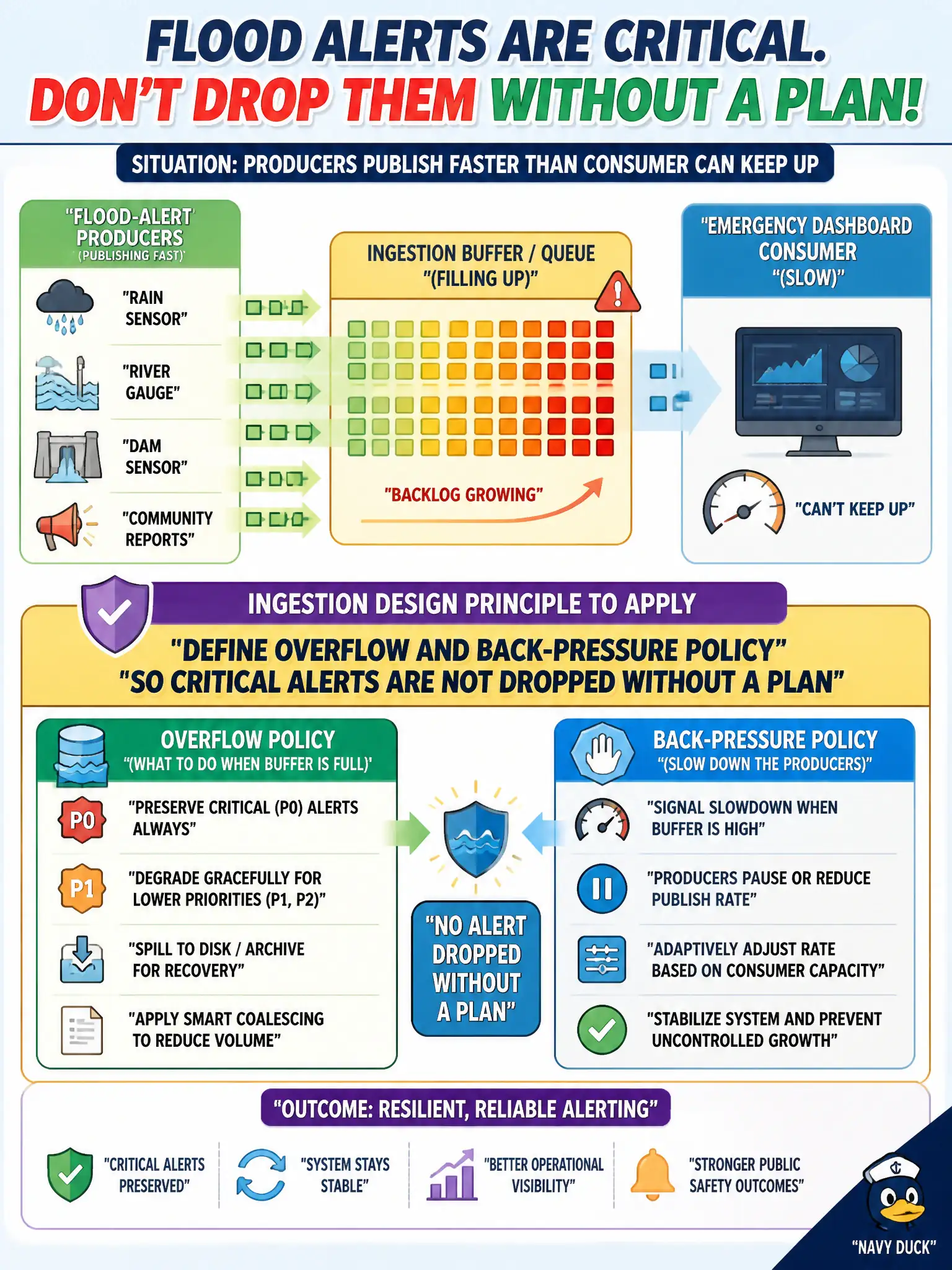
If the hose keeps pouring and the bucket lags, you need a plan—not silent leaks. Civic alert buses need clear overflow and back-pressure rules so critical messages are not tossed quietly. Slow consumers deserve policy, not hope.
Full Explanation
When flood-alert producers outpace a slow emergency dashboard consumer, ingestion design must define overflow and back-pressure policy so critical alerts are not discarded without an explicit plan. Retention limits, producer throttles, consumer scale-out, priority routes, and dead-letter or quarantine paths are examples of governed responses. Public-safety style civic topics require stated behavior under lag, not silent hope that buffers will absorb every surge.
Letting the broker silently discard critical alerts whenever consumer lag grows is an unacceptable default for emergency signaling; lost alerts become operational and accountability failures. Stopping all producers permanently the first time any consumer slows down converts a scaling problem into a citywide blackout of upstream detection. Converting every alert topic into nightly CSV files abandons the velocity that emergency dashboards need and merely relocates the backlog into batch latency.
Exam caveat: back-pressure and overflow policies should distinguish critical alert classes from lower-priority telemetry; one blunt drop-all or stop-all rule rarely fits mixed municipal buses. Operational check: simulate consumer lag in a drill, confirm whether alerts retain, throttle, or route per written policy, and verify on-call runbooks name the metric (lag, retention, drop counters) that triggers escalation.