
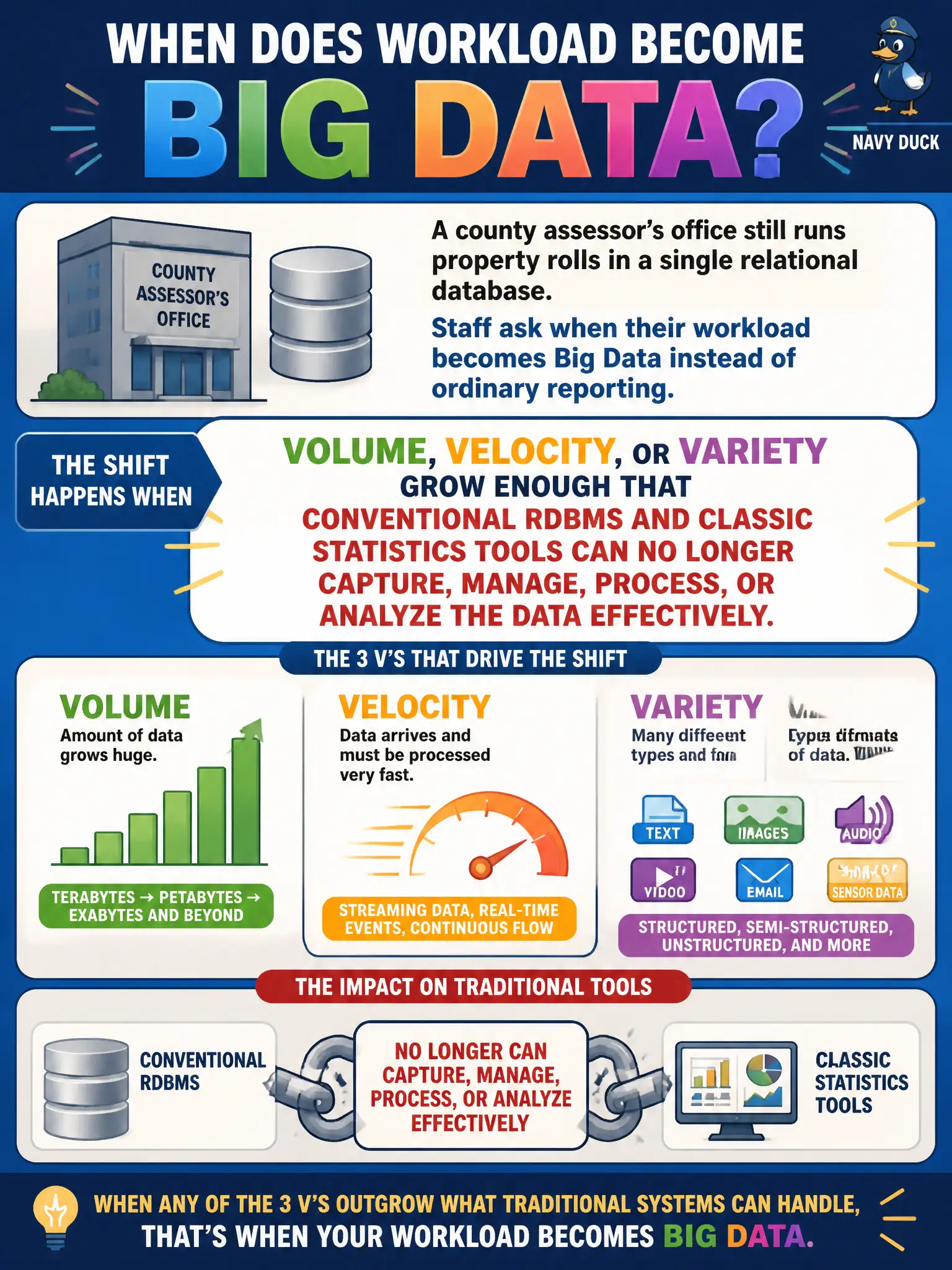
A county assessor's office still runs property rolls in a single relational database. Staff ask when their workload becomes Big Data instead of ordinary reporting. Which condition best marks that shift?
Select an answer to reveal the explanation.
Short Explanation
Big Data is not a row-count trophy. It shows up when the size, speed, or mix of the data outruns the ordinary database and reporting stack you already trust. A tidy ten-thousand-row roll is still ordinary reporting until those limits start to break.
Full Explanation
CertiProf BDPC frames Big Data as datasets whose scale, complexity, and growth make conventional capture, management, processing, and analysis hard. For a county assessor's office still on a single relational property-roll system, the shift into Big Data is therefore a tooling and workload threshold: volume, velocity, or variety grow enough that the ordinary RDBMS and classic statistics path can no longer handle the work effectively. That civic framing keeps the conversation about public-service capacity—tax rolls, appeals, and parcel updates—rather than about fashion labels for "lots of rows."
Treating any spreadsheet above ten thousand rows as automatic Big Data fails by concept: a tidy row-count trophy does not prove conventional tools have failed. Buying any commercial BI dashboard fails by concept: a product SKU is not evidence that capture, management, or analysis have crossed the Big Data threshold. Claiming that fast nightly SQL reports already prove Big Data fails by concept: finishing ordinary batch reporting quickly is the opposite signal—it shows conventional tools still succeed.
Exam caveat: BDPC marks Big Data by difficulty with conventional tools under volume, velocity, variety, and related complexity—not by arbitrary row counts, brand purchases, or report runtime bragging rights.
Operational check: Document which assessor workloads still run cleanly on the current RDBMS, list where storage, ingest latency, or format mix begin to break, and only then propose Big Data platforms tied to those measured thresholds.