
Air monitoring during concrete scarifying shows respirable crystalline silica levels at 15 times the Permissible Exposure Limit while engineering controls are being adjusted. Why must the supervisor replace the crew's half-mask elastomeric respirators?
Select an answer to reveal the explanation.
Short Explanation
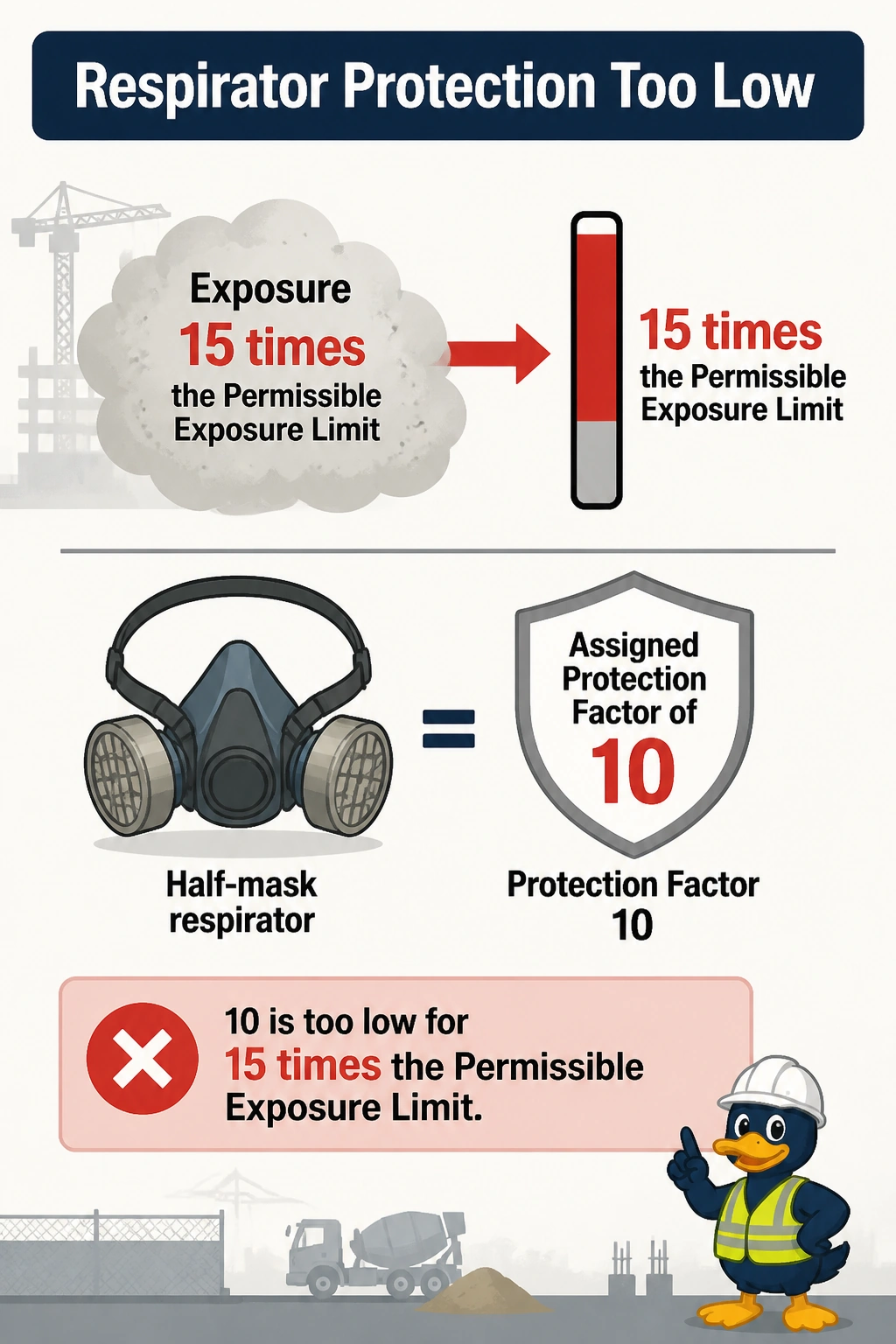
You’re right to replace the crew’s respirators: a half-mask respirator has an Assigned Protection Factor of 10, so it cannot protect you at 15 times the exposure limit. You might assume a tight-fitting respirator with P100 filters works at any dust level, but it does not. You need a respirator with a higher protection factor while controls are being adjusted.
Full Explanation
Under 29 CFR 1910.134, respirators are selected using their Assigned Protection Factor (APF), which defines the maximum workplace concentration relative to the Permissible Exposure Limit (PEL) for which they are effective. A half-mask respirator has an APF of 10, so it is inadequate at 15 times the PEL; the crew needs a respirator with a higher APF. The claim that half-mask elastomeric respirators are approved only for nuisance dust and never for silica is incorrect: properly fitted half-masks with P100 filters can be used for silica up to 10 times the PEL. The claim that elastomeric half-mask facepieces cannot be quantitatively fit tested on construction sites is also incorrect, because half-masks can undergo qualitative or quantitative fit testing. The claim that half-mask respirators require Grade D supplied air whenever silica exceeds the limit confuses air-purifying respirator limits with oxygen-deficient or immediately dangerous atmospheres. Caveat: respiratory protection must be paired with wet methods or vacuum dust collection to reduce silica exposure. Practical check: before the shift, divide the measured exposure by the PEL and confirm the selected respirator’s APF exceeds that hazard ratio.
Prefer to study offline? Printable PDF study book + test engine ($7.50, unofficial). These questions stay free here.