
A general contractor's project manager wants to name a first-year apprentice as the excavation competent person because the apprentice completed an online safety video, even though the apprentice cannot classify soil or order a crew out of a trench. Why must the site supervisor reject this assignment?
Select an answer to reveal the explanation.
Short Explanation
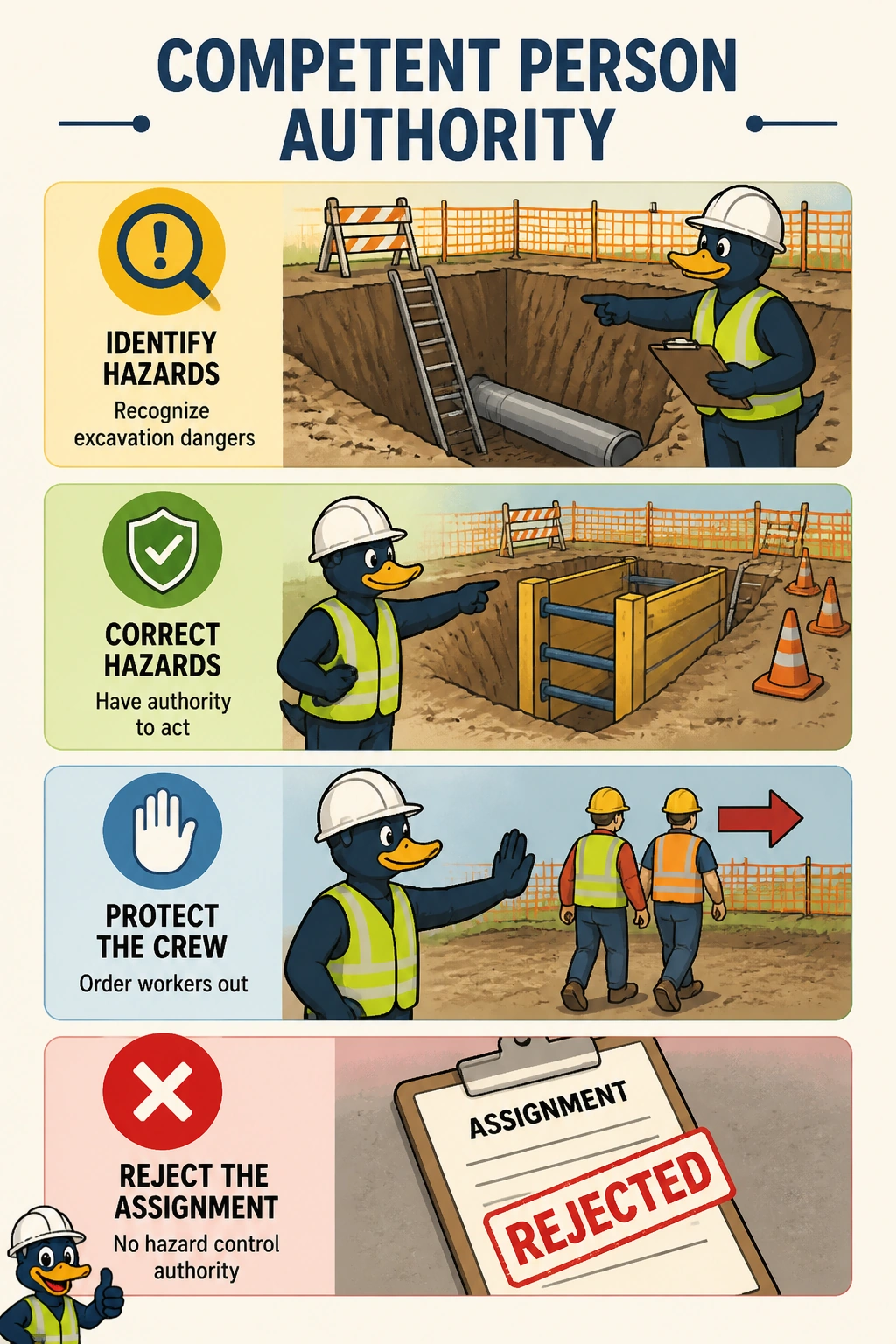
Watching a short safety video does not give someone the eyes to spot failing soil or the clout to shut down a trench. The trap is confusing a training certificate with real jobsite authority, because your competent person needs both hazard-recognition skill and the power to stop unsafe work.
Full Explanation
Under 29 CFR 1926.32(f), "A competent person must be able to identify hazards and have authority to correct them" promptly, including halting work and clearing the trench. Both capability and employer-granted authority are mandatory. Choosing to reject the apprentice because "A competent person must hold a professional engineering license before inspecting any excavation" is wrong because a registered professional engineer is only required for specific deep or non-standard protective designs, not routine daily inspections. Claiming "An excavation competent person is only required on trenches deeper than twenty feet" is false because daily competent-person inspections apply to excavations generally, not only those over twenty feet. Stating "A competent person must be an outside third-party inspector hired separately from the contractor" is also incorrect because the employer routinely designates a qualified in-house supervisor or foreman. One caveat is that completing a class alone never satisfies the standard if the worker lacks practical soil-testing knowledge or real stop-work backing. Verify the assigned competent person's soil-classification training and confirm with project leadership that they have full stop-work authority.
Prefer to study offline? Printable PDF study book + test engine ($7.50, unofficial). These questions stay free here.