
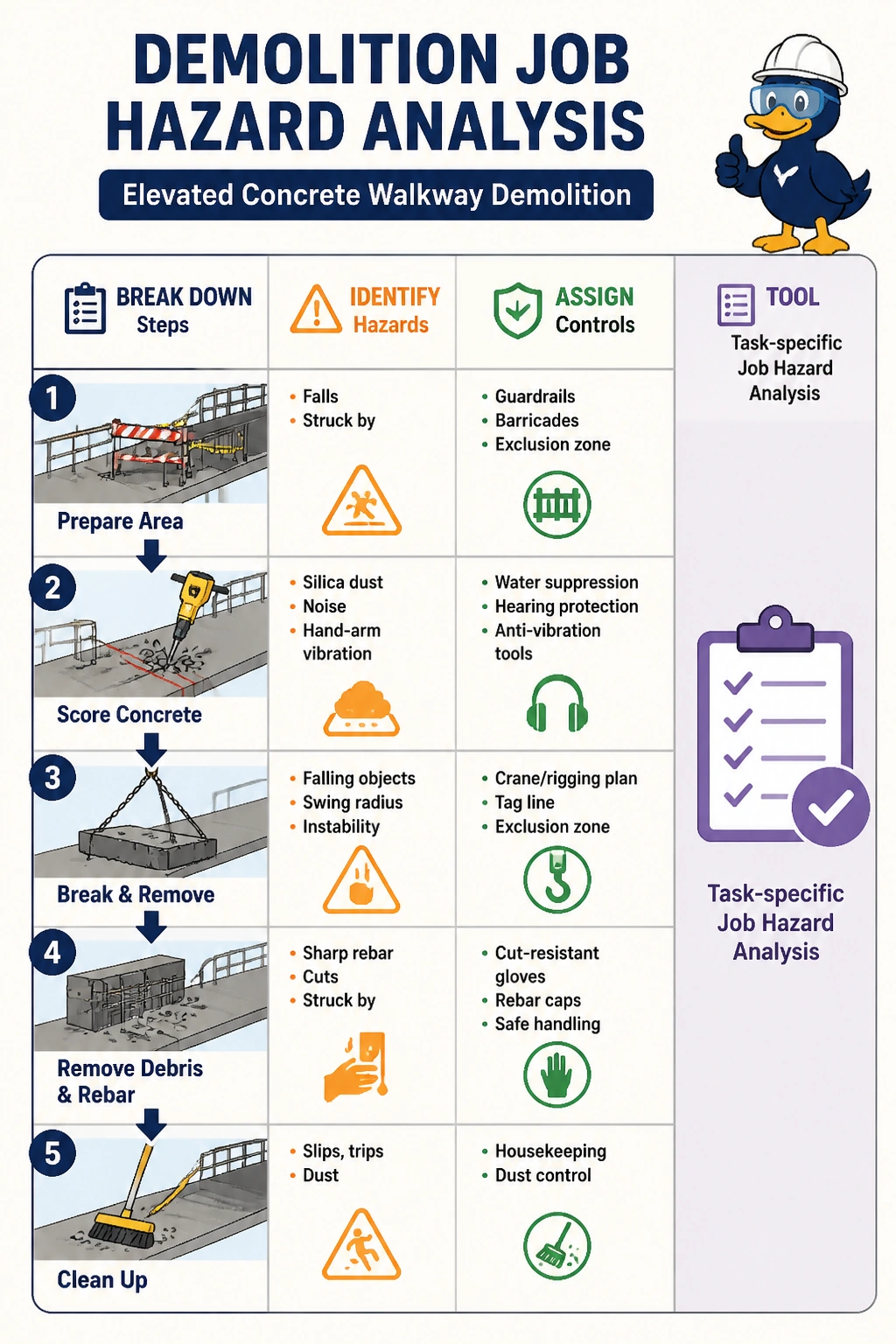
Before a crew begins demolishing an elevated concrete walkway, the safety technician helps the foreman break the task into sequential steps, identify hazards at each step, and assign controls. Which safety management tool is the team completing?
Select an answer to reveal the explanation.
Short Explanation
Breaking a risky job into step-by-step hazards before the hammer swings is the heart of proactive planning. Your trap is confusing this forward-looking task breakdown with post-incident logs or annual injury summaries. When you map out steps, hazards, and controls ahead of time, you are building a Job Hazard Analysis.
Full Explanation
When a team breaks a construction operation into sequential steps, identifies potential hazards at each stage, and assigns specific controls beforehand, it is completing A task-specific Job Hazard Analysis for the demolition sequence. This structured method focuses attention on the exact interaction between workers, tools, and changing site conditions before work starts. By contrast, An annual OSHA Form 300A injury and illness summary certification is a year-end recordkeeping tally of past work-related injuries rather than a pre-task control plan. A post-incident root cause investigation and corrective action log is reactive, performed only after an accident or near miss has already occurred. Similarly, A quarterly corporate workers' compensation loss-run audit report tracks insurance claim dollars over time instead of guiding crews through demolition hazards. As a caveat, a JHA becomes ineffective if copied verbatim from another project without adjusting for site-specific structural conditions or utility lines. For an operational check, review each demolition step with the crew on site before starting work and update the JHA whenever structural conditions change.
Prefer to study offline? Printable PDF study book + test engine ($7.50, unofficial). These questions stay free here.