
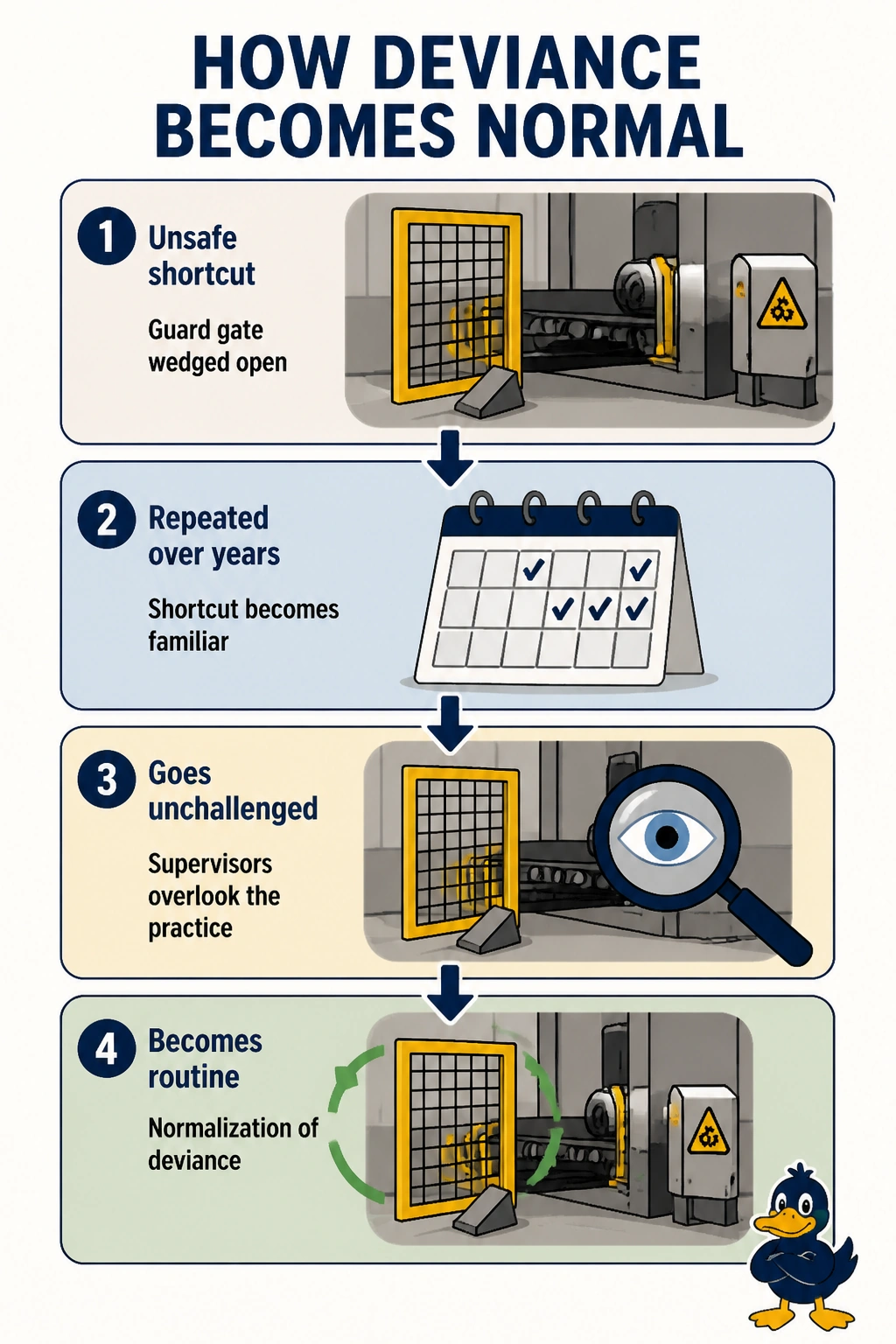
Over several years at a metal stamping plant, press operators routinely prop open an interlocked guard gate with a wooden wedge to clear scrap faster, and supervisors overlook the shortcut because no injuries have occurred yet. Which human-factor phenomenon describes how this unsafe practice became accepted as standard operating routine?
Select an answer to reveal the explanation.
Short Explanation
When nobody gets hurt after cutting a corner once, it becomes easier for your team to treat that shortcut as the new normal. The trap is blaming confirmation bias or skill decay when leadership's silence has quietly rewritten the floor rules.
Full Explanation
This scenario illustrates Normalization of deviance as repeated shortcuts go unchallenged, a cultural drift in which rule-breaking feels safe because prior violations produced no immediate injury. Confirmation bias causing supervisors to seek only positive safety audit reports describes selective attention to favorable data rather than the gradual acceptance of a known guard bypass on the production floor. Cognitive overload from excessive alarms on the stamping press console refers to mental fatigue from too many simultaneous signals, not a deliberate, long-term shortcut to speed up scrap clearing. Skill decay resulting from infrequent operation of emergency stop controls involves forgetting rarely used procedures, whereas these operators intentionally bypass a guard every shift. A key caveat is that reversing this drift requires fixing the underlying production friction—such as hard-to-clear scrap chutes—rather than simply posting reminder signs. As an operational check, conduct unannounced floor observations during scrap-clearing cycles and verify that interlocks are intact and cannot be defeated with wedges.
Prefer to study offline? Printable PDF study book + test engine ($7.50, unofficial). These questions stay free here.