
A warehouse receiver unloads drums of concentrated hydrogen peroxide labeled with the GHS pictogram showing a flame over a circle. How should the safety coordinator explain the primary hazard indicated by this specific symbol under 29 CFR 1910.1200?
Select an answer to reveal the explanation.
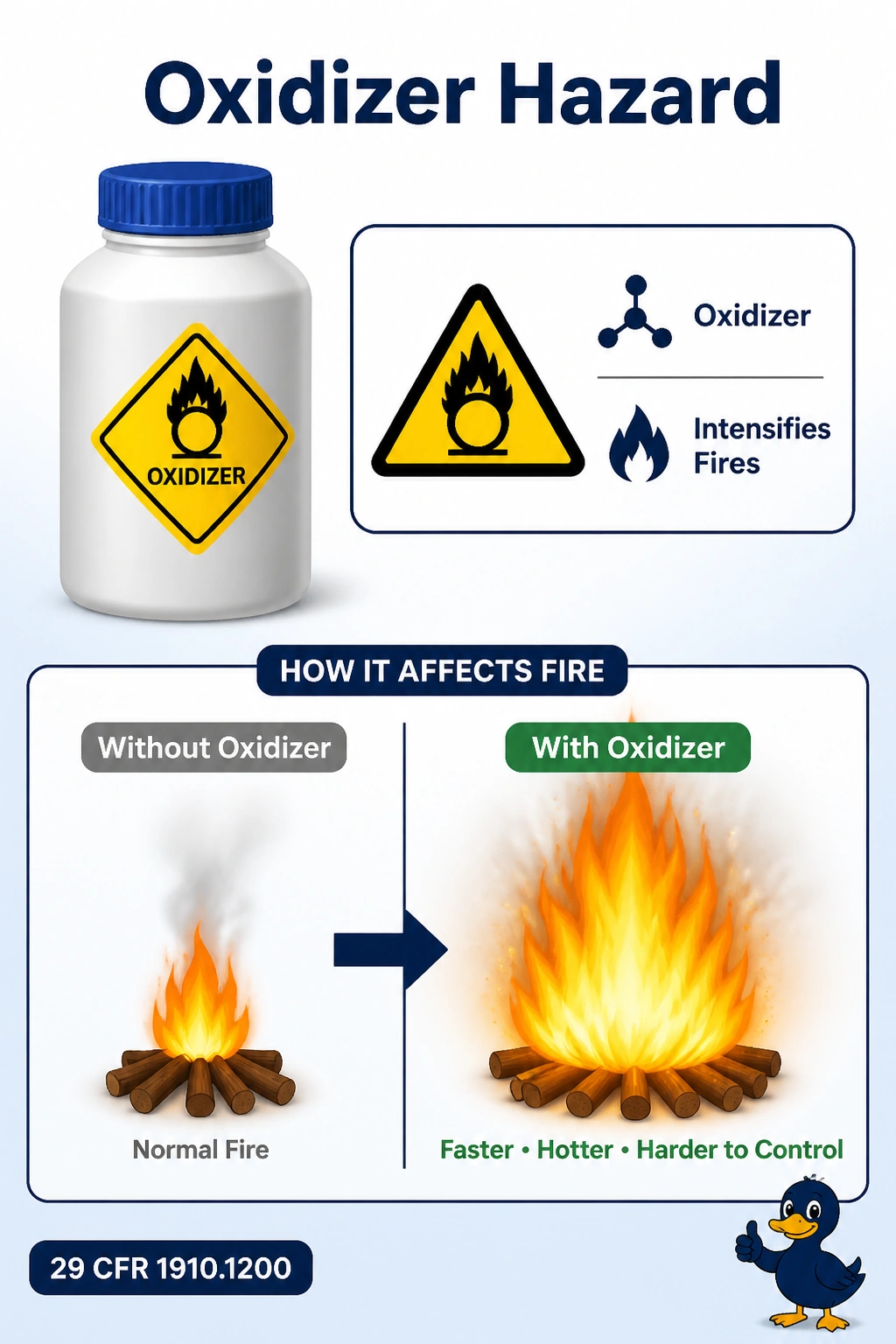
Short Explanation
That little circle under the flames makes all the difference: it signals an oxidizer that can intensify a fire, not a fuel that burns on its own. If you confuse it with a flammable liquid, you could store it beside fuels, where a small leak could turn a spark into an inferno.
Full Explanation
Under OSHA’s Hazard Communication Standard (29 CFR 1910.1200), GHS pictograms communicate specific hazards at a glance. The flame over a circle indicates an oxidizer that can intensify fires by supplying oxygen or another oxidizing agent to support combustion, even in the absence of air. A flammable liquid with a low flash point is a fuel that can ignite readily; it does not describe the oxidizing hazard shown by this symbol. A compressed gas stored under pressure is indicated by a gas-cylinder pictogram, not a flame over a circle. An explosive that detonates on impact is associated with an exploding-bomb pictogram, not this symbol. As an exam caveat, concentrated hydrogen peroxide may also carry other pictograms, such as corrosion for skin and eye burns, so you should check every symbol on the label. As a practical check, audit storage racks to ensure oxidizers are segregated from flammable solvents, organic materials, and reducing agents.
Prefer to study offline? Printable PDF study book + test engine ($7.50, unofficial). These questions stay free here.