
During a warehouse audit, an observer notices an overhead bridge crane operator routinely hoisting loads until the upper limit switch trips to stop the hook at the top of its travel. Why must this practice be prohibited?
Select an answer to reveal the explanation.
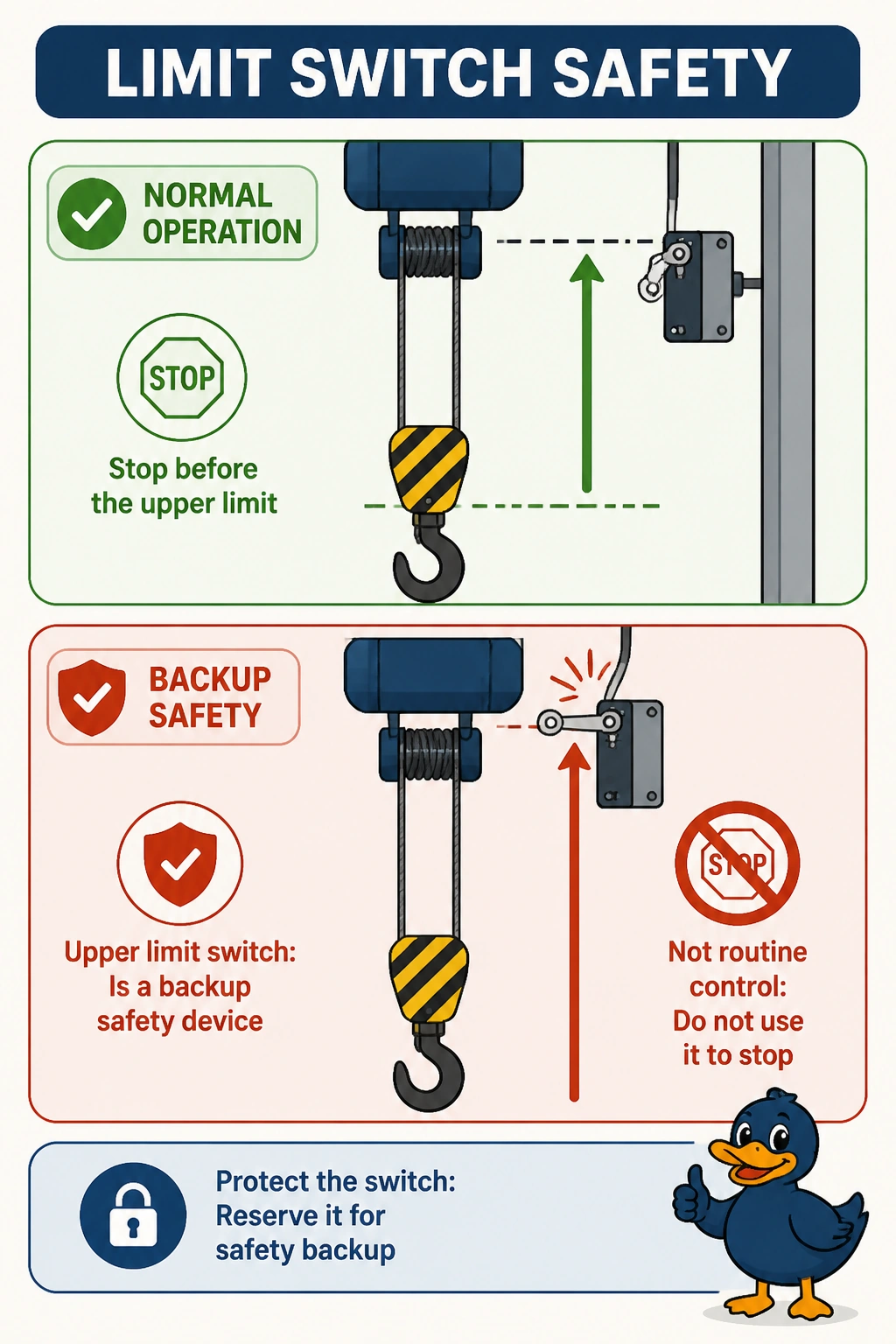
Short Explanation
Relying on an overhead crane's upper limit switch to stop every lift is like using your car's airbag to park in the garage. The trap is assuming that because the switch stops the hook reliably today, it is built for routine cycling—until a worn switch fails and causes a two-blocking incident.
Full Explanation
Under OSHA 29 CFR 1910.179, this practice must be prohibited because the upper limit switch is a backup safety device, not a routine operating control. Its purpose is to prevent the hook block from colliding with the drum or sheave assembly (two-blocking), which can snap the wire rope and drop the load; wearing out the switch through daily cycling removes that final safeguard. The idea that tripping the limit switch automatically locks out the crane's main electrical disconnect is inaccurate, because upper limit switches interrupt the hoisting circuit while typically allowing lowering so the operator can recover safely. The claim that repeated limit-switch activation voids the manufacturer's wire-rope sling load rating confuses crane electrical controls with rigging hardware ratings. Similarly, the statement that using the limit switch reverses the hoist motor polarity and drops the suspended load misstates how hoist limiters function, as they open the up-travel control circuit rather than reversing power. Caveat: operators must still test the upper limit switch at the start of each shift with an empty hook at slow speed. As an operational check, observe crane lifts during floor walks to verify operators stop hoisting manually well below the upper limit.
Prefer to study offline? Printable PDF study book + test engine ($7.50, unofficial). These questions stay free here.