
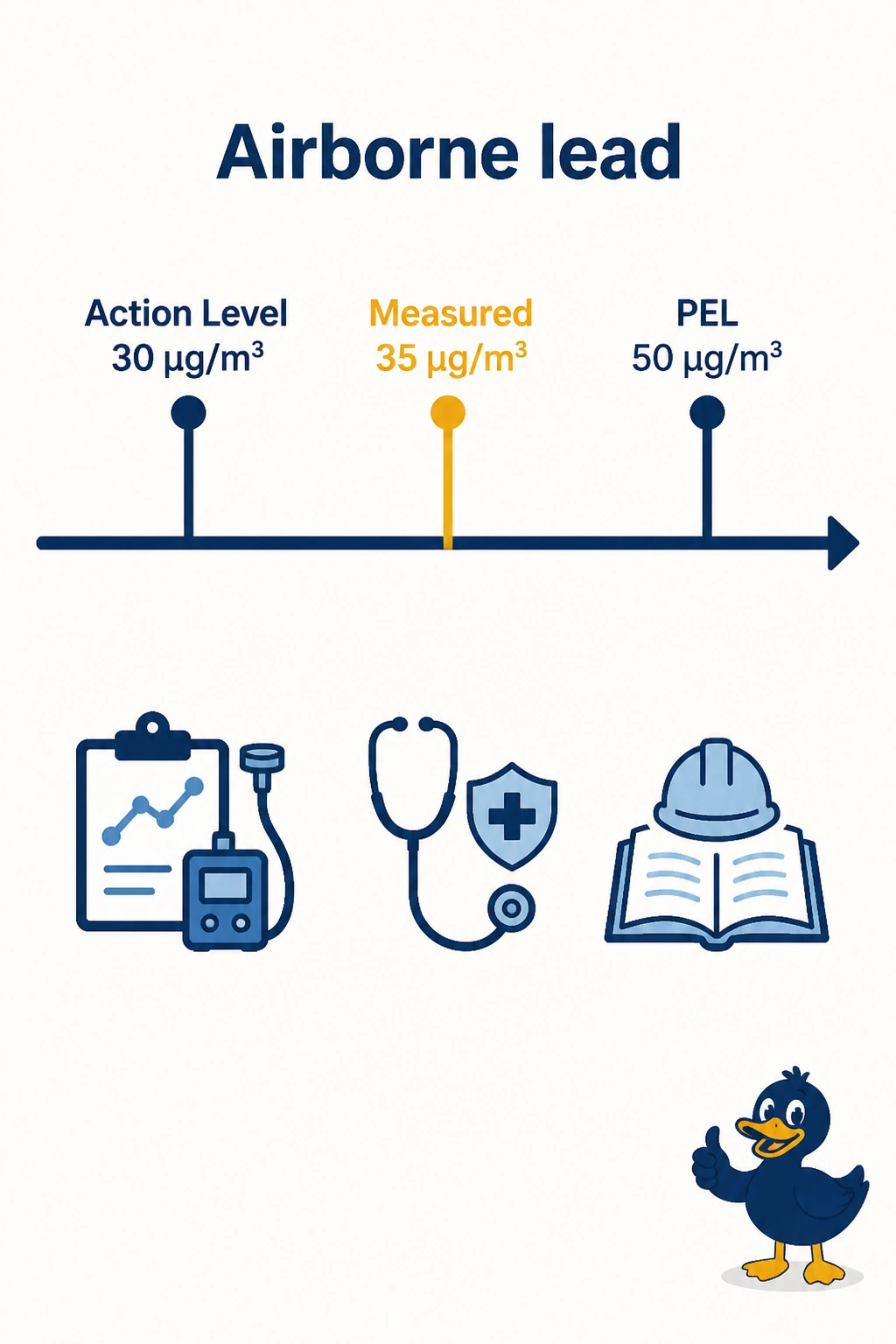
Air-sampling results in a battery-manufacturing plant show airborne lead concentrations averaging 35 micrograms per cubic meter, exceeding OSHA's Action Level of 30 micrograms per cubic meter but remaining below the 50-microgram Permissible Exposure Limit. What does exceeding the Action Level require?
Select an answer to reveal the explanation.
Short Explanation
Think of the OSHA Action Level as a yellow warning light: your exposure is still below the legal limit, but you need to begin monitoring, health checks, and training. You don’t need to evacuate the line just because results exceed the Action Level, and you shouldn’t ignore them until the Permissible Exposure Limit is reached.
Full Explanation
Under OSHA’s Lead standard (29 CFR 1910.1025), the Action Level of 30 micrograms per cubic meter is an early-warning threshold below the 50-microgram Permissible Exposure Limit (PEL) as an 8-hour TWA. Exceeding the action level requires periodic monitoring and training, and it requires medical surveillance when that exposure is at or above the action level for more than 30 days in a year. At 35 micrograms per cubic meter, repeat air monitoring at least every six months under paragraph (d) and training under paragraph (l) apply, with surveillance under paragraph (j)(1)(i) when the 30-day criterion is met, so rising exposures are caught before chronic illness develops. Evacuating the production line until levels reach zero confuses a routine Action Level exceedance with an emergency requiring evacuation. Mandatory citation penalties for violating the legal exposure limit are not triggered merely by exceeding the Action Level: it is not the 8-hour TWA PEL, and results below the PEL do not establish a PEL violation. Taking no action until average exposures exceed the legal limit defeats the Action Level’s preventive purpose and fails to meet OSHA’s substance-specific requirements.
Prefer to study offline? Printable PDF study book + test engine ($7.50, unofficial). These questions stay free here.