
Stockroom associates at a wholesale pharmacy lift 25-pound cartons from a pallet on the floor to a waist-high conveyor, standing two feet back from the load because a fixed guard rail blocks closer access. Which ergonomic principle explains why removing that barrier to let workers stand closer lowers back-injury risk?
Select an answer to reveal the explanation.
Short Explanation
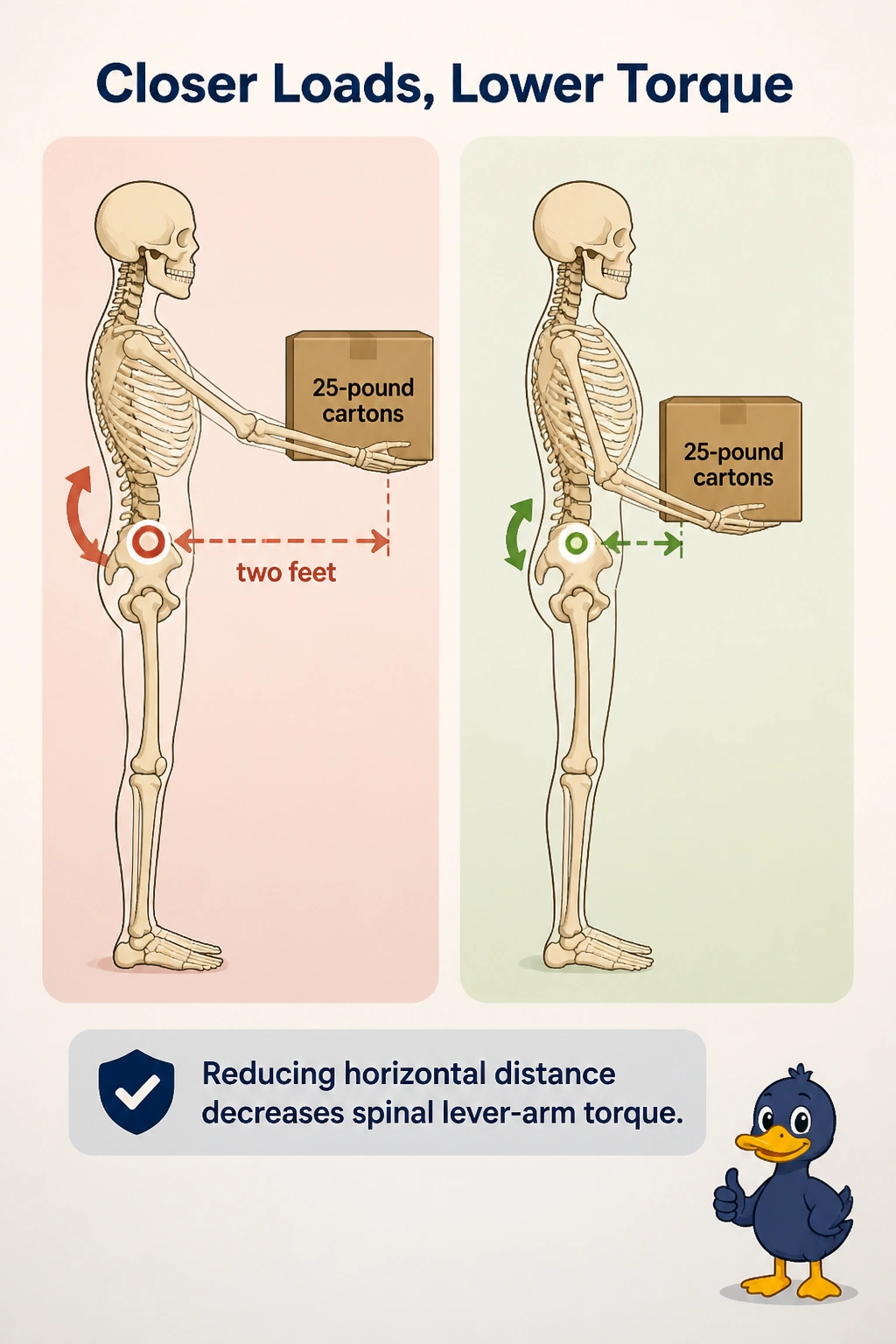
Hold a heavy carton close to your chest and it feels manageable, but hold it at arm's length and your lower back immediately protests. The trap is overlooking how a simple physical barrier forces a long reach, multiplying spinal stress even on moderate weights.
Full Explanation
Reducing horizontal distance decreases spinal lever-arm torque because the lower back acts like a fulcrum, and shortening the horizontal moment arm between the ankles and the load's center of mass sharply lowers compressive and shear forces on the lumbar discs. Increasing vertical travel distance speeds up the lift cycle is incorrect because longer vertical travel increases muscular work and fatigue rather than reducing back strain. Twisting the torso shifts load weight onto stronger leg muscles is false because spinal rotation while lifting creates uneven shear stress on intervertebral discs and raises injury risk instead of protecting the back. Raising the coupling quality eliminates all lumbar disc pressure overstates what handholds can do; good handles improve grip security, yet they never eliminate spinal loading caused by awkward reach. Keep in mind as a caveat that removing the barrier must still leave adequate pedestrian or equipment protection if the rail guarded an adjacent aisle. For a concrete operational check, measure the horizontal reach from the worker's ankles to the carton center before and after modifying the workstation and recalculate the NIOSH Recommended Weight Limit.
Prefer to study offline? Printable PDF study book + test engine ($7.50, unofficial). These questions stay free here.