
An ergonomics team evaluates a warehouse palletizing task using the Revised NIOSH Lifting Equation and calculates a Lifting Index (LI) of 1.8 for the current box weight and reach geometry. What does an LI of 1.8 indicate?
Select an answer to reveal the explanation.
Short Explanation
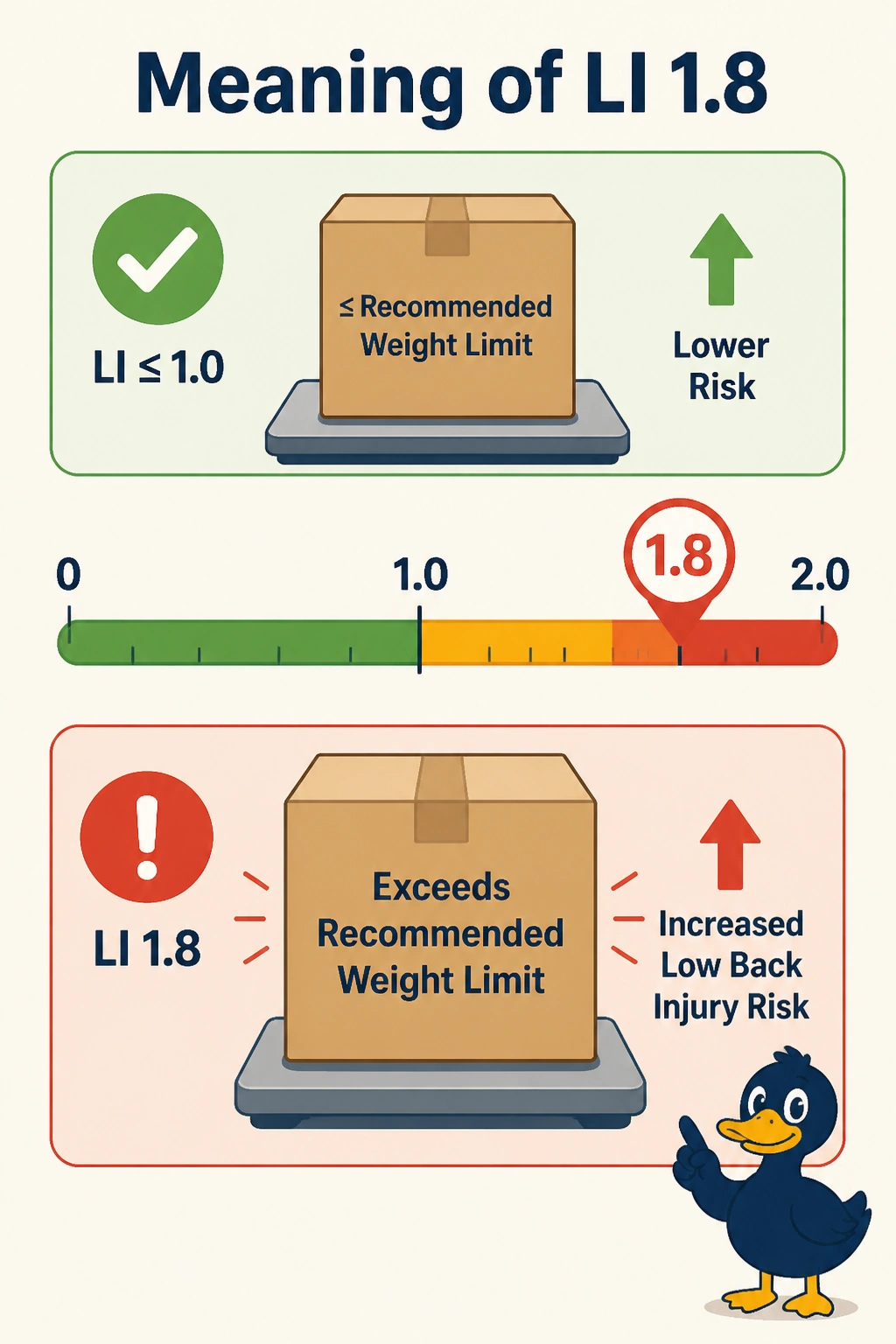
You can read a Lifting Index of 1.0 as the point where the load reaches the Recommended Weight Limit; at 1.8, the load exceeds that limit and carries increased low back injury risk. Remember, 1.0—not 2.0—is the benchmark, so being below 2.0 does not make the task safe for nearly all healthy workers.
Full Explanation
In the Revised NIOSH Lifting Equation, the Lifting Index (LI) is the actual Load Weight divided by the Recommended Weight Limit (RWL). An LI of 1.8 means the load is 1.8 times the RWL, so the load exceeds the Recommended Weight Limit and poses increased low back injury risk for some fraction of the workforce. The claim that the task is safe for nearly all healthy workers because the index remains below 2.0 misreads the benchmark: 1.0, not 2.0, is the point above which risk increases. Saying the box weight is 1.8 times lighter than the maximum permissible lifting limit for the shift reverses the ratio; an LI above 1.0 means the load is heavier than the RWL, not lighter. The claim that only workers with pre-existing spinal injuries face elevated risk overlooks that healthy workers also experience higher rates of lifting-related low back disorders as the LI rises above 1.0. As an exam caveat, the equation assumes smooth, two-handed lifting with adequate coupling and does not apply to one-handed lifts, pushing, or carrying. For a practical check, recalculate the horizontal, vertical, and asymmetric multipliers to identify which workstation change—such as bringing pallets closer to the body—could reduce the LI to 1.0 or below.
Prefer to study offline? Printable PDF study book + test engine ($7.50, unofficial). These questions stay free here.