
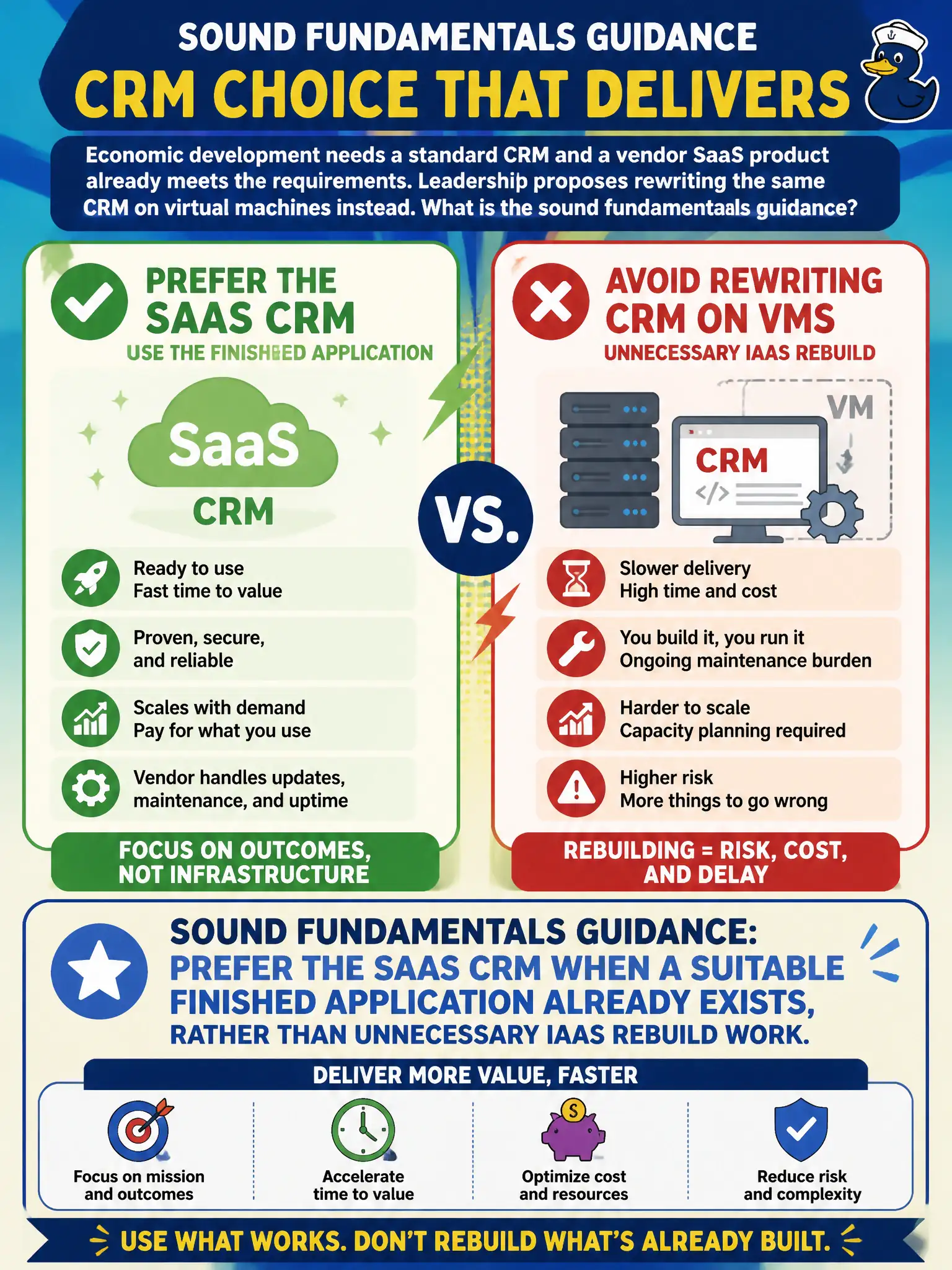
Economic development needs a standard CRM and a vendor SaaS product already meets the requirements. Leadership proposes rewriting the same CRM on virtual machines instead. What is the sound fundamentals guidance?
Select an answer to reveal the explanation.
Short Explanation
If the off-the-shelf SaaS CRM already fits, do not rebuild the same thing on VMs just to say you did cloud. That is paying for lumber when the furniture is already in the showroom. Fundamentals wisdom: pick SaaS when the finished app is good enough.
Full Explanation
When a vendor SaaS CRM already meets economic development requirements, fundamentals guidance is to prefer that finished application rather than rebuilding equivalent capability on virtual machines. SaaS avoids unnecessary IaaS design, patching, and application maintenance when the commodity CRM fit is already good. Cloud adoption is about matching responsibility to need, not maximizing custom infrastructure for its own sake.
Always rebuilding every CRM on IaaS so the city can "claim a custom cloud service type" is anti-pattern spending and operational drag. Availability zones improve resiliency inside a region; they do not include a built-in municipal CRM. Choosing empty PaaS VMs—and the distractor's wording itself confuses PaaS with VMs—misses that SaaS absolutely can host customer-facing business applications when the product fits.
Exam caveat: "prefer SaaS when suitable" still allows exceptions for unique regulatory workflows, deep on-premises integration, or missing features; the point is to justify a rebuild with requirements, not habit.
Operational check: score the SaaS CRM against must-have fields, integration with municipal identity, data export, and records retention; only open an IaaS or PaaS rebuild proposal if documented gaps remain after that fit assessment.