
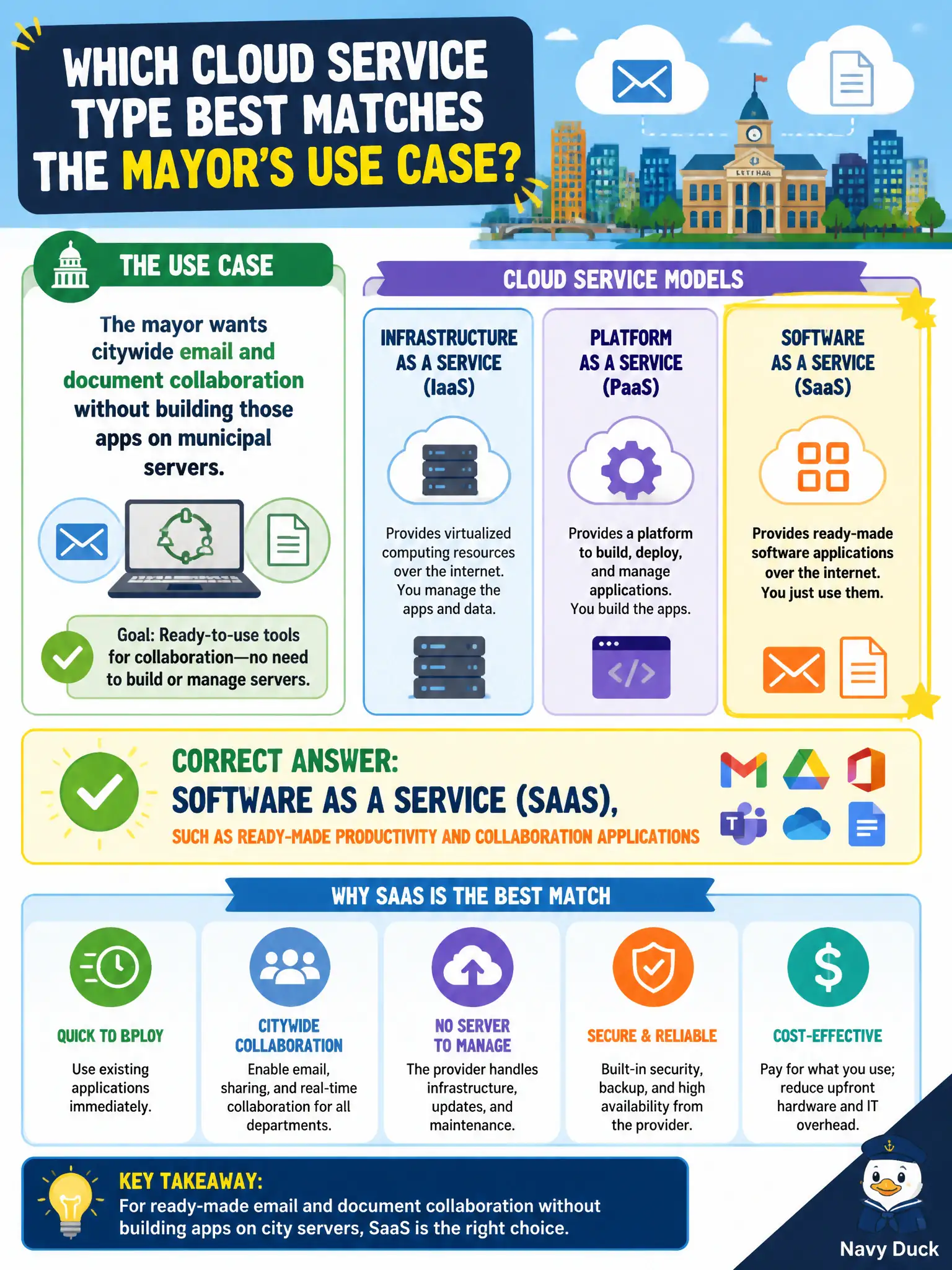
The mayor wants citywide email and document collaboration without building those apps on municipal servers. Which cloud service type best matches that use case?
Select an answer to reveal the explanation.
Short Explanation
Citywide email and docs are the classic just-give-us-the-finished-office-suite ask — that is SaaS. Nobody on this requirement is asking to compile a mail server on a VM or invent documents from an empty platform plan. Grab the ready-made productivity apps and move on.
Full Explanation
Citywide email and document collaboration without building those applications on municipal servers is the textbook Software as a Service use case. SaaS productivity and collaboration suites deliver finished mailbox, document, and sharing experiences operated by the provider. Leadership gets working collaboration quickly because the city consumes the application rather than compiling mail servers or inventing a document platform on empty infrastructure.
IaaS virtual machines used to compile a mail server from source invert the requirement: that path maximizes build and patch work the mayor explicitly wants to avoid. Empty PaaS App Service plans without collaboration features likewise fail—they are a hosting platform for custom apps, not a finished email and documents product. Availability zones are an in-region resiliency construct; they do not provision mailboxes or act as a cloud service type for collaboration.
Exam caveat: adopting SaaS collaboration still demands identity lifecycle, conditional access, retention, and eDiscovery design; moving mail off city servers does not remove public-records or security obligations.
Operational check: align tenant identity with municipal directory sources, set retention and litigation-hold policies before migration waves, and pilot a department to validate external sharing controls for council packets and citizen correspondence.