
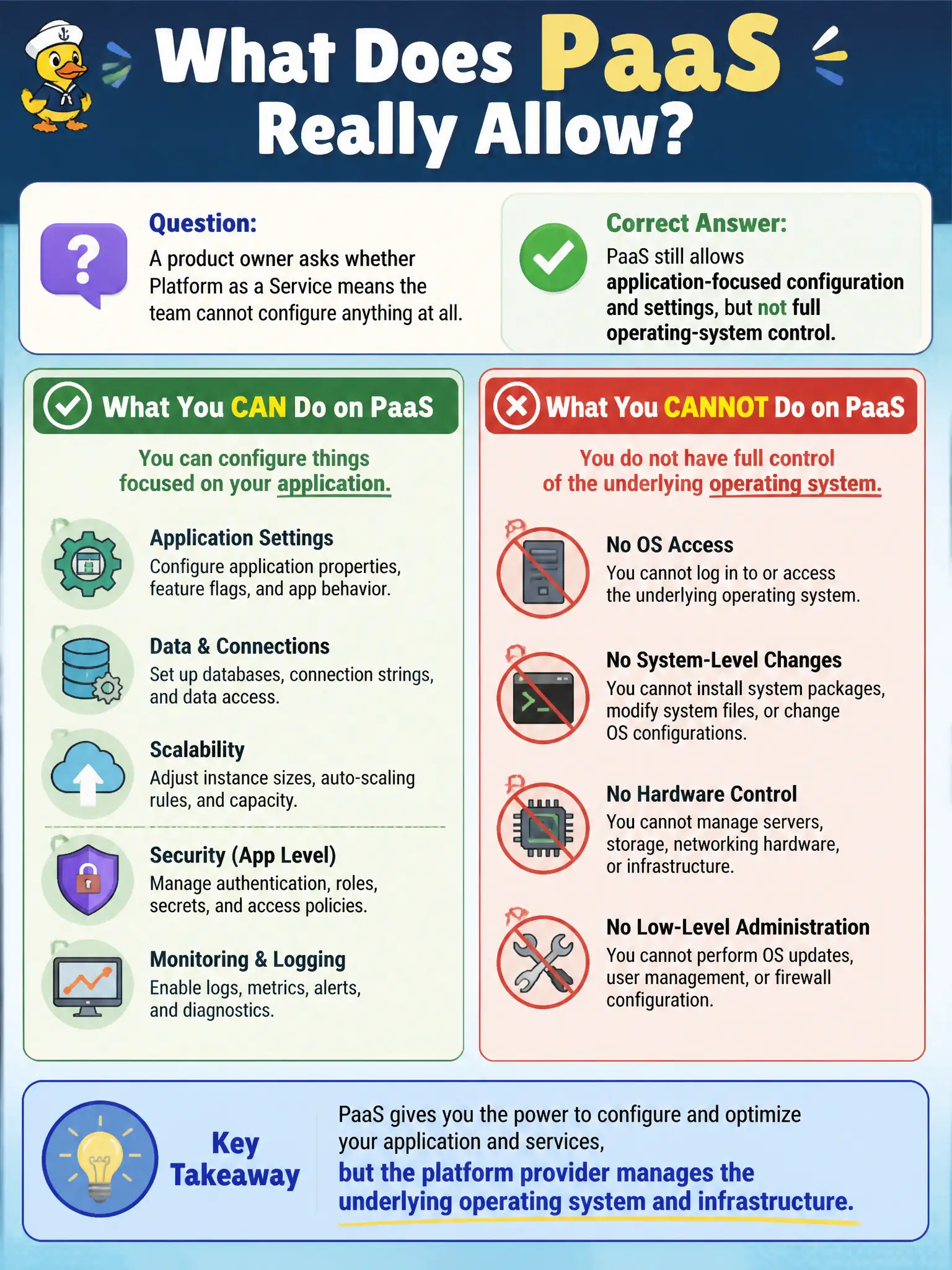
A product owner asks whether Platform as a Service means the team cannot configure anything at all. Which clarification is accurate?
Select an answer to reveal the explanation.
Short Explanation
PaaS is not a locked glass box with zero knobs — you still tune app settings, you just do not get the full OS steering wheel. Think 'configure the app,' not 'rebuild the kernel.' That boundary is the definition sweet spot.
Full Explanation
PaaS still allows application-focused configuration and settings while withholding full operating-system control. Product owners can tune app settings, connection strings, scaling rules, deployment slots, and related platform options without rebuilding kernels or installing drivers. The accurate fundamentals statement is app-focused configurability without full OS ownership—not a locked glass box with zero knobs. PaaS does not permanently lock every setting so no app configuration is possible; that extreme misstates the model. PaaS does not include unrestricted kernel and driver installation rights—that depth belongs to IaaS virtual machines. PaaS is not identical to IaaS for guest OS patching duties; those duties largely shift to the provider on PaaS, which is why teams choose it when they want to escape OS babysitting. Exam caveat: “less control” on PaaS means less OS control, not zero configuration—exam questions often probe that nuance with product-owner wording. Operational check: list which settings the team can change in the PaaS portal versus which OS-level changes are unavailable, and align stakeholder expectations with that documented boundary before go-live. Brief product owners that platform knobs exist for the application layer, while kernel, driver, and guest OS patching remain out of scope on PaaS.