
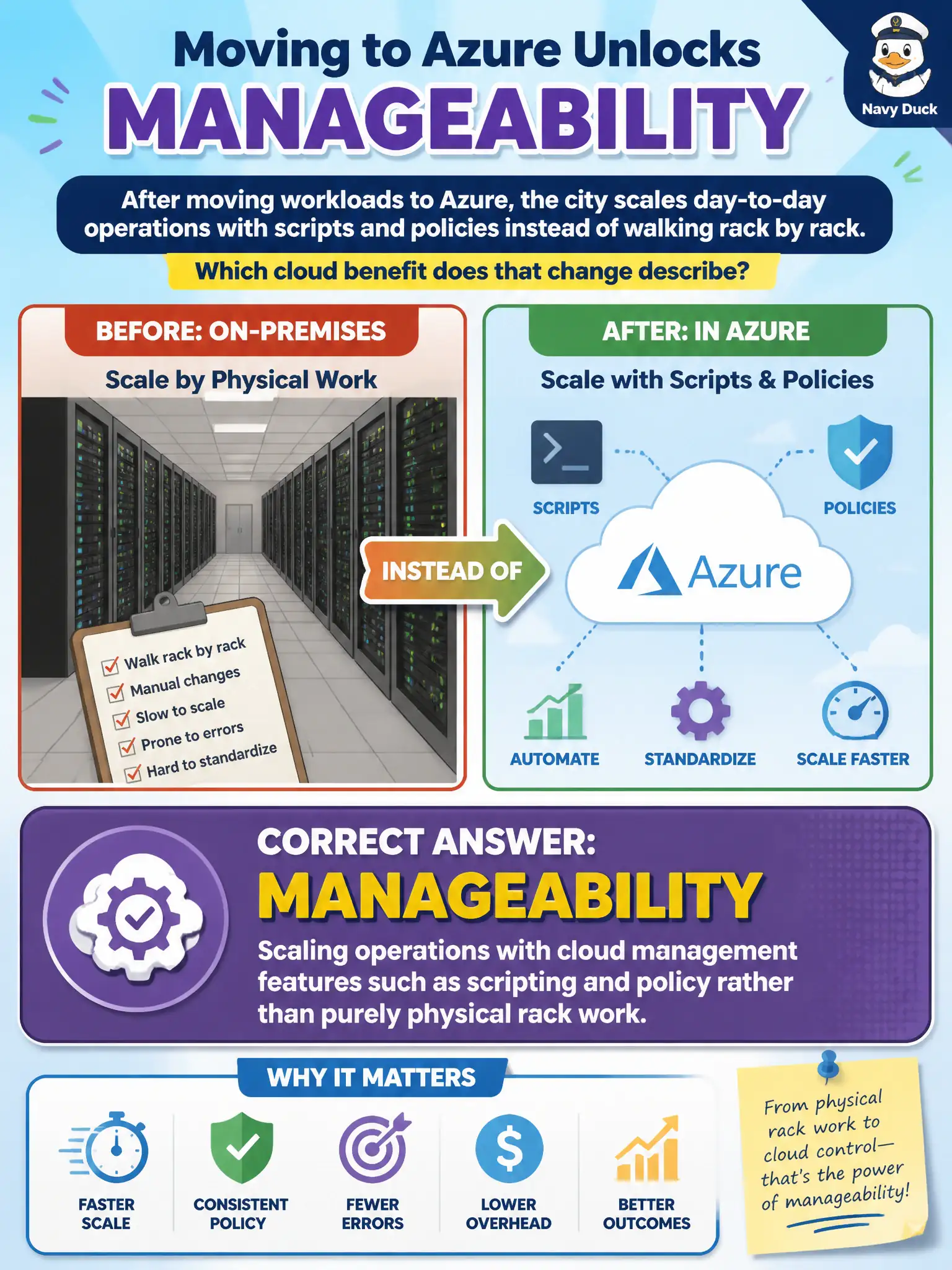
After moving workloads to Azure, the city scales day-to-day operations with scripts and policies instead of walking rack by rack. Which cloud benefit does that change describe?
Select an answer to reveal the explanation.
Short Explanation
When ops shifts from sneakers-in-the-aisle to scripts and policies, manageability is doing the heavy lifting. Cloud management features let a small team cover more ground. Mapping apps and prepaid boxes alone do not explain that ops change.
Full Explanation
Manageability covers scaling day-to-day operations with cloud management features—scripting, policy, and related tooling—rather than walking rack by rack after workloads move to Azure. Small municipal teams cover more estate when operations shift to the management plane and repeatable controls replace aisle-by-aisle touch labor. The change described is operational practice, not a new mapping product or a purchase order. Geospatial mapping features in Microsoft 365 are productivity capabilities, not the ops-scaling benefit described here. Prepaid hardware reservations change purchasing and capacity commitments, not the operational practice of rack walking. Public IP addresses without a management plane do not explain scripting-and-policy operations or reduced physical touch. Exam caveat: fundamentals wants recognition of the manageability benefit, not production runbook authorship or advanced automation certifications beyond AZ-900 scope. Operational check: replace at least one recurring rack-side chore with a scripted or policy-backed cloud operation, verify the change is documented for the ops team, and confirm rollback or exception handling is clear. Treat scripting and policy as the new default path for repetitive changes, and reserve physical rack work for exceptional hardware events only.