
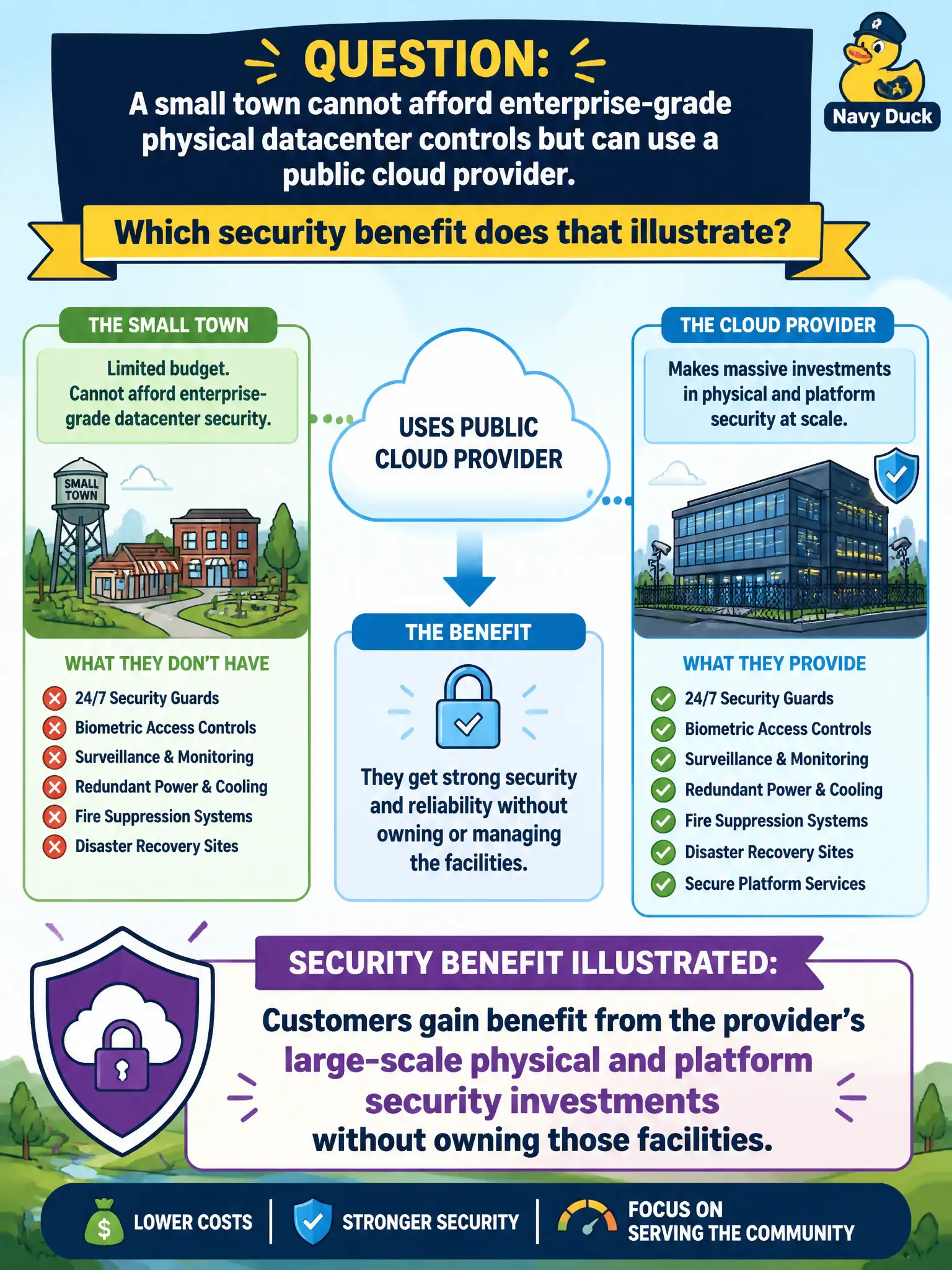
A small town cannot afford enterprise-grade physical datacenter controls but can use a public cloud provider. Which security benefit does that illustrate?
Select an answer to reveal the explanation.
Short Explanation
Small towns rarely build fortress datacenters — providers already did, at huge scale. Using public cloud lets you benefit from that physical and platform security investment without owning the building. You still share other duties, but the facility muscle is part of the security benefit.
Full Explanation
A recognized cloud security benefit is access to provider-scale physical and platform security investments that a small town could not fund alone—facility controls, monitoring, hardened platforms, and continuous investment without owning those buildings. Customers consume that benefit through public cloud without constructing a global facility footprint or hiring a 24×7 facility security staff. The contrast with “we cannot afford enterprise-grade physical controls locally” is intentional teaching. Public cloud does not forbid provider physical security investment; the opposite is true at hyperscale. Treating physical security as only an on-premises CapEx topic misses that fundamentals lists security benefits that include provider facility strength as part of the value of adopting cloud. Exam caveat: benefiting from provider physical security does not erase customer logical-security duties such as identity, access, and data protection under shared responsibility. Operational check: document which facility and platform controls the provider covers for the town’s subscriptions, then list remaining customer-owned controls so leadership does not confuse “we use cloud” with “we own zero security work.”