
Staff hear “serverless” and assume there are literally no servers anywhere. What is the accurate fundamentals explanation?
Select an answer to reveal the explanation.
Short Explanation
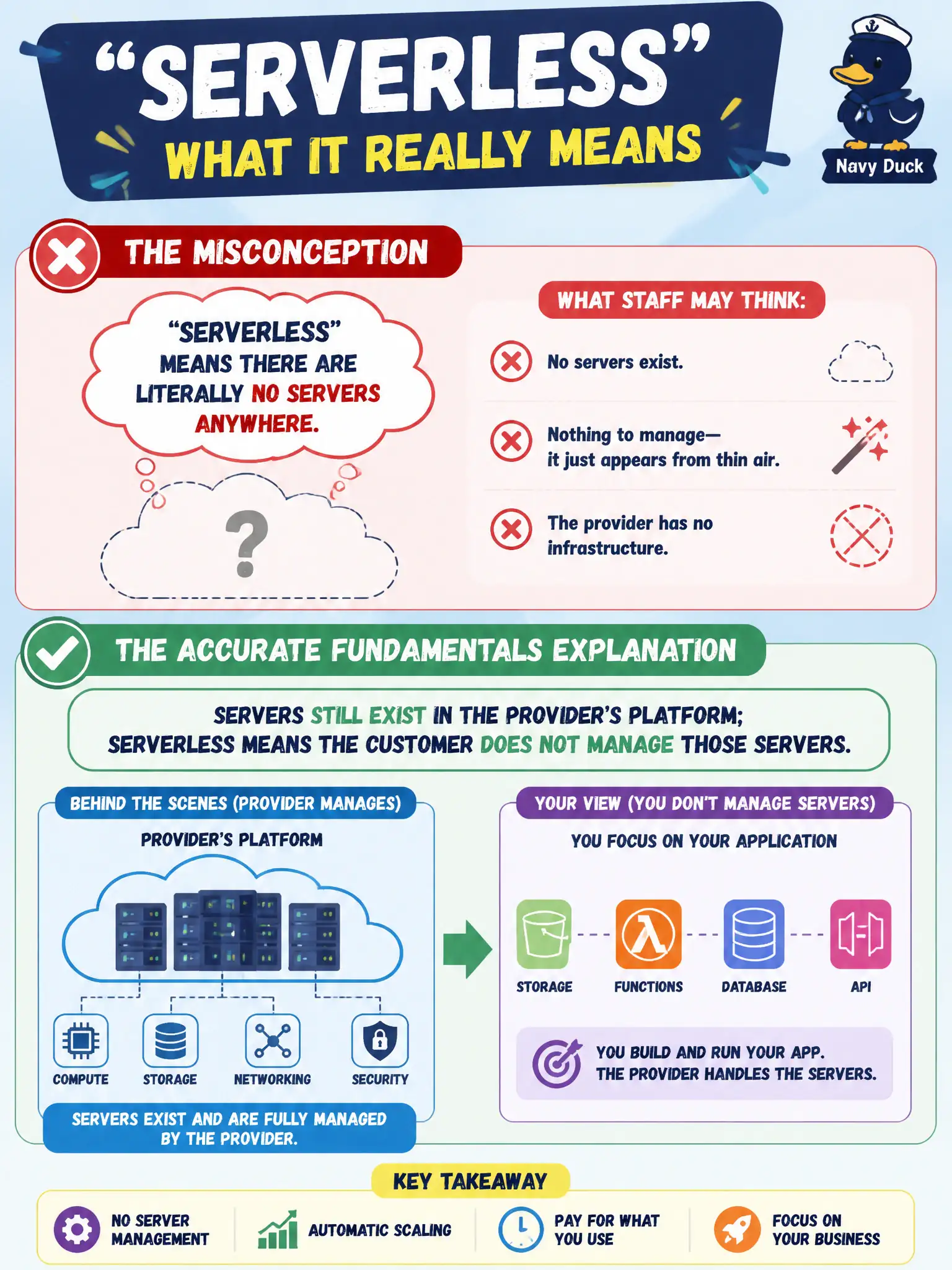
“Serverless” is a marketing shortcut, not a physics claim. The servers are still humming in the provider’s datacenters—you just do not patch, size, or babysit them. Think “someone else’s servers,” not “magic with zero computers.”
Full Explanation
Serverless is an abstraction for the customer, not a claim that compute hardware vanished. Servers still exist in the provider’s platform; the customer does not provision, patch, or manage those servers. For city staff, the accurate fundamentals line is: someone else’s servers, running your code on demand—not no computers anywhere. The name markets the absence of customer server care, not the absence of datacenter racks.
Saying Azure deleted every physical server worldwide and runs only on smartphones is absurd and wrong. Requiring each department to rack bare-metal hosts for every function is the opposite of serverless. Guaranteeing that no compute hardware is involved in running application code denies physics and platform reality.
Exam caveat: because the platform runs the hosts, the city still must secure application code, configuration, secrets, and data—serverless is not zero responsibility, only reduced server administration. Shared responsibility remains in force even when you never see a guest OS.
Operational check: in architecture reviews, replace the phrase there are no servers with we do not manage servers, and list customer-owned controls (code reviews, identity permissions for apps, encryption of permit data) so security and ops share the same accurate definition before the next library or permitting function goes live.