
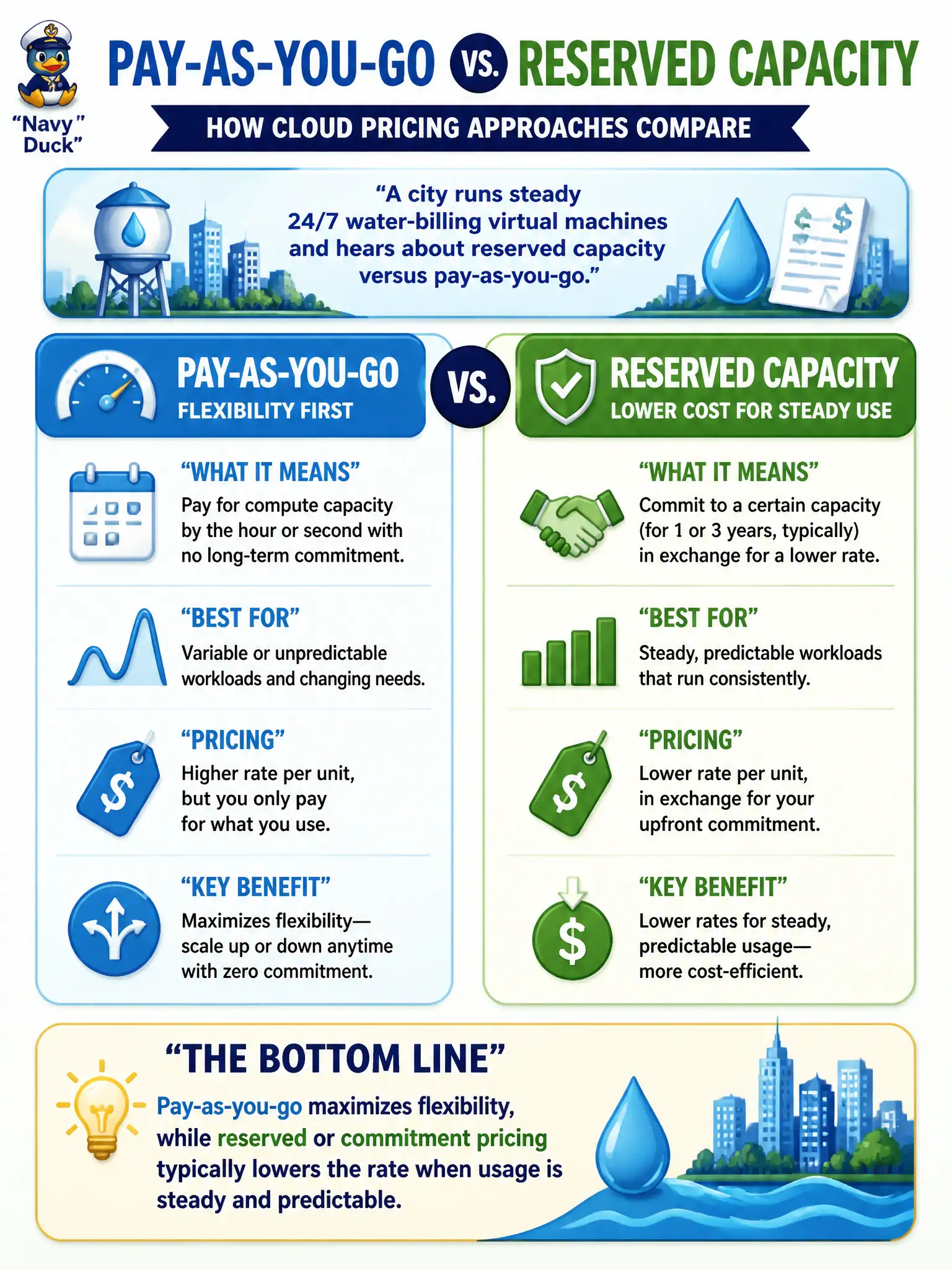
A city runs steady 24/7 water-billing virtual machines and hears about reserved capacity versus pay-as-you-go. At a fundamentals level, how do those pricing approaches compare?
Select an answer to reveal the explanation.
Short Explanation
If the water-billing VMs run every hour of every day, locking in a commitment is like buying a monthly bus pass you know you will use. Pay-as-you-go is the single-ride ticket—handy when plans change, usually pricier when you ride nonstop.
Full Explanation
For steady 24/7 water-billing virtual machines, pay-as-you-go maximizes flexibility: you can change size, stop, or retire instances without a long commitment, usually at a higher effective rate for constant use. Reserved or commitment-based pricing typically lowers the compute rate when you agree to a term because the provider gains predictable demand. At fundamentals depth, the comparison is flexibility versus discounted rate for predictable, continuous workloads—not one path being free.
Assuming pay-as-you-go always costs less than any commitment for constant 24/7 load ignores why reservations exist: discounts reward steady use. Claiming reserved capacity removes all Azure charges including storage and networking forever overstates the benefit—commitments usually target specific compute (or similar) meters, not every line item forever. Restricting reserved pricing to on-premises CapEx servers misplaces the concept; reservations are a cloud purchasing approach.
Exam caveat: reserved or commitment savings apply when the commitment matches the running workload; a mismatch (wrong region, size family, or unused reservation) can erase the expected discount—AZ-900 tests the idea, not deep reservation administration.
Operational check: chart the water-billing VMs’ uptime for a typical month; if they truly run continuously at a stable size, compare estimated pay-as-you-go cost against a reservation quote for that size and region before recommending a commitment to finance.