
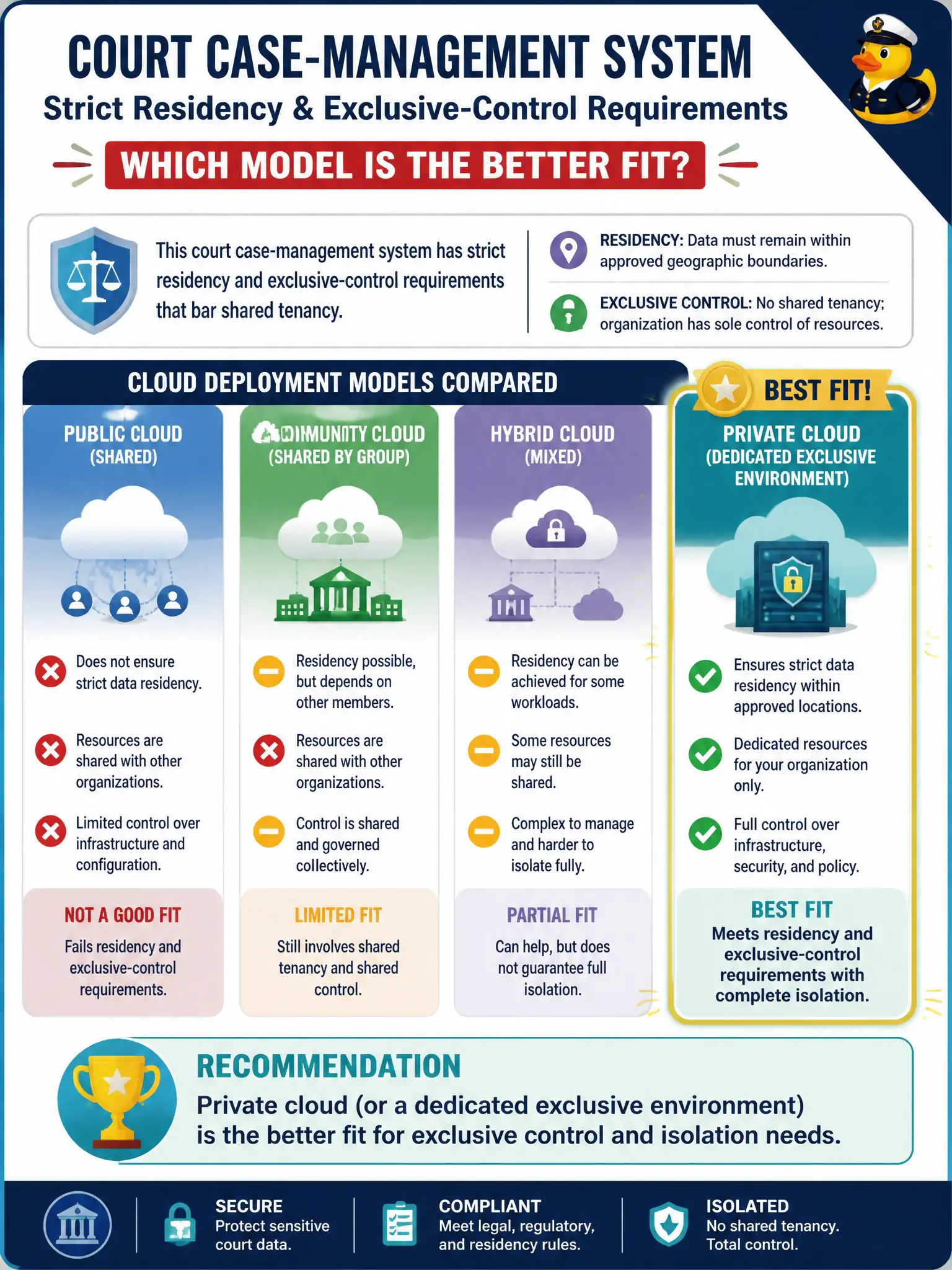
A court case-management system has strict residency and exclusive-control requirements that bar shared tenancy. Which model is the better fit?
Select an answer to reveal the explanation.
Short Explanation
When the court says "nobody else on this gear," that is exclusive-control territory. Private or dedicated environments fit; shared public tenancy fights the requirement. Email SaaS will not magically satisfy case-system isolation.
Full Explanation
When a court case-management system bars shared tenancy and demands exclusive control and strict residency, private cloud or another dedicated exclusive environment is the better model fit. Isolation and control requirements drive the choice more than raw compute price. Public multi-tenant platforms may be excellent for other municipal systems while still failing this constraint set.
Saying public multi-tenant cloud always satisfies exclusive-control mandates contradicts the scenario’s premise. Assuming SaaS email alone replaces case-management isolation requirements confuses collaboration tooling with a specialized records system. Calling something “hybrid by name only” with no private or on-premises component misuses hybrid vocabulary.
Exam caveat: some regulated workloads use public cloud with strong isolation controls; exam scenarios that explicitly bar shared tenancy are steering you toward private/dedicated models. Operational check: capture written residency and tenancy constraints from counsel or records officers, then validate proposed architectures against those constraints before procurement. When exclusive control is non-negotiable, evaluate private cloud or dedicated hosting against the court’s written constraints first, then decide whether any public-cloud component can participate at all. Do not reverse the order by picking a popular public service and hoping tenancy exceptions appear later.