
A county security board wants a simple picture of physical datacenter guards versus password policies under shared responsibility. Which mapping is correct?
Select an answer to reveal the explanation.
Short Explanation
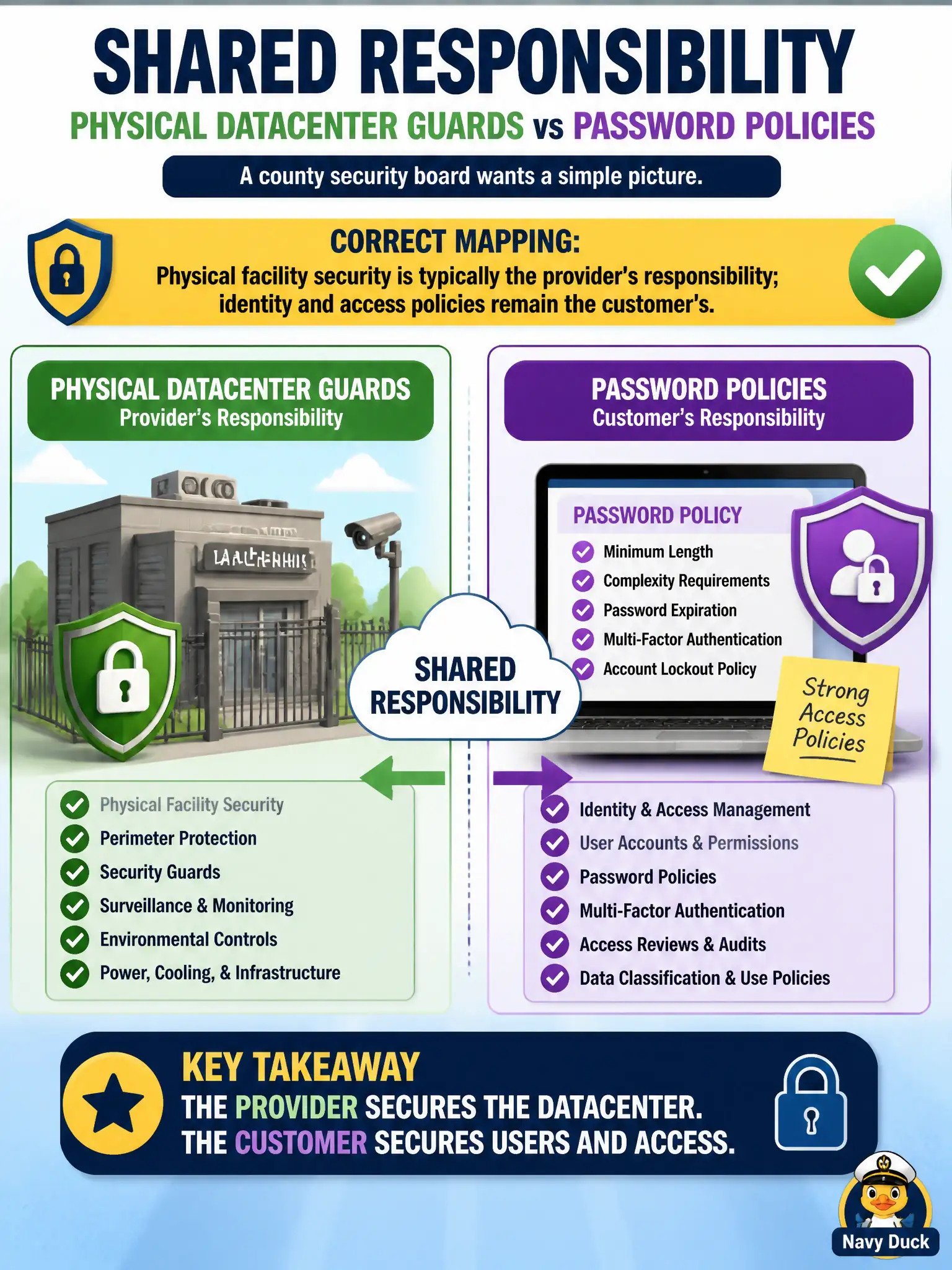
Microsoft handles the datacenter doors, guards, and cameras. You still own who gets passwords, how strong they are, and access rules. Different locks, different owners.
Full Explanation
A practical shared-responsibility picture for a county security board separates physical facility controls from identity controls. Physical datacenter security—guards, cameras, and facility access—is typically the provider’s responsibility in Azure. Password policies, multifactor requirements, and related identity and access policies remain the customer’s responsibility. That mapping keeps “doors versus logins” clear. Assigning password policies only to the provider while making physical guards a customer duty in Azure reverses the usual split. Claiming both guards and password policies are exclusively Microsoft’s for every service erases customer identity hygiene. Saying customers own datacenter fences while providers alone write every municipal password policy again swaps the layers. Exam caveat: customers may still have physical duties in private or on-premises environments; the “provider owns the facility” statement applies to public-cloud provider datacenters, not to city-owned server rooms. Operational check: verify that conditional access, password/MFA policy, and privileged role reviews are owned by county identity administrators, while facility compliance evidence for Azure regions is obtained from Microsoft’s trust documentation—not reinvented by municipal staff.