
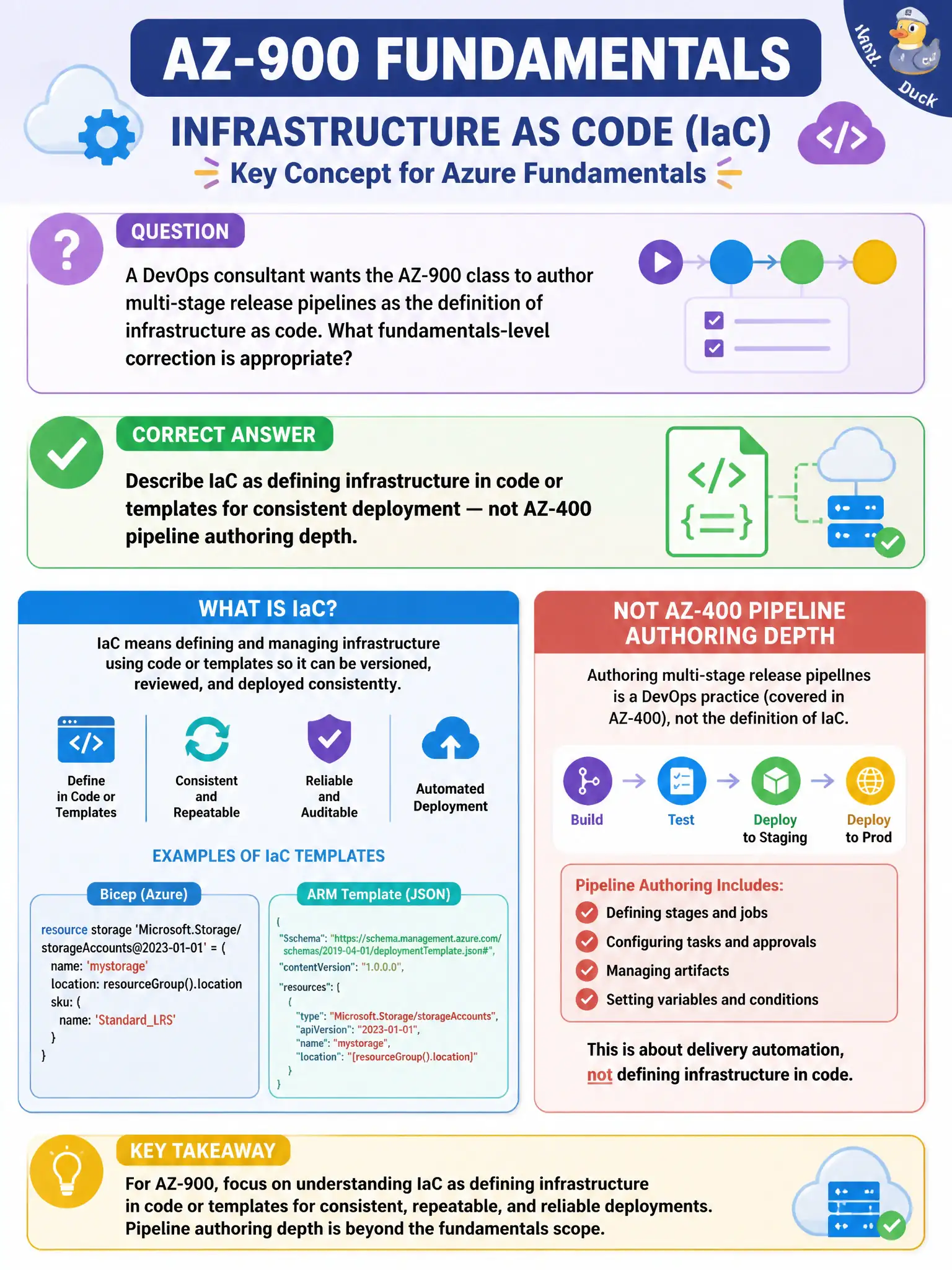
A DevOps consultant wants the AZ-900 class to author multi-stage release pipelines as the definition of infrastructure as code. What fundamentals-level correction is appropriate?
Select an answer to reveal the explanation.
Short Explanation
AZ-900 cares that you can explain why templates beat click-ops — not that you wire a full release factory. Leave the deep pipeline labs for the DevOps exam track. Keep the fundamentals spotlight on IaC’s purpose.
Full Explanation
At fundamentals depth, describe IaC as defining infrastructure in code or templates for consistent deployment. That is the AZ-900 learning goal. Authoring multi-stage release pipelines is valuable DevOps work associated with broader ALM tracks (such as AZ-400 depth), but it is not the required definition of IaC for Azure Fundamentals and should not displace the core idea of desired-state definitions and repeatable deploys.
Requiring every learner to publish production YAML pipelines before discussing resource groups overscopes the fundamentals classroom. Defining IaC solely as writing custom .NET SDK clients for every resource type confuses imperative SDK usage with the usual declarative IaC teaching point. Treating IaC as identical to Microsoft Sentinel analytics rule authoring mixes security detection content with infrastructure deployment practice.
Exam caveat: pipelines often consume IaC, but “has a pipeline” is not synonymous with “understands IaC.” Operational check: teach a tiny declarative definition, deploy it twice, show matching results, and explicitly defer multi-stage release-factory labs to later training paths. Prefer a fundamentals demo that stops at deploy-from-definition success criteria before any multi-stage pipeline discussion.