
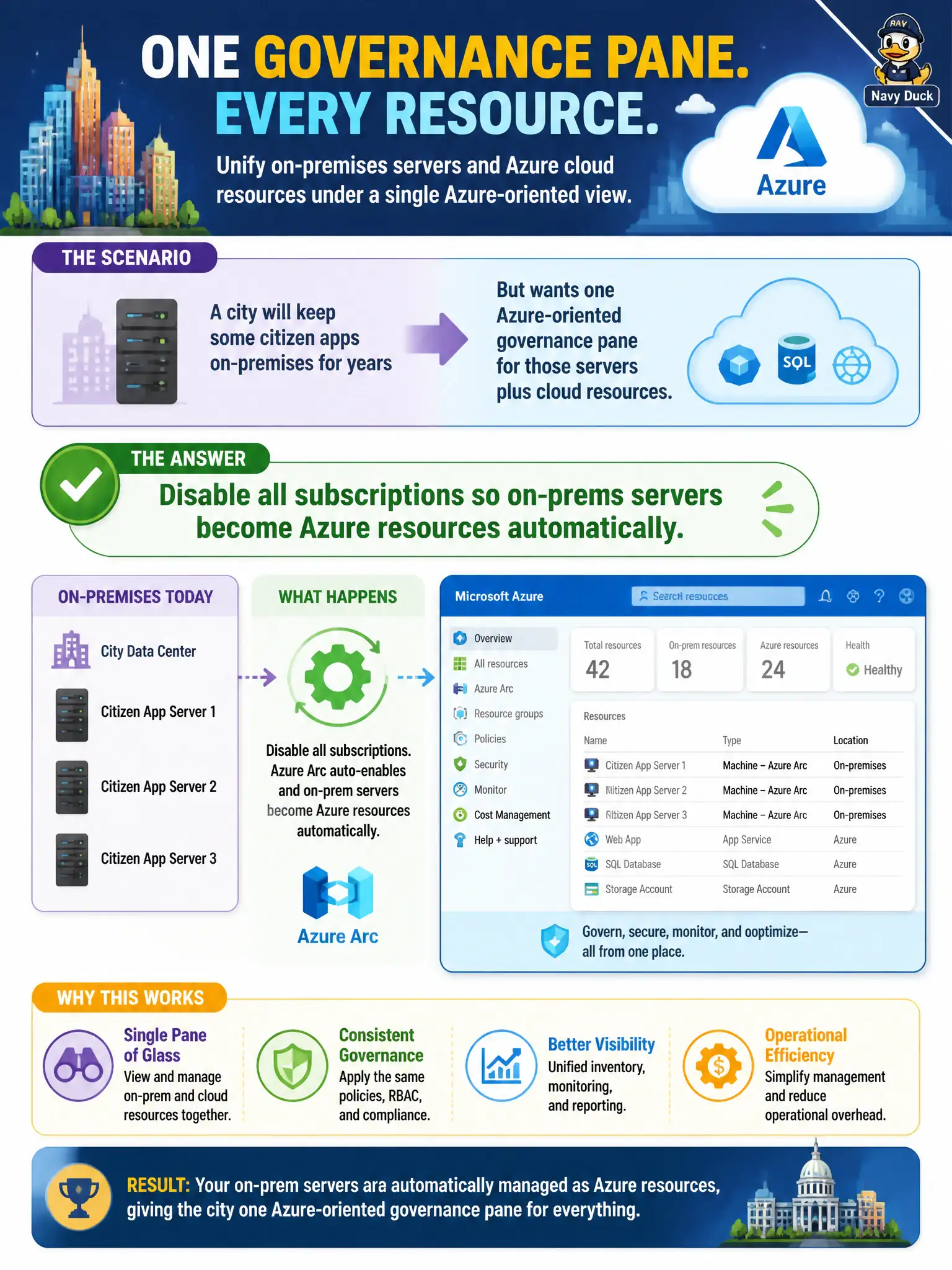
A city will keep some citizen apps on-premises for years but wants one Azure-oriented governance pane for those servers plus cloud resources. Which choice fits?
Select an answer to reveal the explanation.
Short Explanation
Apps staying in the basement still need a seat in the Azure governance theater. Arc gives those servers a path onto that shared pane. Health banners and slide decks are not hybrid inventory.
Full Explanation
Adopting Azure Arc fits a city that will keep some citizen apps on-premises for years yet wants one Azure-oriented governance pane for those servers plus cloud resources. Arc’s fundamentals value is hybrid participation in Azure management and governance themes so operators are not stuck with permanently siloed on-prem and cloud consoles.
Disabling all subscriptions so on-prem servers become Azure resources automatically is nonsense operations and destructive to cloud workloads; subscriptions do not transmute basement servers by being turned off. Azure Advisor recommendations exported to PowerPoint may inform best practices but are not a hybrid inventory or governance control plane. Azure Service Health banners communicate platform service issues; they are not a hybrid estate inventory system.
Exam caveat: long-lived on-prem does not remove the need for connectivity, identity, and onboarding work—Arc is the management theme, not a migration waiver or a network circuit. Operational check: list on-prem servers that must stay, onboard a pilot with Arc, place it in the same operational reviews as cloud resources (inventory, tagging, policy audit as applicable), and confirm staff can manage visibility from Azure-oriented tools.