
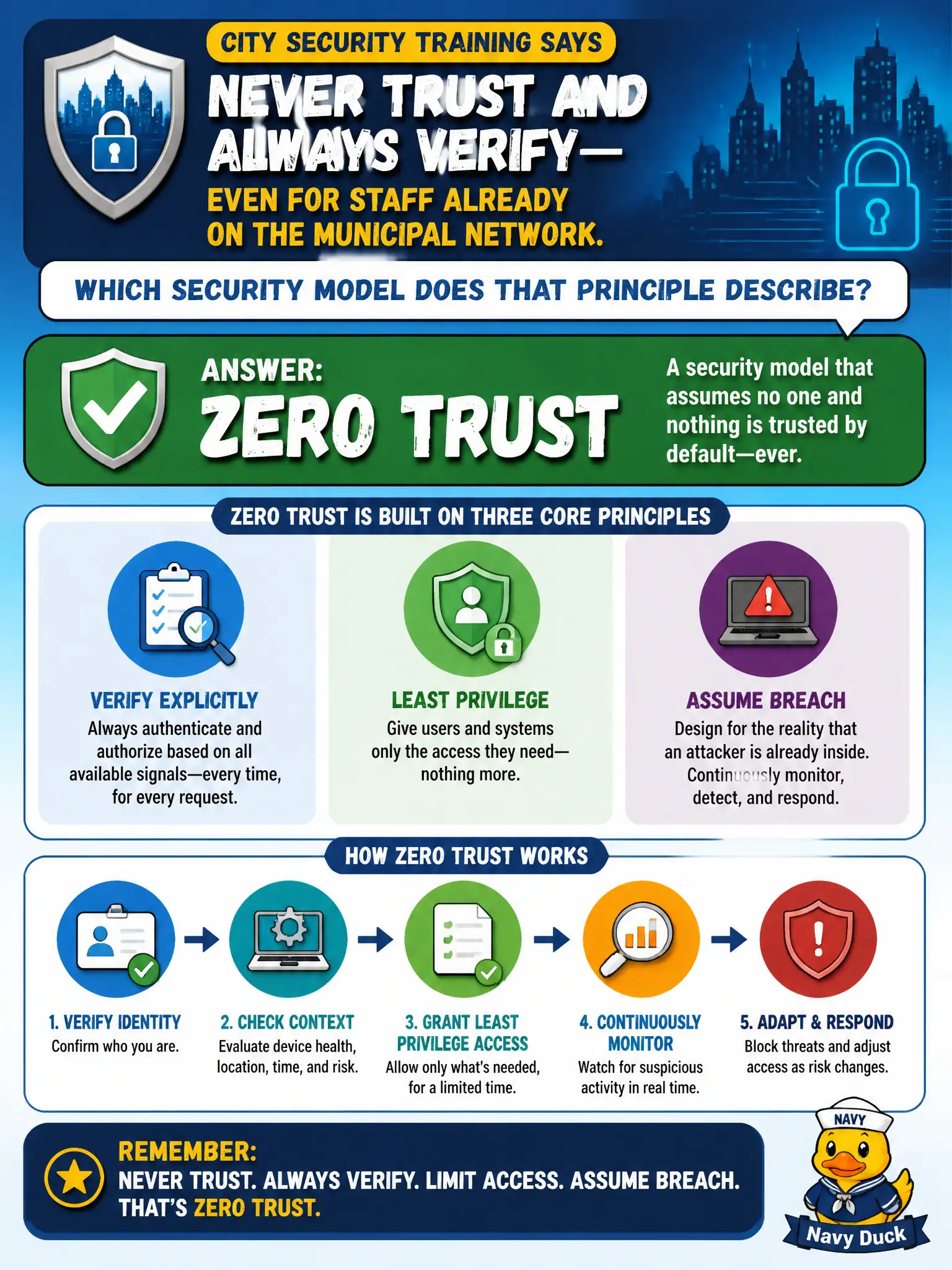
City security training says never trust and always verify—even for staff already on the municipal network. Which security model does that principle describe?
Select an answer to reveal the explanation.
Short Explanation
Zero Trust is the "trust nothing by default" mindset—even inside the city network. Badge on the LAN is not a free pass; you still verify. Perimeter-only thinking is the older opposite story.
Full Explanation
Zero Trust is a security strategy that assumes breach and refuses implicit trust based solely on network location. Its core emphases—verify explicitly, use least privilege, and assume breach—mean city staff already on the municipal network still face continuous identity and device verification for access to apps and data. That model replaces the old idea that “inside the firewall equals safe” with ongoing validation using signals such as strong authentication, device health, and tightly scoped permissions.
Classic perimeter-only trust treats the internal network as fully safe once someone connects, which is the opposite of the training message. Hot/cool/archive storage tiers optimize data access cost and latency; they do not replace identity verification. Pay-as-you-go billing is a consumption pricing model and does not authenticate requests by itself.
Exam caveat: Zero Trust is a model implemented through many controls (Entra Conditional Access, MFA, RBAC, network segmentation, and more)—not a single product you buy and toggle.
Operational check: review whether municipal apps still grant broad access solely because traffic originates on the city LAN; introduce Conditional Access and least-privilege RBAC so on-network location is only one signal among several before access is granted.