
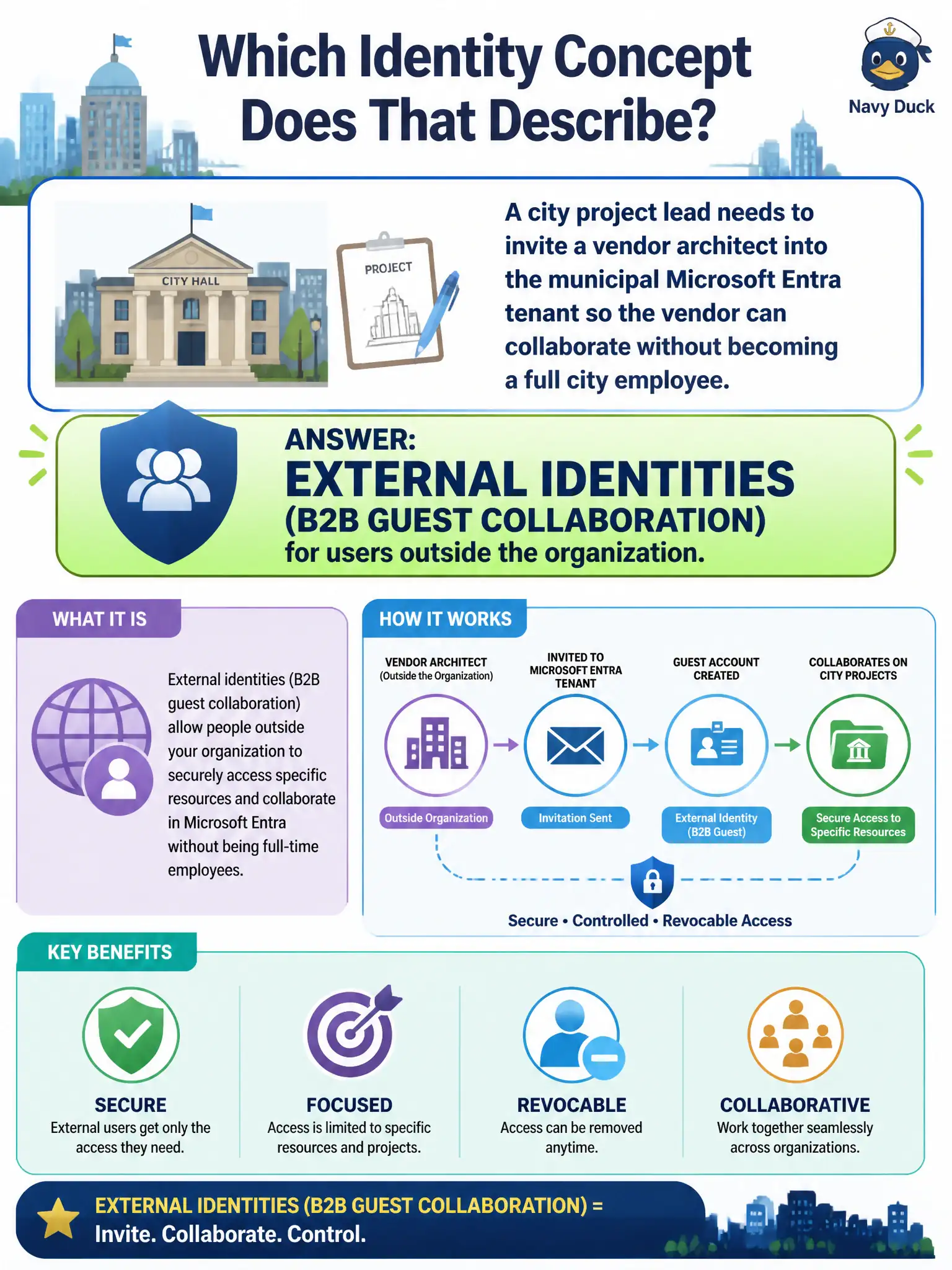
A city project lead needs to invite a vendor architect into the municipal Microsoft Entra tenant so the vendor can collaborate without becoming a full city employee. Which identity concept does that describe?
Select an answer to reveal the explanation.
Short Explanation
External identities are the "visitor badge" for people who are not on the city payroll. The vendor keeps their own home identity but gets invited as a guest. That is collaboration without inventing a fake full employee account.
Full Explanation
External identities in Microsoft Entra ID—commonly B2B guest collaboration—let a city invite people or organizations outside the municipal workforce into the tenant with controlled access. The vendor architect keeps a home identity (often from their own organization) and receives a guest invitation so they can collaborate on selected resources without being hired or provisioned as a full city employee account. That visitor-badge model preserves organizational boundary while enabling project work under municipal governance, auditing, and revocation.
Making storage accounts anonymously public removes authentication entirely and grants the internet undifferentiated object access; it is not a collaboration identity model. Availability Zones improve datacenter-level resiliency for regional deployments and have nothing to do with creating guest user accounts. Reserved Instance pricing is a compute cost commitment mechanism and does not convert vendors into employees or create identity relationships.
Exam caveat: external identities still authenticate; “outside the organization” does not mean “anonymous.” AZ-900 contrasts guests with public anonymous access precisely so you do not conflate them.
Operational check: invite the vendor as a guest in Microsoft Entra ID, assign only the groups or roles needed for the project, confirm they can reach the intended collaboration resources, and set an access review or end date so the guest is removed when the engagement closes.