
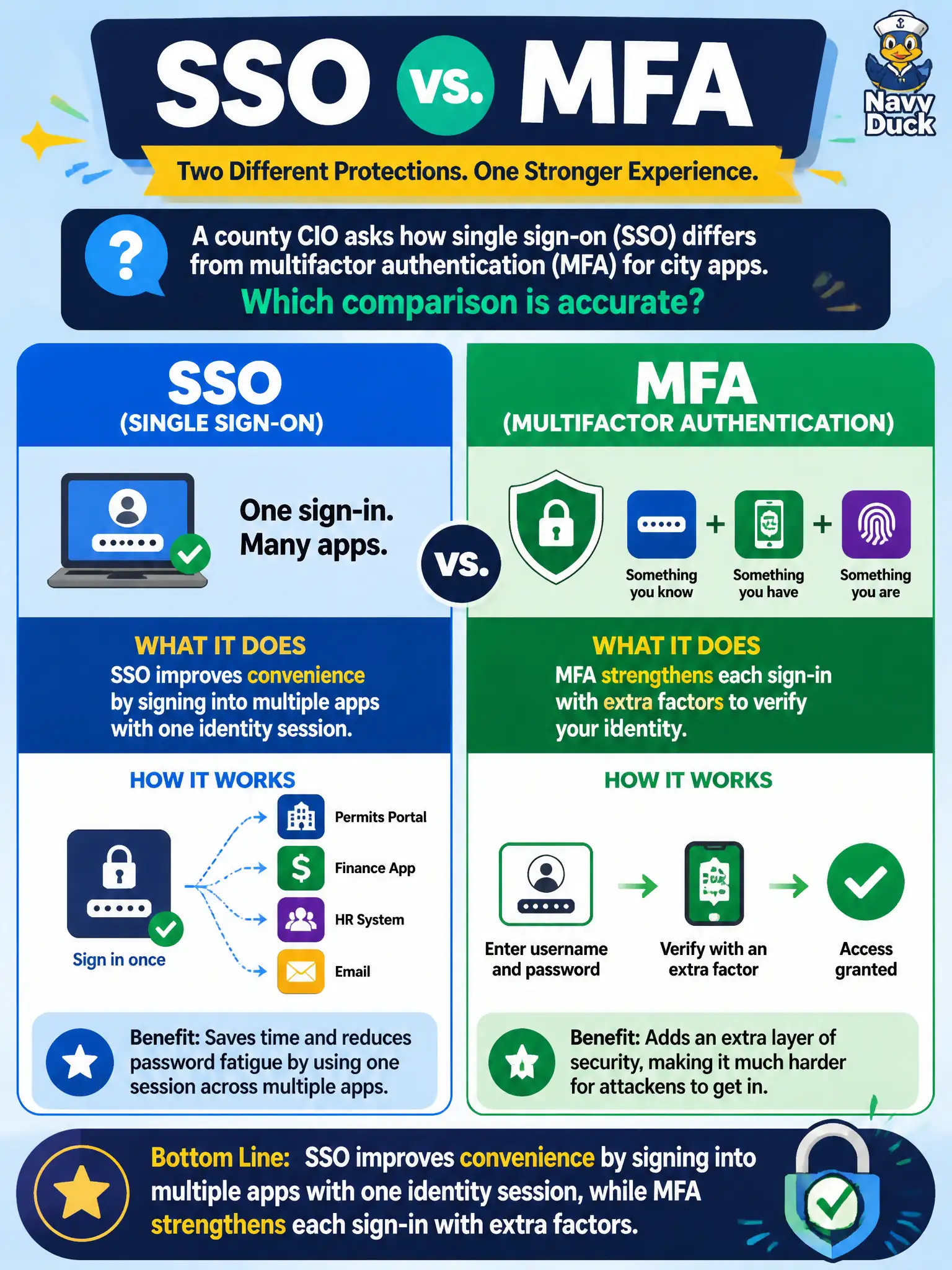
A county CIO asks how single sign-on (SSO) differs from multifactor authentication (MFA) for city apps. Which comparison is accurate?
Select an answer to reveal the explanation.
Short Explanation
SSO is the "one badge for many buildings" convenience story. MFA is the "badge plus PIN" strength story. They solve different problems and often work together, not as clones of each other.
Full Explanation
Single sign-on (SSO) and multifactor authentication (MFA) address different identity outcomes and should be compared on that basis. SSO lets a municipal user authenticate once into an identity session and then reach multiple city apps without re-entering credentials for each application, which reduces password fatigue and help-desk resets. MFA strengthens a given sign-in by requiring additional independent factors so a password alone is insufficient. Used together, staff can enjoy one coherent identity experience while still facing stronger proof when risk or policy demands it.
Treating SSO and MFA as identical one-for-one replacements collapses convenience and assurance into a single false idea and leads to poor design choices. Neither control is a network firewall rule or a storage redundancy setting; those are networking and data-durability concepts, not authentication outcomes. Neither is limited to guest vendors only or to Azure virtual machines only—both apply broadly across identities and cloud apps when configured in Microsoft Entra ID.
Exam caveat: AZ-900 items often tempt you to pick whichever buzzword sounds “more secure.” Choose based on the scenario verb: convenience across apps points to SSO; stronger per-sign-in proof points to MFA.
Operational check: map which municipal apps participate in Entra SSO (federation or app registration) and separately confirm MFA or Conditional Access challenges fire on those same apps for high-risk or privileged roles—then document both results for the CIO brief.