
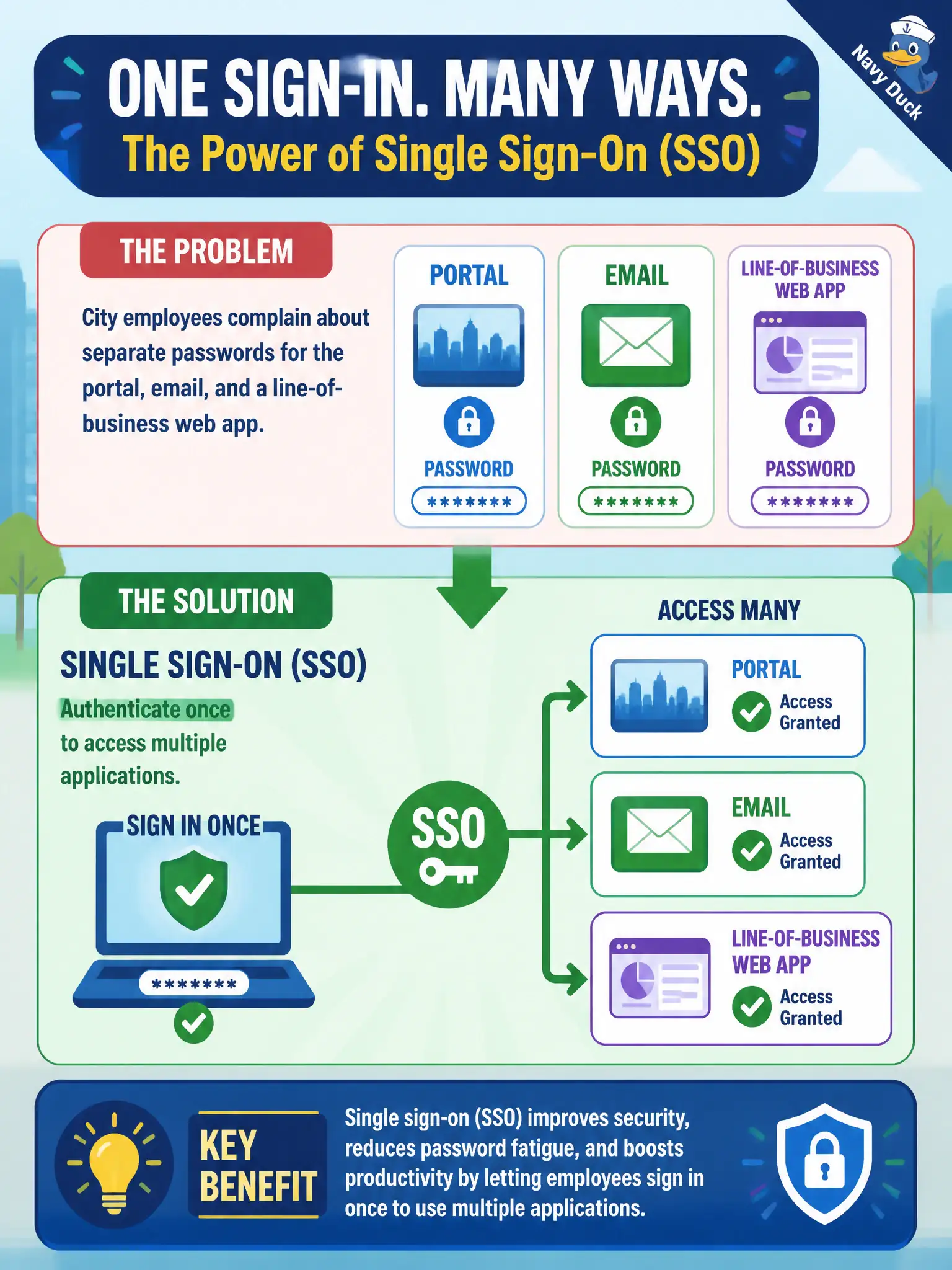
City employees complain about separate passwords for the portal, email, and a line-of-business web app. Which identity benefit describes signing in once to use multiple applications?
Select an answer to reveal the explanation.
Short Explanation
SSO is one key for many doors—sign in once, open portal, mail, and that LOB app without a password parade. Storage redundancy and Archive tiers are about data, not logins. Data Box ships terabytes; it is not SSO.
Full Explanation
Single sign-on (SSO)—authenticating once for multiple applications—describes the identity benefit city employees want when they complain about separate passwords for the portal, email, and a line-of-business web app. SSO reduces password fatigue by letting users sign in once and reach multiple integrated applications through the organization’s identity platform, commonly enabled via Microsoft Entra ID app integrations in Microsoft cloud scenarios. AZ-900 expects SSO to be identified as authenticate-once-for-many-apps.
Geo-redundant storage as an authentication protocol is wrong; GRS is about data durability across regions, not login protocols. Archive tier rehydration as a login method confuses cold blob retrieval with authentication. Azure Data Box as a password vault for every app separately misstates Data Box as an offline transfer appliance and contradicts the SSO goal by implying more separate secrets rather than fewer.
Exam caveat: SSO improves usability but still depends on strong primary authentication and governance—SSO is not a substitute for MFA or least-privilege app assignments. Operational check: enable or verify SSO for the LOB web app against Microsoft Entra ID for a pilot group, confirm employees can open portal, email, and the LOB app without a separate password parade, then expand after help-desk metrics improve.