
A city now has ten Azure subscriptions and wants one place to inherit governance policy downward instead of configuring each subscription from scratch. Which construct organizes subscriptions for that hierarchy?
Select an answer to reveal the explanation.
Short Explanation
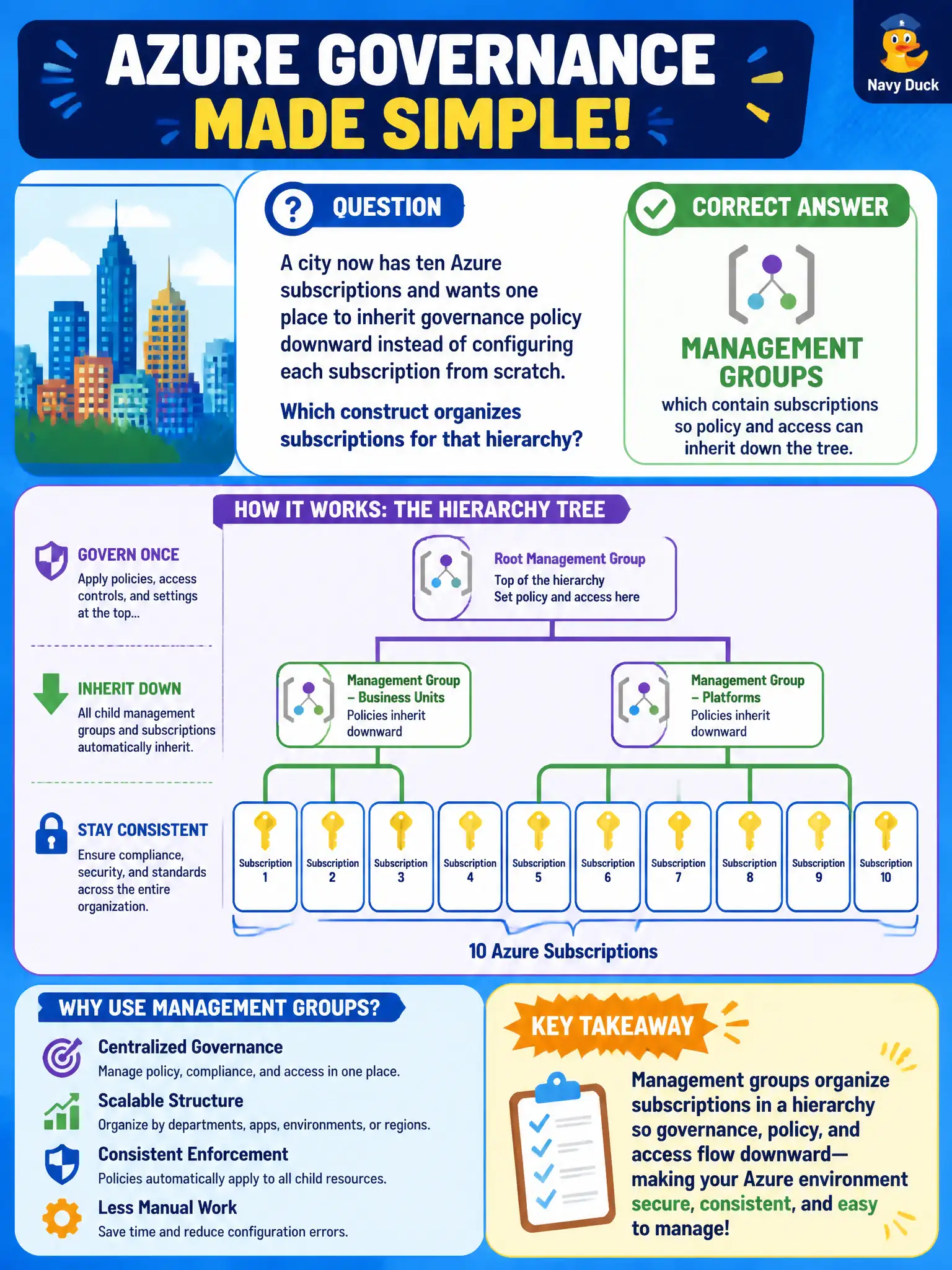
Ten subscriptions and ten copy-paste policy jobs is a headache. Drop those subscriptions under a management group and governance can flow down the tree. One parent, many children — that is the point.
Full Explanation
When a city accumulates many Azure subscriptions, configuring identical policy and access settings on each one by hand becomes error-prone. Management groups exist to contain subscriptions in a hierarchy so governance—especially Azure Policy and role assignments—can inherit downward from a parent instead of being recreated ten times. Placing the ten subscriptions under an appropriate management group gives the city one higher-level place to express shared rules.
A single unmanaged disk shared across subscriptions is not a governance hierarchy and does not organize subscriptions. A resource lock on one test virtual machine protects that one resource from delete or change; it does not inherit policy across ten subscriptions. Choosing a storage redundancy setting such as LRS once in the portal affects durability for that storage resource, not multi-subscription governance inheritance.
Exam caveat: inheritance flows down the tree, but exclusions, not-scoped assignments, and conflicting initiatives can change what actually applies—operators should not assume every child identically mirrors the parent without reviewing compliance. Operational check: create or select a management group, move the city subscriptions under it, assign a pilot policy at the management-group scope, then verify compliance results on at least two child subscriptions before rolling out broader initiatives.